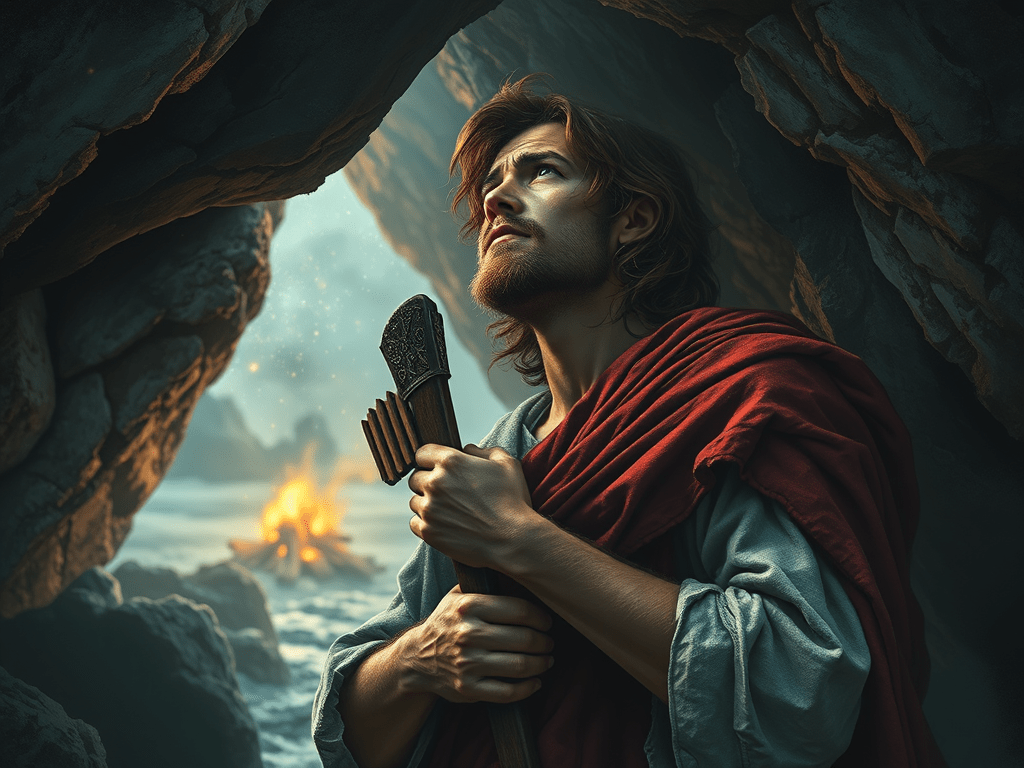
Years stretched on, their paths sundered by war and fate. David became a fugitive king, leading outcasts through rugged cliffs, the crimson tunic fraying with each escape, the harp silent but ever-present. One frostbitten night, in a cave’s shadowed mouth, he wrapped the tunic tighter, bow in hand, and whispered to the stars, “Jonathan, your strength holds me still.” The wind howled, but Saul’s scouts prowled closer, their torches flickering like wolves’ eyes. Jonathan stayed with Saul, torn between love and duty, deflecting the king’s rages to buy David time. Yet their covenant held, a lifeline across the divide.
Then came the news at Adullam: Saul and Jonathan had fallen at Mount Gilboa, slain by Philistine swords. The messenger, dust-caked and trembling, spoke of Jonathan’s final stand—how he’d fought to the last, his bow snapping as he shielded his father’s broken body, arrows spent, blood pooling on the ridge. David collapsed, clutching the bow, the harp slipping to the dust, and a cry tore from him, raw and shattering. “How the mighty have fallen!” he wailed. “Jonathan, my brother—your love was more precious than gold.”
He took the harp, its strings trembling under his fingers, and poured out a lament, the notes rising over the camp like smoke. “Your bow lies still, your tunic ash, yet your vow endures,” he sang, tears streaking his face. He saw the stream again—their hands clasped, blood warm, starlight on the water—and his voice broke. The crimson tunic he burned that night, its threads curling slowly into the fire as he murmured, “Rest, my shield.” A shepherd’s farewell to a prince.
He mourned through the ages, but he kept their oath. As king, he sought Mephibosheth, Jonathan’s lame son, and gave him a place at his table. The boy’s eyes, so like his father’s, met David’s as he said, “For your father’s sake, you’ll eat as my own.” He pressed a scarred hand to the boy’s shoulder, honoring the blood they’d shed by the stream. The bow hung in David’s chambers, the harp beside it, silent witnesses to their covenant—sealed in blood, forged in faith, and kept beyond the grave.
 CovenantRoad
Leave a comment