Tag: young men

  • Bonds in the Wild

    Bonds in the Wild

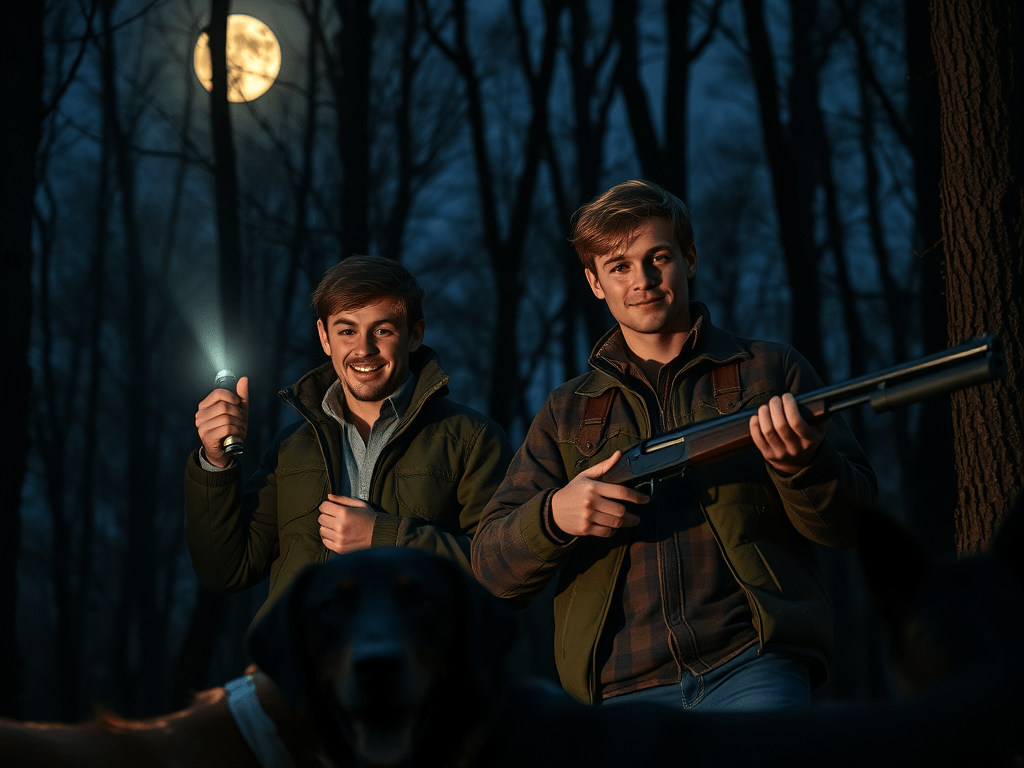
    The hounds bayed sharp and wild, their voices bouncing off the oak-studded hills of eastern Tennessee. Jace loped ahead, his lanky frame cutting through the underbrush, a coon’s trail hot under his boots. Behind him, Tuck trudged steady, stocky and sure, the old 12-gauge slung over his shoulder. The night was thick with cricket hum and the tang of pine, the kind of dark that swallowed you whole if you didn’t know these hollers.

    “Rusty’s got him treed,” Jace called, flashlight beam jerking toward a gnarled sycamore. The hound’s bark turned frantic, paws scrabbling at the trunk.

    Tuck caught up, wiping sweat from his brow with a sleeve. “Betsy’s circling. Reckon it’s a big’un.”

    They were barely twenty, raised on these ridges—Jace a dropout with dreams too big for school, Tuck a feed store grunt who’d rather wrestle sacks of grain than read a book. The dogs were their ticket out, or at least their excuse to roam. They’d hunted since they were kids, splitting pelts and patching each other’s mistakes, but it was the shack that sealed it—a tin-roofed lean-to tucked in a hollow, their claim on the wild.

    Jace grinned, teeth flashing in the dark. “Gonna skin this one clean. Maybe get enough for that carburetor you’ve been yapping about.”

    Tuck snorted, adjusting the shotgun. “You’re the one busting engines. I’m fine hauling feed.”

    They worked quick—Jace coaxing the coon down with a stick, Tuck ready with the gun. One sharp crack, and it was over, Rusty and Betsy nosing the prize. They’d drag it back to the shack come dawn, but for now, they sank onto a fallen log, catching their breath. The air cooled, stars peeking through the canopy.

    “Mom’s done with me,” Jace said, picking at a splinter in his thumb. “Caught me fiddling with that still again. Kicked me out ‘fore supper.”

    Tuck didn’t look up, just dug a can of dip from his pocket and tapped it against his knee. “She’ll cool off.”

    “Nah. Said I’m a lost cause this time.” Jace’s voice was light, but his hands stilled, the splinter forgotten.

    Tuck spat into the dirt, then stood. “C’mon. Shack’s open.”

    They trekked back, hounds trailing, the path worn by their own feet. The shack squatted at the holler’s edge—walls of scavenged pine, roof dented from a storm two summers back. Inside was a mess: pelts stacked in a corner, a kerosene lamp flickering on a crate, a cot Jace had claimed since Tuck liked the floor. Tuck kicked the door wide, tossing Jace a quilt from a milk crate.

    “Ain’t much,” he said, dropping his gear. “But it’s ours.”

    Jace caught the quilt, draping it over his shoulders like a cape. “Better’n a porch step.”

    Tuck grunted, fishing a dented thermos from his pack. He poured lukewarm coffee into a tin cup, splitting it with Jace. They sat on the porch—really just a slab of warped boards—dogs flopped at their feet, the coon’s carcass slung over a branch nearby. The night settled heavy, a whippoorwill calling somewhere deep in the ridge.

    “Got something,” Tuck said, pulling a pocket New Testament from his jeans. The cover was scuffed, pages curled from damp. He flipped it open by the lamp’s glow, squinting. “‘Two are better’n one,’” he read, slow and halting, “‘‘cause they got a good return for their work. If one falls, the other hauls him up.’” He stopped, scratching his jaw. “Ecclesiastes, I think. Preacher rambled ‘bout it once.”

    Jace smirked, sipping the coffee. “You’re turning holy on me?”

    “Shut it.” Tuck elbowed him, but his mouth quirked. “Just stuck, is all. Figure it’s us.”

    Jace leaned back, staring at the stars. “Yeah. Hauling each other up’s about right.”

    They sat quiet after that, the words hanging between them like the smoke from a fire they hadn’t lit. Tuck wasn’t one for books—Jace usually did the talking—but he’d kept that little Testament since his granny slipped it to him years back. Reading it now felt right, like staking a claim.

    “Gonna be alright?” Tuck asked, voice low.

    Jace nodded, slow. “Long as you’re here, I reckon.”

    Tuck capped the thermos, setting it aside. “Ain’t going nowhere.”

    The hounds snored, the night stretched on, and the shack held them—two boys too rough for the world, too tight to let it break them. It wasn’t much, this patch of dirt and tin, but it was theirs, built on pelts and promises and a verse Tuck could barely pronounce. They’d hunt again tomorrow, or the next day, and the holler would keep them. For now, that was enough.


  • Garage Band

    Garage Band

    The garage smelled like motor oil and stale pizza, a haze of dust catching the light from a single dangling bulb. Tyler’s drumsticks clacked against the snare, a rhythm sharp enough to cut through the humid August air. Across from him, Gabe hunched over his beat-up Stratocaster, coaxing a riff out of strings that hadn’t been changed in months. They weren’t good—not by any stretch—but they were loud, and that was enough.

    “Turn it up,” Tyler called, grinning as he kicked the bass pedal. Gabe twisted a knob on the amp, and the sound swelled, rattling the toolbox on the workbench. The neighbors hated it. They loved that part most.

    They’d been at this since sophomore year, when Gabe found the guitar at a yard sale and Tyler begged his mom for a drum kit he’d never master. Three years later, they were still here—eighteen, sweaty, and tethered to this concrete box like it was the only place that made sense. No gigs, no dreams of stadiums. Just the two of them, filling the space with noise.

    “New riff?” Tyler asked, wiping his forehead with the back of his hand.

    “Old one, just louder,” Gabe said, strumming a chord that buzzed like a chainsaw. “You’re off beat again.”

    “Am not. You’re just deaf.” Tyler twirled a stick and missed, letting it clatter to the floor. Gabe snorted, and they fell into the easy silence that came after a jab. It was their rhythm—push, pull, steady.

    The garage door was half-open, letting in the hum of crickets and the occasional bark from the mutt next door. Tyler’s house was a squat ranch-style thing, paint peeling like it was tired of holding on. Gabe lived three blocks over, but he might as well have lived here. His sneakers were piled by the door, his initials scratched into the workbench from a bored afternoon with a pocketknife. They’d built this, piece by piece, without ever saying it aloud.

    “Dad’s pissed again,” Tyler said, tapping the hi-hat absently. “Says I’m wasting my life in here.”

    Gabe looked up, fingers pausing on the strings. “What’d you tell him?”

    “Nothing. Just took it.” Tyler shrugged, but his jaw tightened. “He’s not wrong, maybe.”

    “Bull.” Gabe set Lozano—the guitar had a name, because of course it did—against the amp and crossed his arms. “You’re not wasting anything. We’re here, aren’t we?”

    Tyler smirked, but it didn’t reach his eyes. “Yeah, real high achievers. You’re slinging burgers, I’m flunking trig. Rockstars, man.”

    Gabe kicked a stray soda can across the floor. “Doesn’t matter. We’ve got this.”

    “This” was the garage, the music, the way they could sit here until midnight and not need anyone else. Tyler nodded, slow, like he was convincing himself. Gabe picked up Lozano again, strumming something softer, a melody he’d been messing with for weeks. Tyler joined in, tentative at first, then harder, until the sound felt like a pulse between them.

    They played until the bulb flickered, a warning it was about to die. Tyler tossed his sticks onto the snare and stood, stretching. “Gotta crash. Early shift tomorrow.”

    “Same,” Gabe said, but he didn’t move. He watched Tyler shove the drum kit against the wall, the same way he always did—precise, like it mattered. “You good?”

    Tyler hesitated, hands in his pockets. “Yeah. Just… Dad’s on me about college again. Says I need a plan.”

    “You’ve got one,” Gabe said, voice firm. “Us.”

    Tyler laughed, short and sharp. “That’s not a plan, dude.”

    “It’s enough.” Gabe stood, slinging Lozano over his shoulder. “Come on, I’ll walk you in.”

    They stepped into the night, the air cooler now, crickets louder than the echo of their music. Tyler’s front door creaked as they slipped inside, dodging the living room where his dad’s snores rumbled from the couch. Upstairs, Tyler’s room was a mess—clothes on the floor, posters peeling off the walls. Gabe dropped onto the beanbag by the window, same spot he’d claimed since they were kids.

    “Stay over,” Tyler said, kicking off his shoes. “Floor’s yours.”

    Gabe nodded, like it was already decided. It usually was.

    The next week, everything cracked open. Tyler came home from his shift at the gas station to find his stuff—drumsticks, clothes, a half-dead phone—piled on the porch. His dad stood in the doorway, arms crossed, face red.

    “Out,” was all he said.

    Tyler didn’t argue. He grabbed what he could and walked, the weight of it sinking in with every step. He didn’t call Gabe. Didn’t need to. By the time he hit the third block, Gabe was there, leaning against a streetlight with Lozano strapped to his back.

    “Figured you’d show up,” Gabe said, falling into step beside him. “What happened?”

    “Dad’s done. Says I’m a leech.” Tyler’s voice was flat, but his hands shook as he clutched the bag.

    Gabe didn’t say anything for a minute, just kept walking. Then: “My mom’s at work. You’re crashing with me.”

    “Gabe—”

    “Shut up. You’re not sleeping on the street.” He adjusted Lozano’s strap, a nervous tic. “We’ll figure it out.”

    Tyler stopped, dropping the bag. “Why’re you doing this?”

    Gabe turned, eyes steady. “Because you’re my brother, dumbass. Not blood, but—y’know. We’re in this.”

    Tyler swallowed hard, nodding once. They kept moving, the silence heavier now, but not empty. Gabe’s place was small, a duplex with chipped paint and a leaky sink, but it was warm. He shoved a blanket at Tyler and pointed to the couch. “Yours.”

    Tyler didn’t sleep much that night, staring at the ceiling while Gabe’s snores drifted from the next room. He thought about the garage, the music, the way Gabe never asked questions—just showed up. It wasn’t a plan, not like his dad wanted. But it felt like something solid, something he could hold onto.

    Morning came gray and slow. Gabe shuffled out, hair a mess, and tossed a notebook onto the coffee table. “Wrote this last night,” he said, yawning. “For the band.”

    Tyler flipped it open. Scrawled in Gabe’s chicken-scratch was a line: Strength in two, me and you. Below it, a chord progression, rough but real.

    “Cheesy,” Tyler muttered, but he smiled.

    “Yeah, well, it’s true.” Gabe grabbed Lozano and started picking out the melody. “Play with me?”

    Tyler dug his sticks out of the bag, tapping the table like it was his snare. The sound was thin, nothing like the garage, but it was theirs. They played until the sun broke through the blinds, a promise neither had to speak. It wasn’t about fixing everything—not yet. It was about staying, about being enough.

    And for now, it was.

  • The Rooftop Pact

    The Rooftop Pact

    The city buzzed below, a tangle of headlights and horns that never quit. Up on the roof, it was quieter—just the hum of a vent and the occasional pigeon flapping off into the dark. Ethan leaned against the ledge, his hoodie pulled tight against the wind. Beside him, Jay sprawled on an old lawn chair they’d dragged up months ago, its plastic creaking under his weight. The building was a crumbling six-story walk-up, but this spot was theirs.

    “Think it’ll rain?” Ethan asked, squinting at the gray smear of clouds.

    “Hope so,” Jay said, tipping his head back. “Wash some of this noise away.”

    Ethan smirked, kicking a pebble across the tarred surface. It skittered into a puddle from last night’s drizzle. They’d been coming up here since they moved in—Ethan after dropping out of college, Jay after his barista gig became his only plan. Two years of sharing a shoebox apartment, splitting rent and ramen, had turned into something neither bothered to name.

    Jay pulled a beat-up journal from his jacket, flipping it open. “Wrote something dumb last night.”

    “Read it,” Ethan said, not looking over. He didn’t need to. Jay’s voice was enough.

    Jay cleared his throat, dramatic-like. “‘Sky’s a mess, head’s worse. But we’re here, so screw it.’” He paused, grinning. “Poetry, right?”

    “Deep,” Ethan deadpanned, but his lips twitched. “You’re a regular Shakespeare.”

    “Shut up.” Jay chucked the journal at him. Ethan caught it one-handed, flipping through pages scrawled with half-thoughts and doodles—their lives in smudged ink. He stopped at a line from weeks back: We’re enough for each other, man. Jesus said so. Jay had scratched it out, then rewritten it darker.

    “You believe that?” Ethan asked, voice low.

    Jay shrugged, staring at the skyline. “Some days.”

    Ethan nodded, handing the journal back. Some days was enough.

    They’d met at a bus stop three years ago, both soaked from a storm, arguing over whose headphones were louder. Ethan was nineteen then, all sharp edges and no direction. Jay was twenty, cocky but steady, the kind of guy who’d share his last dollar without asking why you needed it. Now, at twenty-two and twenty-three, they were still a mess—just a mess together.

    “Boss cut my hours again,” Ethan said, picking at a loose thread on his sleeve. “Says I’m ‘unmotivated.’”

    “You are,” Jay said, grinning when Ethan glared. “Kidding. You’ll bounce back.”

    Ethan didn’t answer, just stared at the lights flickering below. He’d dropped out after one semester, burned out on lectures and loans. Now he stocked shelves at a corner store, each shift a reminder he was going nowhere. Jay, at least, had the coffee shop—low pay, but he liked the rhythm. Ethan envied that, though he’d never say it.

    “Got an interview tomorrow,” Jay said, breaking the silence. “That new place by the park. Better tips, maybe.”

    “Good for you,” Ethan muttered, then winced at how bitter it sounded. “I mean it.”

    “I know.” Jay sat up, the chair groaning. “If I get it, I’ll cover rent ‘til you’re solid.”

    Ethan shook his head. “Don’t need charity.”

    “Not charity, dumbass. It’s us.” Jay’s tone was firm, like he’d already decided. Ethan didn’t argue. He never won those fights.

    The wind picked up, tugging at their clothes. Ethan pulled his knees to his chest, resting his chin on them. “Ever feel like you’re just… stuck?”

    Jay didn’t answer right away. He stood, stretching, then walked to the ledge beside Ethan. “Yeah. But then I come up here. You’re here. It’s not so bad.”

    Ethan looked up, meeting Jay’s eyes—steady, like always. He wanted to say something smart, brush it off, but the words stuck. Instead, he nodded, and Jay clapped a hand on his shoulder, leaving it there a beat too long.

    That night, Ethan crashed on the couch, too wired to sleep. Jay’s snores drifted from the bedroom, a sound Ethan could set a clock to. He thought about the roof, the way Jay never pushed, just stayed. It wasn’t a fix for the mess in his head, but it was something.

    Two days later, it all unraveled. Ethan came home from a shift—late, because the bus broke down—to find a note taped to their door. Rent’s due. Pay up or get out. They’d been late before, but this time the landlord meant it. Ethan’s stomach sank. His hours were cut, Jay’s interview hadn’t panned out yet, and their savings were a jar of quarters on the counter.

    He didn’t tell Jay when he got home. Just grabbed a soda and headed for the roof. Jay followed, no questions, journal tucked under his arm. They settled into their spots—Ethan on the ledge, Jay in the chair—like nothing was wrong.

    “Rough day?” Jay asked, flipping pages.

    Ethan popped the can, the hiss loud in the quiet. “You could say that.”

    “Spill.”

    “Landlord’s done. We’re out if we don’t pay by Friday.” Ethan kept his eyes on the city, waiting for Jay to freak.

    Jay didn’t. He scribbled something in the journal, then tore the page out and handed it over. Ethan took it, frowning. We’ll figure it out. Always do.

    “You’re nuts,” Ethan said, but he folded the paper into his pocket.

    “Probably.” Jay leaned back, hands behind his head. “Got a shift tomorrow. I’ll hustle. You?”

    “Same.” Ethan paused, then added, “Thanks.”

    Jay waved it off, but his grin said he got it.

    They stayed up there ‘til the stars peeked through, talking about nothing—old movies, dumb customers, the pigeon that kept stealing Jay’s fries. When the cold drove them inside, Ethan felt lighter, like the weight wasn’t all his anymore.

    Friday came fast. Jay picked up an extra shift; Ethan pawned a watch he didn’t need. They scraped the rent together, barely, and slid it under the landlord’s door with thirty minutes to spare. Back on the roof that night, exhausted, they didn’t say much. Jay scribbled in his journal, Ethan traced cracks in the ledge with his finger.

    “We’re good,” Jay said finally, closing the book.

    “Yeah,” Ethan agreed, and he meant it.

    The city kept buzzing below, but up here, it was just them—two guys against the grind, holding on. Not a plan, not a fix, just a pact. And for now, it held.

  • Flesh and Bone: The Bond that Holds

    Flesh and Bone: The Bond that Holds

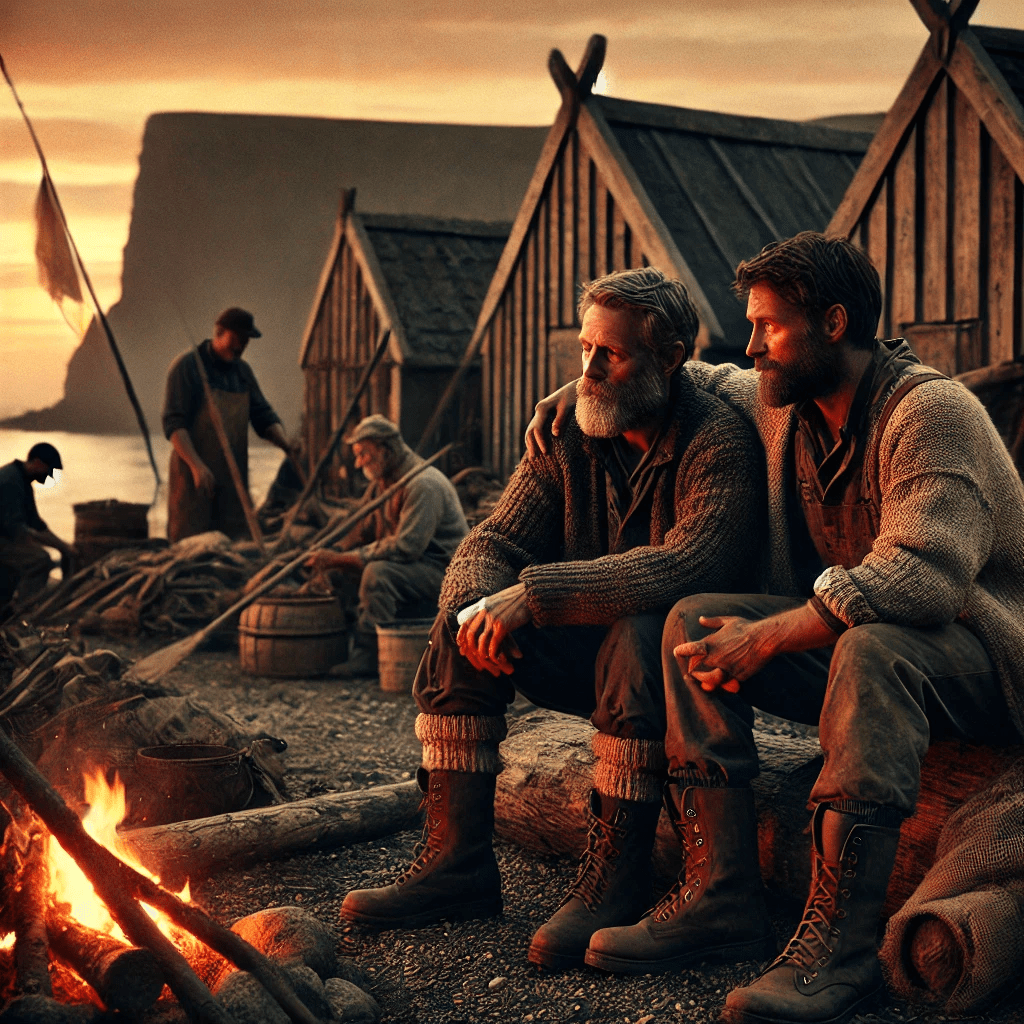
    The wind howled across the cliffs of Dunmoor, dragging salt and spray inland, where a village called Hearthglen clung to the land like a memory. Long before the world grew sharp and distant, the men of Hearthglen lived close—close to the earth, close to each other. They worked the fields and fished the sea, and when the day was done, they sat shoulder to shoulder by the fire, letting touch speak what words didn’t need to.

    Back then, no one questioned it. A hand on the back said, “I’m with you.” A grip on the arm meant, “We’re still standing.” Touch was strength shared, not stolen. The old elder Eamon called it God’s design: “He made us flesh and bone, lads—not just to toil, but to hold.”

    Torin and Calum weren’t brothers by blood, but they might as well have been. One loud, one quiet. One broad and brawny, the other lean and sharp-eyed. They moved through life like two halves of a single soul—until the world changed.

    Traders came with polished steel and slippery words. They sold more than goods; they sold a new idea of manhood: self-made, self-reliant, untouched. And slowly, the village followed. Arms that once held now hung at men’s sides. Brothers became rivals. Words replaced presence. The fire grew cold.

    Then the storm came.

    It tore through Hearthglen, ripping roofs, shattering boats, and leaving silence in its wake. Torin and Calum stood yards apart, working through the wreckage, silent, stiff, the space between them colder than the wind. And it was Eamon, bent and half-frozen, who limped into the heart of it all and shouted what everyone knew but had forgotten: “God gave us hands to hold—not just to hoard.”

    And when a boy named Finn—thin, trembling, alone—stepped into the square asking for help, no one moved… until Eamon did. He wrapped that boy in his frail arms and broke something open.

    Torin stepped toward Calum.

    “Brother,” he said—rough, unsure—and placed a hand on his shoulder.

    Calum flinched… then reached up and gripped Torin’s arm.

    And that was the spark.

    One by one, men followed. An embrace here, a clasp of arms there. Walls crumbled. Eyes softened. Voices rose. It wasn’t polished—it was raw, clumsy, honest. It was holy.

    They rebuilt the village, yes. But more than that, they rebuilt the bond. Shoulder to shoulder. Hand to back. Forehead to forehead in prayer. Touch, reclaimed. Pure. God-honoring.

    The traders came again, puzzled at what they found: not lonely men chasing coin, but a tribe forged in shared strength. They left, muttering. Hearthglen didn’t blink.

    Years passed. Eamon died, buried beneath the cliffs. They carved his words into stone:

    “Flesh and bone—meant to hold fast.”

    And they did.

    Men lingered after the work was done—not to compete, but to stay close. They taught the boys how to fish, how to plant, how to press a hand to a brother’s back when the weight got heavy. They didn’t call it covenant. They didn’t need to. It was carved in the way they leaned into each other. It was how God made them.

    Not just to stand tall.

    But to stand tall together.

  • Reflections of a Brother

    The water is still, reflecting the sky in endless hues of blue and gold. It cradles them, warm and living, flowing around their bodies like the breath of God Himself. Sunlight dances across the rippling surface, tracing golden lines over their bare skin, highlighting strength, form, and the undeniable reality of their shared manhood.

    Lior stands chest-deep in the water, facing Dain. The older man regards him with quiet intensity—not as a teacher measuring a student’s progress, but as a brother standing before an equal. The air between them hums with something unspoken, something weighty yet effortless, as natural as the rise and fall of their breath.

    For a long moment, neither speaks. They simply look—taking in the shape of the other, the lines of muscle honed by labor and trial, the subtle marks of experience that tell the story of their lives. There is nothing hidden, nothing obscured. Here, in the water, in the presence of the One who formed them, they are wholly seen and wholly known.

    Lior is the first to break the silence. “I see it now,” he says, his voice soft yet certain.

    Dain tilts his head, waiting.

    Lior’s eyes do not waver. “I see myself in you. And I see you in me.”

    Dain’s expression does not change, but something deepens in his gaze—pride, understanding, something beyond words.

    “This bond,” Lior continues, voice steady, “it’s not just about learning or growing. It’s about knowing. Knowing who we are. Knowing who God made us to be.” His lips twitch with the hint of a smile. “I thought I was just becoming a man. But I’ve come to see—I was made for brotherhood just as much as for strength.”

    Dain exhales, slow and full, as if hearing words he has long known but never spoken aloud.

    “You understand,” he says. It is not a question.

    Lior nods. “I do.”

    Dain steps forward, and Lior mirrors him instinctively. They meet in the center of the water, standing close enough that their reflections blend together in the shifting surface. Dain places a firm hand on Lior’s shoulder, the touch carrying both weight and warmth.

    “You are a man,” Dain says, his voice low and full of certainty. “You are my brother.”

    Lior lifts his own hand, mirroring the gesture, his grip strong, sure. “And you are mine.”

    The water ripples outward from them, as if the world itself acknowledges what has been spoken. The sky above is vast, the land around them unshaken. But in this moment, it is the reflection in the water that holds the greatest truth—two men, two lives, bound in purpose, in strength, in the love that God Himself has woven into the heart of their covenant.

    They linger a moment longer, their hands remaining where they are—two lives mirrored, two hearts beating as one. Then, with silent agreement, they lower their arms and turn toward the shore.

    The journey is not over. But when they leave the water, they do so as men who have seen and been seen—who have beheld their own reflection in the eyes of a brother and found something sacred there.

    (Chapter from the Unfallen Earth fantasy series. Contact me if you’d like to read the full story or series.)

  • Not Alone

    Jason had been watching Eli slip for weeks.

    It wasn’t the kind of thing most people would notice. He still showed up to work, still laughed at the right moments, still answered texts. But Jason saw the difference. The way Eli’s voice had lost something. The way he never lingered after church anymore. The way his eyes were always tired.

    Tonight was the first time he actually got Eli to come over. No agenda, just burgers and a game on in the background. But Jason could tell—Eli was somewhere else.

    They sat on the porch now, the night quiet around them, crickets filling the space between their words.

    “You gonna tell me what’s going on?” Jason finally asked.

    Eli exhaled sharply. “Nothing, man. Just been tired.”

    Jason didn’t buy it. “Tired how?”

    Eli shrugged, staring at the ground. “Like…what’s the point?”

    Jason’s chest tightened.

    Eli shook his head. “I’m not gonna do anything stupid,” he muttered. “I just—man, I’m so tired of fighting.”

    Jason leaned forward, elbows on his knees. “Fighting what?”

    Eli let out a humorless laugh. “Everything. Temptation. The loneliness. Trying to be strong all the time. Feeling like I’m the only one who walks into an empty house every night, wondering if this whole ‘choosing Christ’ thing is actually gonna be enough.”

    Jason swallowed hard.

    Eli kept going, voice raw now. “I know the truth. I know God’s got me. But it still hurts, man. And it’s like no one even sees it.”

    Jason didn’t speak right away. He just reached over and grabbed Eli by the shoulder, firm.

    Eli flinched, barely noticeable.

    Jason tightened his grip. “I see it.”

    Eli’s throat bobbed.

    Jason didn’t let go. “You hear me? I see you, brother. And I need you to listen to me real close—you are not walking this road alone.”

    Eli squeezed his eyes shut. His breathing was uneven now, something cracking open inside him.

    Jason pulled him in, one hand gripping the back of his neck, the other around his shoulder. Eli didn’t move at first—stiff, like he didn’t know how to accept it.

    Then, slowly, he let out a shaky breath and leaned in.

    Jason held tight. “I’ve got you. We got you. And you’re gonna make it.”

    Eli didn’t say anything. Didn’t have to.

    Jason could feel it—the weight lifting, the battle shifting.

    And for the first time in a long time, Eli let himself believe it.

    This one hits harder—real weight, real release. The physical touch isn’t just an extra detail—it’s part of what breaks through.

  • Already There

    Jake sat on the tailgate of Logan’s truck, staring out over the field. The last of the evening light stretched long across the grass, turning the sky soft shades of orange and blue.

    Logan stood nearby, tightening the straps on the cooler, slow and steady.

    “You ever think about how weird this is?” Jake asked.

    Logan glanced over. “What’s weird?”

    Jake exhaled, rubbing the back of his neck. “This. Us. The way we just… I don’t know, fit.”

    Logan raised an eyebrow. “Something wrong with fitting?”

    Jake huffed. “No. Just feels like—” He shook his head. “I don’t know. Like I didn’t sign up for this, but somehow, here we are.”

    Logan chuckled, shutting the cooler with a firm thunk. “That’s ‘cause you didn’t sign up for it.”

    Jake frowned. “What do you mean?”

    Logan leaned against the truck, arms crossed. “You think David and Jonathan planned to be brothers like that? Think they sat down, drafted up an agreement, made it official?”

    Jake smirked. “I mean, technically, Jonathan did make a covenant with David.”

    Logan nodded. “Yeah. But only ‘cause he recognized what was already there. He didn’t create it. He just stepped into what God had already done.”

    Jake was quiet for a second, letting that settle.

    Logan kept going. “A lot of men walk around thinking they’ve gotta build something like this from scratch. That if they want deep brotherhood, they’ve gotta go find it, make it happen.” He shook his head. “But covenant’s not something we manufacture. It’s something God writes into the grain—and we either step into it or we don’t.”

    Jake exhaled. “So you’re saying this—” he gestured between them—“was always gonna happen?”

    Logan shrugged. “I’m saying it was always possible. But you had to have the eyes to see it. Had to have the courage to say yes to it.”

    Jake picked at the edge of the truck bed, thoughtful. “So… I’m already in this, huh?”

    Logan smirked. “Been in it, brother. Took you long enough to notice.”

    Jake chuckled, shaking his head.

    The field stretched quiet around them. No need for more words.

    Some things don’t have to be built.

    They just have to be seen.

  • Walking It Out

    Zach sat on the park bench, stretching out his legs as he watched the sun sink lower over the trees. Tyler dropped down beside him, taking a long sip of his water.

    “You ever just feel… off?” Zach asked.

    Tyler glanced over. “How do you mean?”

    Zach shrugged. “Not like I’m doubting or anything. Just—some days, the whole celibacy thing feels easy. Other days, it feels like climbing a mountain with no summit.”

    Tyler nodded. “Yeah. I get that.”

    Zach exhaled. “So what do you do when it feels like that?”

    Tyler took another sip, thinking. “Honestly? I remind myself why I’m here. Not just the why not—but the why. The bigger picture.”

    Zach smirked. “Oh, here we go. Hit me with some deep wisdom.”

    Tyler laughed. “Nah, man. I just mean… I think about what I’d actually be chasing if I wasn’t choosing this. I think about how everything else is temporary, but this—this life in Christ? This brotherhood? It’s solid.”

    Zach nodded slowly. “Yeah. That’s what I keep coming back to, too.”

    They sat in silence for a moment, just taking in the stillness of the park.

    Tyler leaned forward, elbows on his knees. “You ever notice how people assume celibacy is all about what we’re missing? Like we’re just out here suffering through it?”

    Zach scoffed. “All the time. Like, ‘Oh man, you’re choosing not to be with someone? That must be so miserable.’”

    Tyler grinned. “Right? But they don’t get it. It’s not just about not doing something. It’s about living for something bigger.”

    Zach was quiet for a second, then nodded. “Yeah. And the crazy thing is, even on the hard days, I wouldn’t trade it. I mean, I get to live my life fully present, not chasing the next emotional high or trying to figure out where I belong.”

    Tyler leaned back. “Exactly. And we’re not doing this alone.”

    Zach smirked. “That’s the best part.”

    Tyler grinned. “Damn straight.”

    Zach bumped his shoulder. “Careful, man. We gotta keep it holy.”

    Tyler laughed. “Yeah, yeah. Work in progress.”

    They sat there a while longer, the sun dipping behind the trees. No rush. No weight of expectation. Just two brothers, walking the road together.

    And somehow, even on the hard days, it was enough.

    This keeps the focus on living it out—not on what they left, but on why it’s worth it now.

  • Firelight Rite

    The logs cracked and shifted, sending sparks into the night air. Nathan sat across from the fire, arms resting on his knees, eyes locked on the flames. The heat flickered against his face, but the tightness in his chest had nothing to do with the cold.

    Caleb sat beside him, rolling a stone in his palm, quiet. He’d been quiet most of the night, letting Nathan wrestle with whatever he wasn’t saying.

    Finally, Caleb spoke. “You ever notice how fire changes wood?”

    Nathan frowned, looking up. “What?”

    “The heat pulls something out of it. You can hear it—the sap hissing, the cracks forming. It burns, but it becomes something different.” Caleb turned the stone between his fingers. “A lot of guys think they just wake up one day as men. Like time will do the work for them. But that’s not how it happens.”

    Nathan looked back at the flames, swallowing. “Then how does it happen?”

    Caleb didn’t answer right away. He stood, grabbed a thick branch from the pile beside them, and tossed it into the fire. The bark sizzled, blackening, flame curling up its sides. “It happens when you go through something. When other men see you, speak into you, and won’t let you sit in doubt.”

    He turned to Nathan. “You don’t become a man by accident, brother. You step into it.” He held Nathan’s gaze. “And you’re ready.”

    Nathan exhaled. His hands clenched, then released.

    No one had ever said that to him before.

    Caleb reached into his pack and pulled out a knife. He flipped it open, then grabbed a thick piece of wood from the pile. “Mark it,” he said, handing the blade to Nathan.

    Nathan hesitated. “Mark what?”

    “This moment,” Caleb said. “Right here, right now. You’re stepping in. Make it real.”

    Nathan turned the knife in his palm, feeling its weight. He looked down at the wood, rough and unshaped, then glanced at Caleb. He wasn’t joking. Wasn’t explaining. Just waiting.

    Nathan pressed the blade against the surface and started to carve. He didn’t overthink it. Didn’t try to make it perfect. Just let the knife bite into the grain, cutting something real into what had been blank.

    When he was done, he sat back, staring at what he had made. It wasn’t much—just a symbol, a word, something only he and God would understand. But it was there. And it was his.

    Caleb leaned forward, nodding. “That’s it.” His voice was steady, sure. “You are a man, Nathan. No more waiting. No more questioning. Walk in it.”

    Nathan swallowed hard.

    The fire cracked again, and something in his chest cracked with it.

    He didn’t say anything. Didn’t have to.

    He just nodded. And for the first time, he felt it.

  • Brotherhood as the Missing Rite of Passage

    Some men were initiated into manhood. Most of us weren’t.

    We never had that moment—the one that said, You are a man now. Step into it. We just kept moving forward, hoping that at some point, it would click.

    But it never really did.

    The world tells us that manhood just happens when we turn 18, or when we hit certain milestones—first job, first car, marriage, fatherhood. But deep down, we know that’s not how it works.

    We don’t need another achievement to feel like men. We need other men to call us forward. And more than that—we need Christ to define us first.

    Brotherhood Restores What Was Lost

    The ancient rites of passage weren’t just about a challenge—they were about witnesses. Older men stood around the younger and said, We see you. You have passed the test. You are one of us now.

    That’s what covenant brotherhood does.

    • It doesn’t leave a man to figure it out alone. It calls him up—through challenge, truth, and trust.

    • It doesn’t measure him by worldly standards. It confirms what God already placed in him.

    • It doesn’t let him sit in doubt. It names him as a man and holds him accountable to live as one.

    But even brotherhood is incomplete without the One who created it.

    Christ is the True Initiator

    Before any man can call us forward, before we can walk in covenant with our brothers, we need to hear it from God Himself.

    “You are my son.”

    “You belong to Me.”

    “Your manhood is not fragile—it is rooted in Me.”

    Christ is the One who restores what was lost. But He doesn’t do it in isolation—He places us in brotherhood, because manhood was never meant to be lived alone.

    It’s Not Too Late

    Brotherhood is the road back to initiation. It’s not about recreating old rituals—it’s about stepping into a circle of men who won’t let you drift, won’t let you doubt, and won’t let you stay passive.

    It’s about walking with men who challenge you, not to prove yourself, but because they already see the man God made you to be.

    And once you have that? You do the same for another. Because manhood isn’t just about being called up. It’s about calling others up too.

  • When Do You Become a Man?

    There was a time when a boy knew when he became a man.

    He didn’t have to wonder. There was a moment—whether through trial, initiation, or the voice of older men—when it was spoken over him. You are a man now. Step into it.

    Now? Most men never hear those words. They just drift into adulthood, hoping that one day they’ll feel different, but they never do.

    We’ve lost something vital.

    Manhood Was Never Meant to Be a Guessing Game

    In most cultures throughout history, men didn’t just stumble into manhood—they were called into it. Sometimes it was through a test of endurance, sometimes a sacred ritual, sometimes a hard-earned responsibility. But whatever it was, it left no doubt:

    The boy was gone. The man had stepped forward.

    But today? There’s no clear line. No defining moment. Boys grow older, but they don’t become men—they just age into them.

    And the result? A generation of men who feel like they’re still waiting for permission to become what they were made to be.

    Without Initiation, Men Drift

    • Some chase achievement, hoping that success will finally make them feel like men.

    • Some chase women, thinking masculinity is proven through conquest.

    • Some stay passive, unsure, never stepping up because no one ever told them they were ready.

    Deep down, every man wants to know he is one. But no one tells him. No one confirms it. So he keeps waiting.

    It’s Not Too Late to Step In

    Brother, if you never had that moment—if no one ever called you up—you are not stuck. You don’t have to keep drifting, waiting for someone to hand you manhood like a diploma.

    Here’s the truth:

    • God has already named you a man. He created you as one. You don’t need to prove it—you need to step into it.

    • Manhood isn’t given in isolation. Other men confirm it. That’s why covenant brotherhood matters. You need men who will say, Brother, you belong. We see you. Walk in it.

    • You may not have had a rite of passage—but you can mark the moment now. Maybe it’s a challenge, a commitment, a moment before God where you declare, No more waiting. No more drifting. I will walk in who I am.

    Manhood Is Meant to Be Stepped Into

    You were never meant to spend your life wondering if you are a man. If no one ever told you—hear it now:

    You are a man. God made you one. Step into it.

    And if you’ve already walked this road? Then look behind you. There’s a younger brother who is still waiting to hear what no one ever told him. Call him up. Show him the way.

    Because manhood isn’t just about becoming. It’s about calling others forward.

  • Giving the Wound to Christ

    Brother, if you’ve seen the wound, named the lie, and know the truth in your head—but still feel the weight of it—this is for you.

    It’s one thing to recognize the wound. It’s another to give it to Christ and let Him redeem it. But what does that actually look like?

    Here’s where it starts:

    1. Stop Trying to Fix It Yourself

    We’ve spent years trying to prove our masculinity—trying to overcome the wound by being “man enough.” But healing doesn’t come through striving. It comes through surrender.

    That means admitting:

    “Lord, I can’t fix this. I’ve believed lies about myself for years, and I need You to replace them with truth.”

    That alone is hard. Because it means trusting His definition of us more than our own feelings, memories, or past experiences.

    2. Bring the Wound Into the Light

    Wounds fester in silence. The enemy wants you to keep it locked inside, to believe it’s just your burden to bear. But when you name it before God—when you bring it to a trusted brother, even—something shifts.

    When Jesus healed, He often asked, “What do you want Me to do for you?” Not because He didn’t know, but because naming it was part of the healing.

    So we bring it into the light:

    “Lord, I have believed I am less of a man. I have felt like I don’t belong. I give this to You—show me the truth.”

    And then, we listen. We let Him speak into it.

    3. Let God Redefine You Through Brotherhood

    Christ redeems our wounds, but He often does it through the hands and words of our brothers.

    When a brother sees you, challenges you, calls you his equal—not out of pity, but because he sees the man God made you to be—that’s healing in motion.

    You don’t become a man by proving yourself. You are a man because God made you one. The more you walk in real covenant, the more that truth sinks in.

    4. Walk in the Truth Before You Fully Feel It

    Here’s the hard part—choosing to believe what God says about you, even before your emotions catch up.

    That means when the old wound whispers, You don’t belong, you answer, That’s a lie. I am a son.

    When you feel like you’re on the outside looking in, you step in anyway. When brotherhood feels like something other men get, you stand in it as your birthright.

    Truth isn’t a feeling. It’s reality. And when we choose to walk in it, the wounds that once defined us start to fade.

    Brother, you don’t have to carry this alone. Christ is already in the work of redeeming it. You just have to give it to Him—again and again, until His truth is more real than the lies ever were.

    And He will finish what He started.

  • Brotherhood Isn’t Made—It’s Found

    It’s easy to think brotherhood is something we have to build from scratch. Like it’s some rare, fragile thing that has to be carefully constructed, held together by effort and good intentions.

    But that’s not the truth.

    Brotherhood isn’t something we create—it’s something we recognize. Something we step into. It’s already there, woven into the design of manhood by the One who made us.

    Think about it—before you ever longed for a brother to walk with, God had already set the pattern. David and Jonathan didn’t invent their bond. Jesus didn’t assemble His disciples like a team-building exercise. Paul and Timothy didn’t force their connection.

    God wrote brotherhood into the foundation of how men are meant to live. The only reason it feels rare today is because we’ve ignored it, let it atrophy, or bought the lie that men are meant to go at it alone.

    But look at how men naturally operate. We bond through shared struggle, through battle, through standing shoulder to shoulder with someone who gets it. That’s not just culture—that’s creation. Brotherhood was always meant to be a cornerstone of our lives, not a side note.

    So what’s the move?

    If brotherhood is already there, waiting, then our job isn’t to “make it happen.” Our job is to open our eyes. To recognize when God is putting a brother in our path. To step into the covenant He’s already laid before us. To stop treating deep, Christ-centered friendships like a bonus and start living like they’re essential.

    Brother, you don’t have to force this. You just have to show up. The Author has already written it—now it’s time to walk it out.

  • Iron Sharpens Iron

    Why do men need each other?

    I think it comes down to three things: how we strengthen, how we understand, and how we walk together.

    1. Strength Through Struggle

    Men forge each other through resistance. Women nurture, and that’s a gift, but men? We test, challenge, push. We’re built to sharpen one another, not by coddling but by contending. You see it in the way brothers wrestle as kids, in the way soldiers bond in battle, in the way accountability between men works best when it’s direct—no sugarcoating, no sidestepping.

    A good brother in Christ won’t just encourage you—he’ll call you out, push you past your limits, and refuse to let you settle. He’ll see your potential and demand more, because he knows that strength isn’t just given, it’s forged.

    2. The Unspoken Understanding

    Men don’t have to explain everything to each other. We get it. The weight of responsibility, the pressure to lead, the fight against sin and self-doubt—it’s built into us, and another man knows that struggle without needing a thousand words.

    That’s why men bond through doing—through work, through hardship, through side-by-side silence. We don’t always need to process verbally; sometimes we just need another man who understands the fight and stands next to us in it.

    3. Walking the Narrow Road Together

    A good wife can be a partner, but she can’t be a brother. A woman can love, support, and respect a man, but she can’t be him—can’t reflect back to him the exact nature of his struggle. That’s why brotherhood is necessary, even for men who are happily married. Because some battles require men beside you, not just a woman behind you.

    Jesus surrounded Himself with brothers. David found strength in Jonathan. Paul didn’t walk alone. If these men of God needed brotherhood, what makes us think we don’t?

    Brotherhood isn’t just a good idea—it’s part of God’s design. And in a world that wants men to go at it alone, covenant is the answer.

  • Alone in a Crowded World

    Brother, let’s be real. You feel it. The weight. The quiet. That hollow space inside you that nothing seems to fill.

    Maybe you don’t call it loneliness. Maybe you just say you’re tired, busy, not in the mood to talk. But deep down, you know. You scroll, you distract, you keep moving—but when the noise dies down, it’s just you. And it’s not enough.

    God didn’t design you to walk this life alone.

    He made you for connection. Not just casual friendships, not just Sunday morning acquaintances, but real, deep, unshakable brotherhood. The kind where a man sees you, really sees you, and doesn’t flinch. Where you can be honest—about your struggles, your doubts, your sins—and instead of turning away, your brother stands firm.

    That’s what Christian brotherhood does. It brings God’s love to life.

    We know God is with us. We know He never leaves us. But sometimes, in the thick of it, we need that truth to be flesh and blood. We need a brother who says, “You’re not carrying this alone. I’m with you. God is with you.” A brother who reminds us of grace when we forget, who speaks truth when the enemy’s lies are loud, who lifts us up when we stumble.

    Jesus didn’t walk alone. He surrounded Himself with men He called brothers. He built a bond so strong that when Peter fell, Jesus restored him. So why do we act like we’re supposed to do this on our own?

    The world offers cheap substitutes for belonging. More apps, more distractions, more ways to stay “connected” without ever actually being known. But covenant brotherhood? It’s God’s answer to that ache inside you.

    So what do you do?

    You lean in. You ask God for the kind of brothers who will fight for you in prayer, who will call you to holiness, who will walk with you no matter what. And you be that brother for someone else. Because, brother, you are not meant to be alone.

    And in Christ, you never are.

  • Brotherhood Over Everything

    (Scene: Jason and Eli sit in Jason’s beat-up Honda outside a gas station. Jason’s slumped in the driver’s seat, staring at his hands like they’ve let him down. Eli’s sprawled in the passenger seat, sipping a cherry Slurpee like the world’s all good.)

    Jason: “Dude. I think I’m broken.”

    Eli: (deadpan) “Yeah, I could’ve called that back when you thought that mullet was a good idea in tenth grade.”

    Jason: (gives him a look) “Not like that, idiot. I mean… I don’t fit anywhere. Like, Christians think I’m sus, and the world thinks I’m repressed. Feels like no matter what I do, I’m gonna disappoint someone.”

    Eli: “So stop trying to fit into their boxes.” (slurps loudly)

    Jason: (groans) “That’s not helpful.”

    Eli: “No, really. You act like you’ve only got two choices: be fake, or give in. What if neither of those is what God actually wants for you?”

    Jason: (leans back, stares at the roof) “Yeah? So what does He want? Me to be single forever and just, like… die alone?”

    Eli: (snorts) “Wow. Dramatic. No, bro. He wants you to stop thinking love only counts if it’s romantic. You ever notice how Jesus had deep friendships? How David and Jonathan were tight? You think they were just… kinda friends? No, man. That was brotherhood. Covenant. Ride-or-die kinda love.”

    Jason: (softly) “I want that. I just don’t know how to get it.”

    Eli: “You don’t ‘get it.’ You build it. You find the right people, and you show up. You put in the work. You let yourself need people, which I know is hard for you, Mr. I-Don’t-Do-Feelings.”

    Jason: (half-smirks) “Shut up.”

    Eli: “I’m serious, Jase—you’re not messed up. You’re wired for something deep. The world’s just twisted how we see it. God? He’s all about brotherhood—designed it that way. Stop chasing the cheap stuff—hookups, whatever. That’s not you.”

    (Jason exhales, nods. The weight in his chest feels a little lighter. Eli, sensing the moment has gone too deep for too long, slurps obnoxiously again.)

    Jason: (rolling his eyes) “I hate you.”

    Eli: (grinning) “Nah, you love me. Brother.”

    They sat there—the car creaking under them—gas station lights buzzing faint—a quiet hum settling in. Jason didn’t have it all sorted—but for once, that didn’t feel like a dead end.