Tag: same-sex attraction

  • The Storm and the Shelter (chapter)

    The Storm and the Shelter (chapter)

    The thunder came low and steady at first—more a warning growl than a threat. By the time Clyde swung the church’s side door shut behind them, the sky had split full open. Sheets of rain hammered the tin roof like it had something to prove.

    The power had flickered twice during the evening men’s gathering, and Ted had called it early, shooing everyone out before the worst of it hit. Everyone except Clyde and Tyler, who’d stayed behind to gather chairs and clean up—same as always. Familiar rhythm. Shared silence. And now, the storm.

    “Guess we’re waitin’ it out,” Clyde muttered, glancing toward the windows streaked with water.

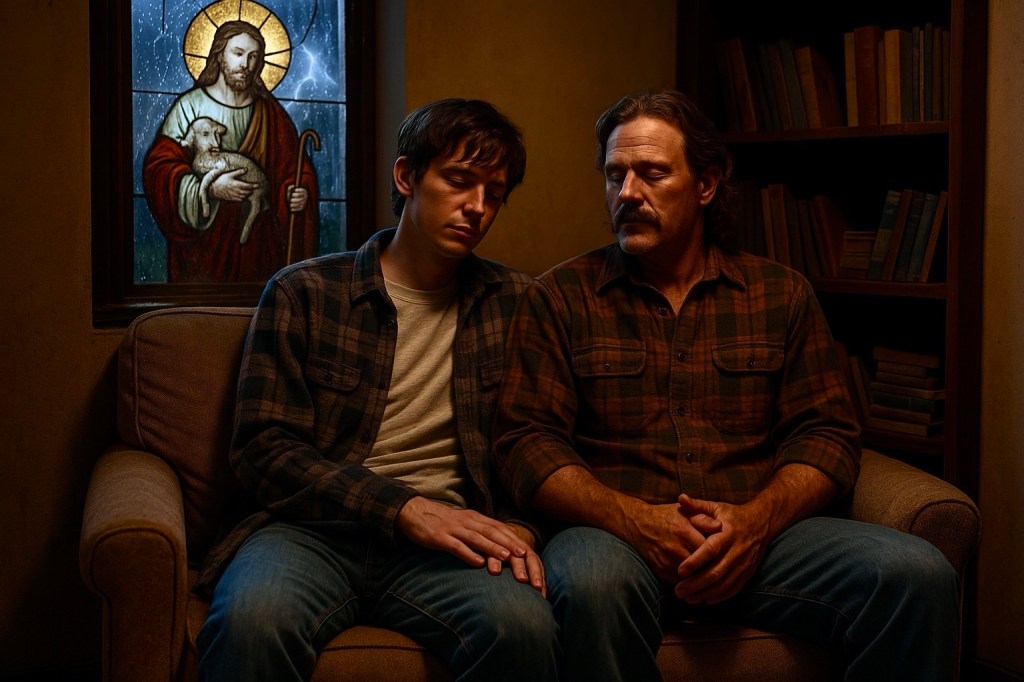
    Tyler didn’t answer at first. He was watching the lightning flash behind the stained glass—Christ the Shepherd lit up in flickers of blue and gold. “Not a bad place to get stuck,” he said softly.

    They settled into the little room off the back hallway—part storage, part prayer nook. A loveseat sat against one wall, old and sunken in places, and a shelf of dusty devotionals lined the opposite wall like forgotten psalms.

    Tyler sat first, curling one leg under him. Clyde followed, stiff at first. The air smelled of wood polish and rain.

    Neither spoke for a while.

    The thunder moved closer.

    Tyler’s voice came quiet. “Storms used to scare me. When I was a kid.”

    Clyde looked over. “Me too.”

    Tyler gave a faint smile. “Not the thunder. Just… the feeling like something was comin’ for me. Like the house couldn’t quite hold.”

    Clyde nodded slowly. “Yeah.”

    The silence returned, but it wasn’t empty.

    Then Clyde said, voice low and unsure, “There’s nights I still feel it. That ache. Not just for someone beside me… but for someone who sees it all and doesn’t flinch.”

    Tyler didn’t move. Just listened.

    Clyde went on. “I spent half my life tryin’ to shut that down. To be a man nobody had questions about. And I was good at it, mostly.” He gave a rough breath of a laugh. “Guess the trouble came when I stopped wantin’ to be unseen.”

    Lightning lit the windows again, and the thunder came close behind.

    Tyler reached over—just a hand on Clyde’s knee, quiet and steady. Not pulling. Not asking. Just… there.

    Clyde looked at it. Then at Tyler. His voice shook a little. “I still want it sometimes.”

    Tyler held his gaze, warm and unswerving.

    “But not as much,” Clyde whispered, “as I want it to be holy.”

    Something passed between them then—heavier than want, lighter than fear. Like grace threading through the air.

    They both leaned back into the worn cushions, shoulders touching now–warm and steady. Tyler let his hand fall away, but the closeness remained, no longer needing to ask for space.

    “We’re not wrong for needing,” he said gently. “But we’re free to choose what we do with it.”

    They sat there, the storm drumming above like it was testing the roof. Clyde let his eyes close for a moment.

    When he opened them, he said, “Would you pray?”

    Tyler nodded once, then bowed his head—not in performance, but in offering.

    The words were soft. Just enough to be heard above the rain.

    “Lord, be near. In the ache, in the waiting. Make this bond more Yours than ours. Keep it steady. Keep it clean. Amen.”

    They didn’t speak after that.

    Just sat together as the storm ran its course.

    Two men under one roof, shoulder to shoulder.

    Choosing peace.

    Choosing light.

    (Chapter from Held Fast, from the Tyler and Clyde series. Contact me if you want to read the whole story!)
  • Amos and Jonah (Part 5)

    Amos and Jonah (Part 5)

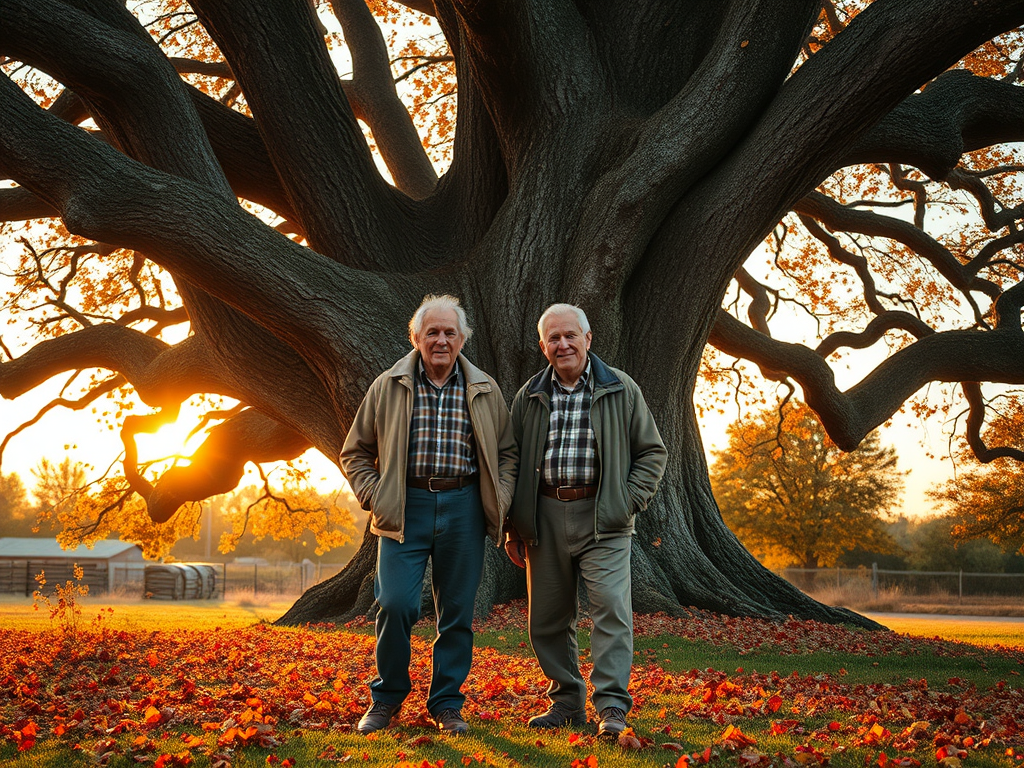
    The seasons spun on, each one layering their story deeper into the land. The oak by the porch grew gnarled, its branches heavy with years, much like the men who sat beneath it. They’d carved out a life that defied the whispers of the world—a brotherhood so fierce it stood as a testament, a living sermon etched in calloused hands and shared silences.

    The physical pull never left, not entirely. It’d flare in quiet moments—when Jonah’s arm slung around Amos’s shoulders as they watched a storm roll in, or when Amos’s fingers grazed Jonah’s wrist passing him a mug of coffee. But they’d mastered it, turned it into a current that ran beneath their covenant, powering it rather than pulling it apart.

    One summer, a traveling preacher came through, a wiry man with a voice like thunder. He stayed a night at the farm, breaking bread with them in the flickering light of the kitchen. He watched them close, his keen eyes catching the way Amos filled Jonah’s plate without asking, the way Jonah’s hand rested easy on Amos’s arm as they laughed over some old story. After supper, the preacher sat back, pipe in hand, and said, “Y’all got somethin’ special here. Like David and Jonathan, souls knit together. Ain’t seen many live it out so true.”

    Amos and Jonah exchanged a look, a flicker of pride and something softer passing between them. “Just tryin’ to honor Him,” Amos said, and Jonah nodded.

    “Ain’t always easy, but it’s good,” Jonah added.

    The preacher left the next day, but his words stuck, a quiet blessing on what they’d built. And build they did—year after year, until the farm wasn’t just a patch of dirt but a legacy of faith and fidelity. The chapel became a gathering place for the scattered folk of the hills, drawn by the warmth of two men who lived what they preached. They’d sit on those oak benches, listening as Jonah read Scripture or Amos prayed in that low, steady voice, and they’d leave feeling the weight of something holy.

    Fall came again, decades piling up like the leaves drifting against the barn. Amos was slower now, his back stooped from years of bending to the plow, and Jonah’s hands shook when he whittled, but they still worked the land, still knelt in the chapel, still laughed like the young men they’d once been. One evening, as the sun dipped low and the sky burned crimson, they walked the fence line, checking posts like they’d done a thousand times. Amos stopped, leaning heavy on a post, breath fogging in the chill.

    Jonah paused beside him, concern creasing his brow. “You alright?” he asked, stepping close, his hand finding Amos’s shoulder.

    Amos nodded, catching his breath. “Just takin’ it in. This place. You. All of it.”

    Amos turned, his hazel eyes locking with Jonah’s, weathered and deep with years of shared struggle and triumph. The wind kicked up, rustling the crimson leaves around their boots, and for a moment, they just stood there, the weight of their bond heavier than the post Amos leaned on. Jonah’s hand stayed firm on Amos’s shoulder, a tether as real as the Kentucky clay beneath them.

    “Reckon we’ve walked this road right,” Amos said, his voice a low rumble, softened by the years. “Ain’t been easy, fightin’ what we felt, but we made it somethin’ better. Somethin’ He can look down on and call good.”

    Jonah nodded, his gray eyes steady, a faint smile tugging at his lips. “Aye. Brothers, true and deep. That’s what He gave us strength for. Ain’t no shame in lovin’ you like this—pure, like David and Jonathan. We kept it holy.”

    Amos straightened, clapping Jonah on the back, the gesture rough but warm, a seal on their unspoken vow. “Let’s head in. Coffee’s callin’, and I ain’t freezin’ out here for pride.”

    They turned toward the farmhouse, shoulders brushing as they walked, the chapel’s silhouette a quiet sentinel against the fading light. Inside, they shed their coats, the fire already crackling from earlier. Jonah grabbed the pot, pouring two mugs, while Amos sank into his chair, the creak of the wood as familiar as a hymn. They sat across from each other, steam curling up between them, and raised their mugs in a silent toast—not to romance, not to what could’ve been, but to the brotherhood they’d forged, a covenant stronger than steel, rooted in their faith.


    Years later, when the townsfolk found them—Amos gone in his sleep, Jonah a day after, unwilling to linger alone—the chapel still stood, their initials carved in the bench. The land bore their mark, a testament to two men who’d wrestled the hum into something glorious, a friendship that glorified God’s design. They buried them side by side under the sycamore, the tree’s roots curling deep, just like the bond they’d lived out to the end.

  • Amos and Jonah (Part 4)

    Amos and Jonah (Part 4)

    Years rolled on, and the farm flourished under their care, a testament to their labor and their faith. The townsfolk would talk—two bachelors living out there, thick as thieves, closer than brothers, working the land and praising the Lord with a fire few could match. They’d see Amos and Jonah at the market, bartering for seed or a new plow blade, their easy banter and shared glances a quiet marvel. Some whispered, wondering at the depth of it, but most just saw two men who’d found a rare thing—a bond forged in sweat and Scripture, unbreakable as the Kentucky hills.

    The years etched lines into their faces, turned Amos’s hair to silver and Jonah’s to a dusty gray, but the rhythm of their days held steady. They’d rise before dawn, coffee brewing on the old stove, and head out to tend the herd or mend a fence. The physical affection stayed—a constant thread woven into their lives, natural as breathing. A hand on the back after a hard day, a rough hug when the weight of the world pressed too heavy, a playful shove that’d spark a wrestle in the yard, their laughter ringing out across the fields.

    The hum lingered too, a quiet ember they’d long learned to tend without letting it flare. It was there in the way Jonah’s eyes would trace Amos’s broad frame as he split wood, or how Amos’s breath would catch when Jonah sang hymns in that low, steady tenor. But they’d made their choice, and it was a choice they renewed every day—with every prayer, every shared meal, every step they took side by side.

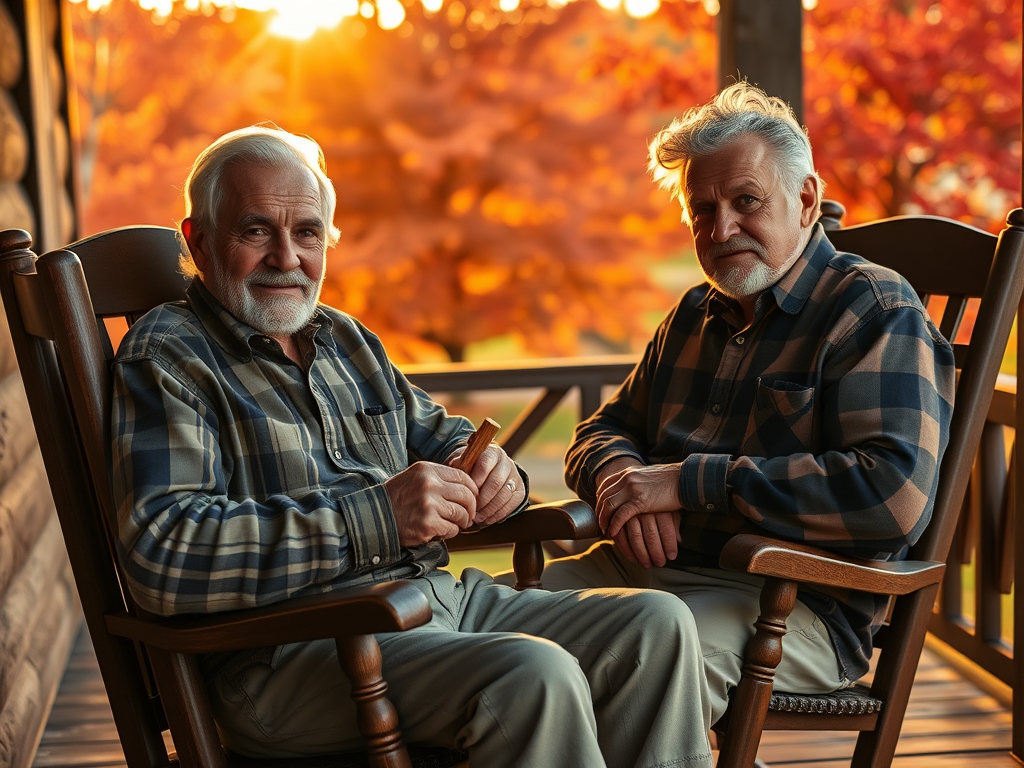
    One crisp autumn evening, as the maples blazed red and gold, they sat on the porch, rocking chairs creaking under their weight. The harvest was in, the barn stuffed with hay, and the air smelled of apples ripening on the tree out back. Jonah whittled now, a habit he’d picked up from Amos, shaping a small cross from a chunk of walnut. Amos leaned back, hands folded over his belly, watching the sun sink behind the ridge.

    “Reckon we’ve done alright, Jonah,” Amos said, his voice a deep rumble softened by time. “This life, this place. Him up there’s gotta be smilin’ down on it.”

    Jonah paused, the knife still in his hand, and looked over at Amos. The fire in his eyes hadn’t dimmed, not even after all these years. “More’n alright,” he said. “We took what He gave us—this pull, this whatever-it-is—and made it somethin’ good. Somethin’ holy, even.”

    Amos grunted, a sound that might’ve been agreement or just the comfort of hearing Jonah’s voice. “Ain’t been easy,” he said after a beat. “Times I wanted to give in, let it turn to somethin’ else. But you kept me straight. Iron sharpens iron, like you’re always quotin’.”

    Jonah grinned, setting the cross on the arm of his chair. “You did the same for me. Nights I’d lie awake, wonderin’ if we was fools to fight it. But then I’d hear you snorin’ through the wall, and I’d think, ‘Naw, that’s my brother. That’s my rock.’ And I’d pray for us both.”

    Amos turned his head, meeting Jonah’s gaze. There was a weight there, a tenderness that didn’t need words, but he spoke anyway. “I’d do it all again, you know. Every wrestle, every hard day, every time I had to pull back from you. ’Cause what we got—it’s rarer than gold. Ain’t many men get a friend like this, a brother like this.”

    Jonah nodded, his throat working as he swallowed down the swell of emotion. “Same, Amos. Same.”

    They fell quiet then, the crickets picking up their song as dusk settled over the farm. The chapel still stood at the edge of the field, weathered now but sturdy, a silent witness to their covenant. Inside, they’d carved their initials into the back of one bench—A.K. and J.T., side by side, a small mark of the life they’d built. The townsfolk called it the Brotherhood Chapel, a name that stuck after old man Carver saw them praying there one Sunday and said it felt like walking into a piece of heaven.


    One winter, when the snow piled high and the wind howled through the eaves, Jonah took sick. A cough that wouldn’t quit turned into a fever that kept him abed, his lean frame shivering under a pile of quilts. Amos tended him like a mother hen, broth simmering on the stove, prayers muttered under his breath as he pressed a cool cloth to Jonah’s brow. The farm could wait—the cattle would survive a day untended—but Jonah couldn’t. Not to Amos.

    “Stop fussin’,” Jonah rasped one night, his voice weak but his eyes sharp. “I ain’t dyin’ yet. Got too much left to do with you.”

    Amos huffed, dipping the cloth back into a basin of cold water and wringing it out with hands that trembled just a touch. “Better not be dyin’. I ain’t haulin’ this farm alone, you hear? And I sure ain’t prayin’ in that chapel by myself.”

    Jonah managed a faint chuckle that turned into a cough, and Amos was quick to prop him up, a broad hand splayed across Jonah’s back, steadying him until the fit passed. Their eyes met in the dim lantern light, and for a moment, that old ember flared sharp and bright, a pang of longing they’d spent years taming. Amos’s hand lingered, warm against Jonah’s fevered skin, and Jonah’s breath hitched, not just from the sickness.

    “Lord, keep us,” Jonah whispered, a prayer as much as a plea, and Amos echoed it with a gruff “Amen.” He eased Jonah back onto the pillows, pulling the quilts up tight.

    “Rest now. We got this,” Amos said, his voice a rock in the storm.

    And they did. The fever broke by morning, leaving Jonah weak but alive, and Amos sank to his knees by the bed, head bowed in gratitude, tears cutting tracks through the grime on his weathered face.

    Spring came late that year, the frost clinging stubborn to the ground, but when it finally thawed, the land burst forth like a promise kept. Jonah was back on his feet, thinner now, his cheeks hollowed, but his spirit unbowed. They stood together in the chapel one Sunday, the air thick with the scent of damp earth and new growth seeping through the cracks. Jonah’s voice rose in a hymn—“Blessed be the tie that binds”—and Amos joined in, his rumble blending with Jonah’s tenor, rough harmony lifting to the rafters. Their shoulders brushed as they sang, and when the last note faded, they stayed there, side by side, breathing in the stillness.

    (Concluded in Part 5)

  • Amos and Jonah (Part 2)

    Amos and Jonah (Part 2)

    Amos’s words hung heavy in the air, raw and unguarded. “Reckon I’d die for you, Jonah.” The confession slipped out like a stone dropping into a deep well, rippling through the silence of the farmhouse. Outside, the wind rustled the bare branches of the oak tree by the porch, a soft moan that mirrored the ache in both their chests.

    Jonah rose from his chair, the Bible still resting on the table, its leather cover worn smooth from years of touch. He crossed the room slow, his boots scuffing the pine floor, and stopped a pace behind Amos. “Don’t say that less you mean it,” Jonah said, his voice low but steady, like the hum of a hymn. “’Cause I feel the same, and it scares me somethin’ fierce.”

    Amos turned, his hazel eyes catching the firelight, glinting with a mix of resolve and torment. “I mean it. Ain’t no lie in me when it comes to you. But feelin’ it don’t make it right, does it? We’re men of the Word. We know what’s laid out for us.”

    Jonah nodded, his throat tight. He stepped closer, close enough that Amos could smell the sweat and earth clinging to him from the day’s labor, a scent as familiar as the fields they worked. “It’s a fight, ain’t it?” Jonah said, his voice trembling just a hair. “Lovin’ you like this and knowin’ we gotta turn it into somethin’ else. Somethin’ God can smile on.”

    Amos clenched his fists at his sides, the muscles in his forearms flexing under the rolled-up sleeves of his flannel shirt. “Ain’t never felt a pull this strong,” he admitted. “Not even when I was young and full of fool notions about the world. You’re in my bones, Jonah. But I ain’t here to defy Him. I’m here to serve Him.”

    Jonah reached out, hesitant, then rested a hand on Amos’s shoulder, firm and warm through the worn fabric. “Same,” he said. “We’re brothers in Christ first. That’s the covenant that matters. Whatever this is, we shape it to fit His will.”

    They stood there, locked in that touch, the fire popping behind them like a chorus urging them onward. The weight of their faith pressed down, but so did the strength of it, lifting them above the churn of their hearts. Amos finally stepped back, breaking the contact, and ran a hand over his stubbled jaw.

    “Let’s pray on it,” he said gruffly. “Ain’t no better way to sort this out.”

    They knelt together on the braided rug by the hearth, knees sinking into the faded colors woven by Amos’s mother years back. Jonah led, his voice steadying as he spoke. “Lord, You see us. You know every corner of our hearts, every stumble and every hope. We’re Yours, first and always. Take this bond we got, this love, and make it holy. Shape it to Your design, not ours. Give us strength to walk upright, to glorify You in all we do.”

    Amos murmured an “amen,” his head bowed, the firelight dancing across the planes of his face. When they rose, there was a quiet resolve between them, a pact forged in the heat of that moment. They wouldn’t run from what they felt, but they wouldn’t let it rule them either. It’d be a brotherhood, deep and true, tempered by faith.