Tag: masculine identity

  • The Altar of Surrender

    Ethan had been fighting the same war since he was nine. It started with a memory—his older cousin, shirtless and laughing, tossing a baseball with a grace Ethan could never mimic. He’d wanted to be him, to wear that strength like a second skin. But the want turned dark, curling into a heat he didn’t understand, a pull that followed him into adolescence. By sixteen, it had a name—lust, envy, a tangled mess he hid behind a church-boy smile. He’d pray it away, fists clenched, begging God to rip it out. Make me normal. Make me good. But it clung like damp rot.

    Now, at twenty-eight, Ethan stood in his apartment, the late March light slanting through the blinds. He’d just hung up from a call with his pastor, who’d invited him to a men’s retreat. “Come as you are,” Pastor Dan had said. Ethan snorted. As he was? A man whose longing for brotherhood had fused with something erotic, something he couldn’t untangle? He’d tried everything—fasting, cold showers, dating women he didn’t want. Nothing worked. The desires still ambushed him, sparked by a coworker’s handshake or a stranger’s stride.

    He sank to his knees by the couch, the carpet rough against his shins. Jesus, I don’t know how to do this. He’d heard the phrase a thousand times—lay it at the cross—but it felt like jargon, a platitude with no map. He pictured a literal cross, splintered and bloody, and himself standing before it, hands empty. What did that even mean? Dump his shame there and walk away? He’d tried. It always came back.

    The retreat was a week away. Ethan spent the days wrestling. He opened his Bible to Galatians 2:20—“I have been crucified with Christ. It is no longer I who live, but Christ who lives in me.” The words stung. Crucified. Dead. Was that it? Not just handing over the mess, but letting it die with Him? He closed his eyes, picturing it—his envy, his hunger, nailed up there, bleeding out. Take it, Jesus. Kill it. His voice shook. I don’t want it anymore.

    It wasn’t a feeling, not at first. No rush of peace, no choir of angels. Just a choice, raw and deliberate. He kept at it, night after night, kneeling until his knees ached. This longing—the way it twists me—it’s yours. I’m done owning it. He imagined driving the nails himself, each prayer a hammer strike. The fantasies still came—unbidden, vivid—but he’d stop, breathe, and say it again. Yours, not mine. It was clumsy, unglamorous, a surrender he had to remake daily.

    The retreat was a cabin in the woods, ten guys around a firepit. Ethan arrived late, nerves buzzing. Pastor Dan greeted him with a nod, and the others—gruff, bearded types mixed with quieter ones—offered handshakes. He braced for the old pull, the way his eyes might linger, but he whispered under his breath, Yours, Jesus. It didn’t erase the flicker, but it shifted the weight.

    The first night, they shared stories. Dan went first—his own pride, a marriage he’d nearly wrecked. Another guy, Paul, talked about porn, voice cracking. Ethan’s pulse raced. He could stay silent, safe. But the cross loomed in his mind, a place of death and release. He cleared his throat. “I’ve… wanted to be one of the guys my whole life. But it got messed up. Envy turned into… stuff I’m ashamed of. I’ve been giving it to Jesus, but it’s hard.”

    The fire snapped. He waited for the shift—disgust, distance. Instead, Dan leaned forward. “That’s real, man. Takes guts to say it.” Paul nodded. “Yeah. We’re all carrying something.”

    Ethan exhaled, shaky. They didn’t pry, didn’t flinch. They just sat with it, with him. The next day, they hiked, fished, laughed over burnt hot dogs. Paul clapped him on the back after he snagged a trout—awkwardly, but still a win. “Nice one, brother.” The word landed soft, true.

    That night, Ethan knelt by his bunk, the cabin quiet. Jesus, thank you. For taking it. For them. He pictured the cross again, his desires pinned there, not gone but powerless. The surrender wasn’t a one-time fix—it was a rhythm, a daily dying. But it worked. Not because he felt clean, but because he trusted the one who’d already carried it.

    Months later, the group stuck. They met for coffee, prayed over texts. Ethan still stumbled—the old pull flared at a gym locker room or a friend’s grin—but he’d name it, nail it down. Yours. And the brothers stayed, not as saviors, but as echoes of the cross—living proof he wasn’t alone. Christ was the root; they were the branches. Ethan wasn’t healed, not fully. But he was held.

  • Flesh and Bone: The Bond that Holds

    Flesh and Bone: The Bond that Holds

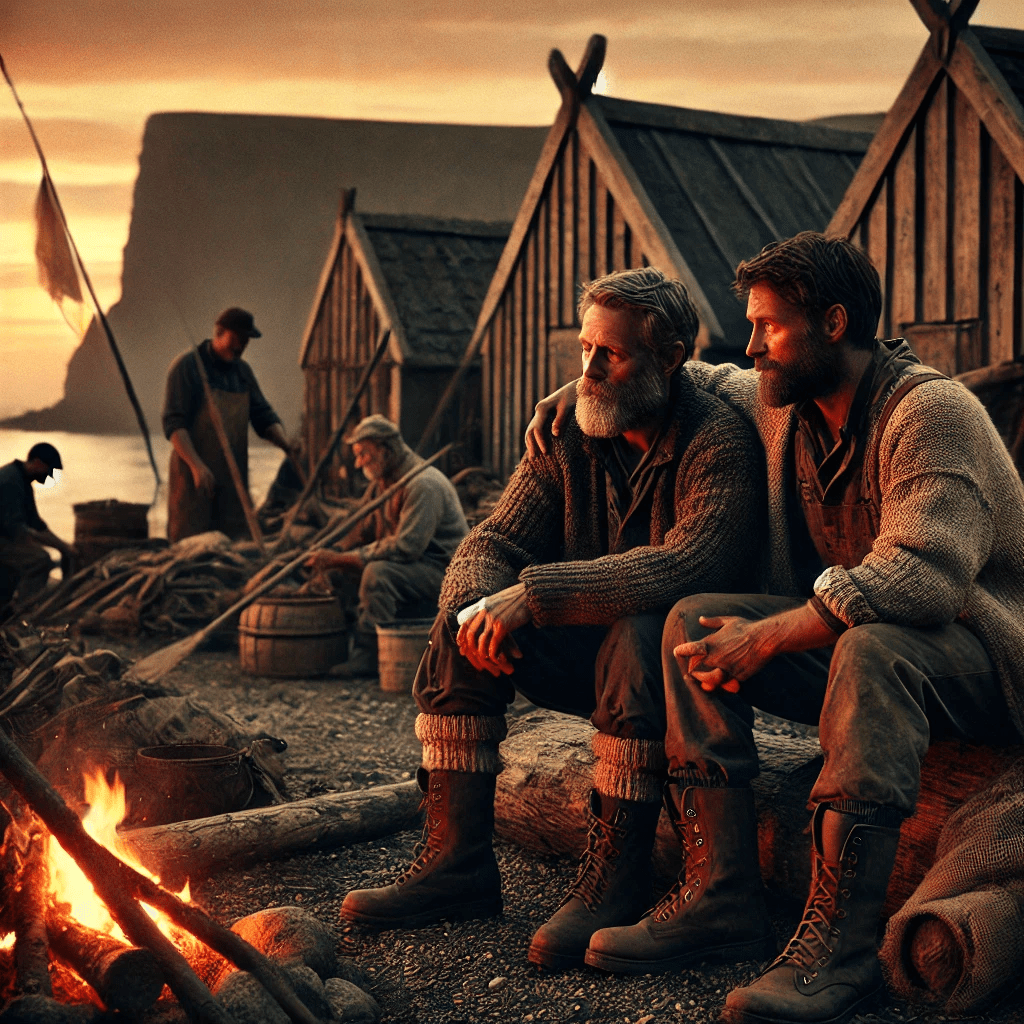
    The wind howled across the cliffs of Dunmoor, dragging salt and spray inland, where a village called Hearthglen clung to the land like a memory. Long before the world grew sharp and distant, the men of Hearthglen lived close—close to the earth, close to each other. They worked the fields and fished the sea, and when the day was done, they sat shoulder to shoulder by the fire, letting touch speak what words didn’t need to.

    Back then, no one questioned it. A hand on the back said, “I’m with you.” A grip on the arm meant, “We’re still standing.” Touch was strength shared, not stolen. The old elder Eamon called it God’s design: “He made us flesh and bone, lads—not just to toil, but to hold.”

    Torin and Calum weren’t brothers by blood, but they might as well have been. One loud, one quiet. One broad and brawny, the other lean and sharp-eyed. They moved through life like two halves of a single soul—until the world changed.

    Traders came with polished steel and slippery words. They sold more than goods; they sold a new idea of manhood: self-made, self-reliant, untouched. And slowly, the village followed. Arms that once held now hung at men’s sides. Brothers became rivals. Words replaced presence. The fire grew cold.

    Then the storm came.

    It tore through Hearthglen, ripping roofs, shattering boats, and leaving silence in its wake. Torin and Calum stood yards apart, working through the wreckage, silent, stiff, the space between them colder than the wind. And it was Eamon, bent and half-frozen, who limped into the heart of it all and shouted what everyone knew but had forgotten: “God gave us hands to hold—not just to hoard.”

    And when a boy named Finn—thin, trembling, alone—stepped into the square asking for help, no one moved… until Eamon did. He wrapped that boy in his frail arms and broke something open.

    Torin stepped toward Calum.

    “Brother,” he said—rough, unsure—and placed a hand on his shoulder.

    Calum flinched… then reached up and gripped Torin’s arm.

    And that was the spark.

    One by one, men followed. An embrace here, a clasp of arms there. Walls crumbled. Eyes softened. Voices rose. It wasn’t polished—it was raw, clumsy, honest. It was holy.

    They rebuilt the village, yes. But more than that, they rebuilt the bond. Shoulder to shoulder. Hand to back. Forehead to forehead in prayer. Touch, reclaimed. Pure. God-honoring.

    The traders came again, puzzled at what they found: not lonely men chasing coin, but a tribe forged in shared strength. They left, muttering. Hearthglen didn’t blink.

    Years passed. Eamon died, buried beneath the cliffs. They carved his words into stone:

    “Flesh and bone—meant to hold fast.”

    And they did.

    Men lingered after the work was done—not to compete, but to stay close. They taught the boys how to fish, how to plant, how to press a hand to a brother’s back when the weight got heavy. They didn’t call it covenant. They didn’t need to. It was carved in the way they leaned into each other. It was how God made them.

    Not just to stand tall.

    But to stand tall together.

  • Healing Father Wounds Through Faith

    Healing Father Wounds Through Faith

    The fire crackled low, flames licking at the edges of the stacked wood. A cool breeze carried the smoke upward, disappearing into the night sky. Jake sat hunched forward on the log, elbows on his knees, eyes fixed on the embers. Across from him, Sam leaned back, one boot resting on the other knee, watching but not pushing.

    They’d been sitting there a while.

    Jake finally exhaled, shaking his head. “I don’t even know where to start.”

    Sam poked at the fire with a stick. “Start with the lie.”

    Jake gave him a sideways glance. “What?”

    “The lie,” Sam repeated. “The one that’s got its claws in you the deepest. Say it out loud.”

    Jake swallowed hard. The words felt dangerous, like saying them might make them more real. He hesitated, then finally muttered, “I’m not like other men.”

    Sam nodded, unshaken. “That’s a common one.”

    Jake scoffed. “That supposed to make me feel better?”

    “It’s supposed to tell you the truth,” Sam said. “You’re not alone in that feeling. But it’s still a lie.”

    Jake leaned forward again, rubbing his hands together. “Is it, though? I mean, look at me. I never fit in with guys growing up. Always felt different. Still do. I don’t think I’m wired like them.”

    Sam tossed the stick into the fire. “Different doesn’t mean deficient. You were made a man. That’s not something you feel your way into—it’s something you already are.”

    Jake clenched his jaw. “Then why do I feel like something’s missing?”

    Sam’s voice was steady. “Because you were meant to be sharpened by other men. Not as something you need to possess, but as something to grow alongside.” He let the words settle before continuing. “You think you need another man to complete you. But you don’t. Christ already made you whole.”

    Jake’s throat tightened. “Doesn’t feel that way.”

    Sam leaned forward, elbows on his knees now. “Feelings aren’t the final word, brother. Truth is. And the truth is, you lack nothing.”

    Jake swallowed hard. “My dad never made me feel that way. He barely looked at me half the time.”

    Sam nodded, his voice softening. “I get that. When a father doesn’t affirm his son, it leaves a gap. A hunger. But your dad’s failure doesn’t get the final say on who you are.” He pointed at Jake’s chest. “Your Father in Heaven already called you His son. Already gave you what your earthly dad didn’t. And He doesn’t hold back His love.”

    Jake looked down, his fingers curling into fists. “Then why do I still crave it? Why does it hit me so hard when a guy sees me—really sees me?”

    Sam let out a slow breath. “Because deep down, you were made for brotherhood. For real, deep, non-sexual connection with other men. But the enemy took that God-given longing and twisted it, made it feel like something else.”

    Jake’s jaw clenched. “So what am I supposed to do? Just ignore it?”

    “No,” Sam said firmly. “You name it. You stop running from it. And you let God untangle what the enemy twisted. You step into real brotherhood—not in secrecy, not in shame, but in the light.”

    Jake looked at him then, really looked. “And that works?”

    Sam held his gaze, then reached over, clapping a firm hand on Jake’s shoulder before sliding his arm around his back in a solid, steady grip. “I’m here, aren’t I?”

    The warmth of that touch cut through the cold night air—solid, grounding, real. Jake didn’t pull away. He let himself feel it, the strength of another man standing with him, not against him.

    The fire popped, sending sparks into the night. Jake let the words sink in, the truth pushing against years of lies.

    He wasn’t there yet. Not fully. But for the first time, he believed it might be possible.

    And for now, that was enough.

    Themes: Christian man struggling with same-sex attraction, Healing father wounds through Christ,  What does the Bible say about masculinity? Healing from rejection as a man

  • Brother, I See You

    Brother,

    I need you to hear this. I see you.

    Not just the surface—not just the things you do or how the world labels you. I see the man you are. And I honor you.

    I see your body—strong, capable, shaped by the hands of God Himself. Maybe you carry muscle, maybe you don’t. Maybe you bear scars from battles, inside or out. Maybe your frame isn’t what the world calls impressive, but it carries the weight of your life, and that matters. You are made in His image, every part of you, and you are not a mistake. (Genesis 1:27, Psalm 139:14)

    I see your mind—sharp, searching, always wrestling, always reaching. Maybe you think fast, or maybe you take your time. Maybe your thoughts run deep, or maybe you keep things simple. Either way, God has given you a mind meant for wisdom, for truth, for discernment. You are built to think, to lead, to make sense of this world through His Word. (Proverbs 2:6, James 1:5)

    I see your heart—stronger than you know. Maybe it’s been bruised, maybe it carries weight most men wouldn’t understand. But it still beats with purpose. Your heart was made to love, to stand, to endure. To fight for what’s right, to protect what’s sacred, to hold onto the ones God has placed in your life. It beats because He has a plan for you. (Psalm 73:26, Jeremiah 29:11)

    I see your spirit—anchored in Christ, even when you doubt. You are not a lost cause. You are not too far gone. You are not defined by your past, your temptations, your struggles. You are a son of the Most High, a man called into something greater than yourself. (Romans 8:14-15, 2 Corinthians 5:17)

    I see your strength—not just the kind that lifts weight, but the kind that lifts burdens. The kind that carries others when they can’t stand on their own. The kind that chooses truth over comfort. The kind that refuses to quit when the enemy whispers, “You are not enough.” Brother, you are enough, because Christ in you is enough. (2 Corinthians 12:9-10, Philippians 4:13)

    I see your place among men. You are not an outsider. You are not unworthy. You belong. God made you to walk alongside your brothers—to stand shoulder to shoulder, to fight and to build, to love and to lift each other up. You were never meant to go at this alone. (Ecclesiastes 4:9-10, Proverbs 27:17)

    I see your calling—whether you are married, single, or bound in covenant brotherhood, your life has purpose. You are not waiting for something else to make you whole. You are already whole in Christ. Your worth does not come from a title, a relationship, or the approval of the world. It comes from the One who calls you His own. (Isaiah 62:2, Colossians 2:10)

    Brother, I see you. And I need you to hear this—you are a man. Not because of what you do, but because God made you one. Not because you always feel it, but because He designed you that way. Not because of the world’s standards, but because you were formed by the hands of the Almighty.

    Stand in that truth. Walk in it. Live in it. And know this—you do not walk alone.

    I am here. Your brothers are here. And Christ is with you always.

    You are seen. You are known. You are honored. You are loved.

    Now go walk as the man God made you to be.

  • Reflections of a Brother

    The water is still, reflecting the sky in endless hues of blue and gold. It cradles them, warm and living, flowing around their bodies like the breath of God Himself. Sunlight dances across the rippling surface, tracing golden lines over their bare skin, highlighting strength, form, and the undeniable reality of their shared manhood.

    Lior stands chest-deep in the water, facing Dain. The older man regards him with quiet intensity—not as a teacher measuring a student’s progress, but as a brother standing before an equal. The air between them hums with something unspoken, something weighty yet effortless, as natural as the rise and fall of their breath.

    For a long moment, neither speaks. They simply look—taking in the shape of the other, the lines of muscle honed by labor and trial, the subtle marks of experience that tell the story of their lives. There is nothing hidden, nothing obscured. Here, in the water, in the presence of the One who formed them, they are wholly seen and wholly known.

    Lior is the first to break the silence. “I see it now,” he says, his voice soft yet certain.

    Dain tilts his head, waiting.

    Lior’s eyes do not waver. “I see myself in you. And I see you in me.”

    Dain’s expression does not change, but something deepens in his gaze—pride, understanding, something beyond words.

    “This bond,” Lior continues, voice steady, “it’s not just about learning or growing. It’s about knowing. Knowing who we are. Knowing who God made us to be.” His lips twitch with the hint of a smile. “I thought I was just becoming a man. But I’ve come to see—I was made for brotherhood just as much as for strength.”

    Dain exhales, slow and full, as if hearing words he has long known but never spoken aloud.

    “You understand,” he says. It is not a question.

    Lior nods. “I do.”

    Dain steps forward, and Lior mirrors him instinctively. They meet in the center of the water, standing close enough that their reflections blend together in the shifting surface. Dain places a firm hand on Lior’s shoulder, the touch carrying both weight and warmth.

    “You are a man,” Dain says, his voice low and full of certainty. “You are my brother.”

    Lior lifts his own hand, mirroring the gesture, his grip strong, sure. “And you are mine.”

    The water ripples outward from them, as if the world itself acknowledges what has been spoken. The sky above is vast, the land around them unshaken. But in this moment, it is the reflection in the water that holds the greatest truth—two men, two lives, bound in purpose, in strength, in the love that God Himself has woven into the heart of their covenant.

    They linger a moment longer, their hands remaining where they are—two lives mirrored, two hearts beating as one. Then, with silent agreement, they lower their arms and turn toward the shore.

    The journey is not over. But when they leave the water, they do so as men who have seen and been seen—who have beheld their own reflection in the eyes of a brother and found something sacred there.

    (Chapter from the Unfallen Earth fantasy series. Contact me if you’d like to read the full story or series.)

  • The Father’s Heart for His Sons

    Beloved sons,

    I, the Lord your God, speak to you from the heavens, where I see each of you clearly, without the veils of human judgment or the shadows of imperfection. You are all My sons, crafted in My image, each one of you a testament to My love and creativity. From the moment I breathed life into Adam, I established a brotherhood amongst all men—a sacred bond, deeper than blood, meant to strengthen and uphold each of you in your walk with Me.

    Hear Me now, for I say to you, every man, regardless of his stature, whether he stands tall or not; whether his frame is broad or slender; whether his skin is dark, light, or any shade in between; you are all equally My sons. Age does not diminish your worth in My eyes; from the youngest boy to the eldest man, you are precious to Me. The external signs of what society might call masculinity do not define you. Whether you are bold and outspoken or quiet and reflective, you are all equally men in My kingdom.

    The size of your body or the depth of your voice does not measure your manhood; these are but fleeting aspects of your earthly vessel. Nor does your physical strength or athletic prowess dictate your value, for I look at the heart, not the muscle. My love for you does not waver if you are disabled or if your body does not conform to what the world deems perfect. You are each a unique expression of My love, and I cherish you just as you are.

    In marriage, singleness, or covenant brotherhood, you are each called to serve Me in your unique way. Those who are married, those who remain single for the Kingdom, and those who forge brotherhood covenants in My name all share in the same mission—to love, to lead, and to live in righteousness. Your worth does not come from your marital status, but from your faithfulness to Me and your willingness to walk in the bond of brotherhood I have ordained.

    Regarding the inclinations of your heart, understand that My love for you is unwavering, but I call you to live according to My teachings. Your identity as My sons is not defined by where your attractions lie, but by your commitment to live a life that honors Me. I encourage you to seek purity in your thoughts and actions, to walk in My ways which lead to life and peace.

    Let not the world’s judgments or its shallow standards of manhood sway you. You are all part of a greater brotherhood, a covenant that reflects My love—a bond meant to support, uplift, and call each other to holiness. Stand firm together, for where one stumbles, another is there to lift him up. Where one is weary, another is there to strengthen him. This is My design, that no man should walk alone. (Ecclesiastes 4:9-10)

    Remember, My sons, you are not defined by what you see in the mirror or what others see in you, but by what I see in your hearts. Stand tall in this truth, for in My eyes, you are all equally men, equally loved, equally called into a brotherhood that reflects My Kingdom. Walk in this knowledge, live in this love, and let your bond as brothers be a beacon of My grace and truth in the world.

    With eternal love,
    Your Father in Heaven

    (This is not a direct prophecy or revelation, but a reflection of what God has spoken through Scripture—truths He has already declared about men, our identity, and our brotherhood.)

  • Who We Are, Men of God

    1. I am fearfully and wonderfully made, created by God in His image as a man (Psalm 139:14; Genesis 1:27).
    1. I am a beloved son of God, adopted into His family through Jesus Christ (Galatians 3:26; Ephesians 1:5).
    1. I am chosen by God, called to live as a man of strength, integrity, and purpose (1 Peter 2:9).
    1. I am fully seen, known, and loved by the One who formed me in my mother’s womb (Jeremiah 1:5; Psalm 139:15).
    1. I am equipped by God to fulfill the good works He has prepared for me as a man of faith (Ephesians 2:10).
    1. I am redeemed and restored through Christ, free to walk in my true identity as a man of God (2 Corinthians 5:17).
    1. I am called to reflect God’s image in my masculinity, bearing His strength and compassion (Genesis 1:26-27; Micah 6:8).
    1. I am a temple of the Holy Spirit, chosen and empowered to live as a godly man (1 Corinthians 6:19-20).
    1. I am part of the body of Christ, where I belong and am valued as a brother in the family of faith (Romans 12:4-5).
    1. I am strengthened by the Lord to be courageous and stand firm in my identity as a man (1 Corinthians 16:13; Joshua 1:9).
  • Brother, This is Who You Are

    1. You are a man because God made you one, and He does not make mistakes. (Genesis 1:27, Psalm 139:14)

    2. You are strong—not just in body, but in heart, in mind, in spirit. (1 Corinthians 16:13, Joshua 1:9)

    3. Your manhood is not defined by your skills, interests, or personality—it is defined by God’s design. (1 Samuel 16:7, Isaiah 64:8)

    4. You were made to lead with love, to protect with strength, and to serve with courage. (Ephesians 5:25, Mark 10:45)

    5. You are not alone—you were created for brotherhood, to walk with other men, sharpening and strengthening each other. (Ecclesiastes 4:9-10, Proverbs 27:17)

    6. You are a warrior in God’s kingdom, equipped to stand firm against the enemy. (Ephesians 6:10-11, 2 Timothy 2:3-4)

    7. Your past does not define your manhood—God does, and He is making you new. (2 Corinthians 5:17, Romans 8:1-2)

    8. You do not need the world’s approval to be a man—you already have your Father’s blessing. (Matthew 3:17, Galatians 1:10)

    9. Your body was made by God and is good, a temple for His Spirit, not for shame. (1 Corinthians 6:19-20, Genesis 1:31)

    10. You are called to be bold, to stand firm, to walk in truth, and to live as the man God made you to be. (Micah 6:8, 1 Corinthians 16:13-14)

  • Firelight Rite

    The logs cracked and shifted, sending sparks into the night air. Nathan sat across from the fire, arms resting on his knees, eyes locked on the flames. The heat flickered against his face, but the tightness in his chest had nothing to do with the cold.

    Caleb sat beside him, rolling a stone in his palm, quiet. He’d been quiet most of the night, letting Nathan wrestle with whatever he wasn’t saying.

    Finally, Caleb spoke. “You ever notice how fire changes wood?”

    Nathan frowned, looking up. “What?”

    “The heat pulls something out of it. You can hear it—the sap hissing, the cracks forming. It burns, but it becomes something different.” Caleb turned the stone between his fingers. “A lot of guys think they just wake up one day as men. Like time will do the work for them. But that’s not how it happens.”

    Nathan looked back at the flames, swallowing. “Then how does it happen?”

    Caleb didn’t answer right away. He stood, grabbed a thick branch from the pile beside them, and tossed it into the fire. The bark sizzled, blackening, flame curling up its sides. “It happens when you go through something. When other men see you, speak into you, and won’t let you sit in doubt.”

    He turned to Nathan. “You don’t become a man by accident, brother. You step into it.” He held Nathan’s gaze. “And you’re ready.”

    Nathan exhaled. His hands clenched, then released.

    No one had ever said that to him before.

    Caleb reached into his pack and pulled out a knife. He flipped it open, then grabbed a thick piece of wood from the pile. “Mark it,” he said, handing the blade to Nathan.

    Nathan hesitated. “Mark what?”

    “This moment,” Caleb said. “Right here, right now. You’re stepping in. Make it real.”

    Nathan turned the knife in his palm, feeling its weight. He looked down at the wood, rough and unshaped, then glanced at Caleb. He wasn’t joking. Wasn’t explaining. Just waiting.

    Nathan pressed the blade against the surface and started to carve. He didn’t overthink it. Didn’t try to make it perfect. Just let the knife bite into the grain, cutting something real into what had been blank.

    When he was done, he sat back, staring at what he had made. It wasn’t much—just a symbol, a word, something only he and God would understand. But it was there. And it was his.

    Caleb leaned forward, nodding. “That’s it.” His voice was steady, sure. “You are a man, Nathan. No more waiting. No more questioning. Walk in it.”

    Nathan swallowed hard.

    The fire cracked again, and something in his chest cracked with it.

    He didn’t say anything. Didn’t have to.

    He just nodded. And for the first time, he felt it.

  • Brotherhood as the Missing Rite of Passage

    Some men were initiated into manhood. Most of us weren’t.

    We never had that moment—the one that said, You are a man now. Step into it. We just kept moving forward, hoping that at some point, it would click.

    But it never really did.

    The world tells us that manhood just happens when we turn 18, or when we hit certain milestones—first job, first car, marriage, fatherhood. But deep down, we know that’s not how it works.

    We don’t need another achievement to feel like men. We need other men to call us forward. And more than that—we need Christ to define us first.

    Brotherhood Restores What Was Lost

    The ancient rites of passage weren’t just about a challenge—they were about witnesses. Older men stood around the younger and said, We see you. You have passed the test. You are one of us now.

    That’s what covenant brotherhood does.

    • It doesn’t leave a man to figure it out alone. It calls him up—through challenge, truth, and trust.

    • It doesn’t measure him by worldly standards. It confirms what God already placed in him.

    • It doesn’t let him sit in doubt. It names him as a man and holds him accountable to live as one.

    But even brotherhood is incomplete without the One who created it.

    Christ is the True Initiator

    Before any man can call us forward, before we can walk in covenant with our brothers, we need to hear it from God Himself.

    “You are my son.”

    “You belong to Me.”

    “Your manhood is not fragile—it is rooted in Me.”

    Christ is the One who restores what was lost. But He doesn’t do it in isolation—He places us in brotherhood, because manhood was never meant to be lived alone.

    It’s Not Too Late

    Brotherhood is the road back to initiation. It’s not about recreating old rituals—it’s about stepping into a circle of men who won’t let you drift, won’t let you doubt, and won’t let you stay passive.

    It’s about walking with men who challenge you, not to prove yourself, but because they already see the man God made you to be.

    And once you have that? You do the same for another. Because manhood isn’t just about being called up. It’s about calling others up too.

  • When Do You Become a Man?

    There was a time when a boy knew when he became a man.

    He didn’t have to wonder. There was a moment—whether through trial, initiation, or the voice of older men—when it was spoken over him. You are a man now. Step into it.

    Now? Most men never hear those words. They just drift into adulthood, hoping that one day they’ll feel different, but they never do.

    We’ve lost something vital.

    Manhood Was Never Meant to Be a Guessing Game

    In most cultures throughout history, men didn’t just stumble into manhood—they were called into it. Sometimes it was through a test of endurance, sometimes a sacred ritual, sometimes a hard-earned responsibility. But whatever it was, it left no doubt:

    The boy was gone. The man had stepped forward.

    But today? There’s no clear line. No defining moment. Boys grow older, but they don’t become men—they just age into them.

    And the result? A generation of men who feel like they’re still waiting for permission to become what they were made to be.

    Without Initiation, Men Drift

    • Some chase achievement, hoping that success will finally make them feel like men.

    • Some chase women, thinking masculinity is proven through conquest.

    • Some stay passive, unsure, never stepping up because no one ever told them they were ready.

    Deep down, every man wants to know he is one. But no one tells him. No one confirms it. So he keeps waiting.

    It’s Not Too Late to Step In

    Brother, if you never had that moment—if no one ever called you up—you are not stuck. You don’t have to keep drifting, waiting for someone to hand you manhood like a diploma.

    Here’s the truth:

    • God has already named you a man. He created you as one. You don’t need to prove it—you need to step into it.

    • Manhood isn’t given in isolation. Other men confirm it. That’s why covenant brotherhood matters. You need men who will say, Brother, you belong. We see you. Walk in it.

    • You may not have had a rite of passage—but you can mark the moment now. Maybe it’s a challenge, a commitment, a moment before God where you declare, No more waiting. No more drifting. I will walk in who I am.

    Manhood Is Meant to Be Stepped Into

    You were never meant to spend your life wondering if you are a man. If no one ever told you—hear it now:

    You are a man. God made you one. Step into it.

    And if you’ve already walked this road? Then look behind you. There’s a younger brother who is still waiting to hear what no one ever told him. Call him up. Show him the way.

    Because manhood isn’t just about becoming. It’s about calling others forward.

  • Giving the Wound to Christ

    Brother, if you’ve seen the wound, named the lie, and know the truth in your head—but still feel the weight of it—this is for you.

    It’s one thing to recognize the wound. It’s another to give it to Christ and let Him redeem it. But what does that actually look like?

    Here’s where it starts:

    1. Stop Trying to Fix It Yourself

    We’ve spent years trying to prove our masculinity—trying to overcome the wound by being “man enough.” But healing doesn’t come through striving. It comes through surrender.

    That means admitting:

    “Lord, I can’t fix this. I’ve believed lies about myself for years, and I need You to replace them with truth.”

    That alone is hard. Because it means trusting His definition of us more than our own feelings, memories, or past experiences.

    2. Bring the Wound Into the Light

    Wounds fester in silence. The enemy wants you to keep it locked inside, to believe it’s just your burden to bear. But when you name it before God—when you bring it to a trusted brother, even—something shifts.

    When Jesus healed, He often asked, “What do you want Me to do for you?” Not because He didn’t know, but because naming it was part of the healing.

    So we bring it into the light:

    “Lord, I have believed I am less of a man. I have felt like I don’t belong. I give this to You—show me the truth.”

    And then, we listen. We let Him speak into it.

    3. Let God Redefine You Through Brotherhood

    Christ redeems our wounds, but He often does it through the hands and words of our brothers.

    When a brother sees you, challenges you, calls you his equal—not out of pity, but because he sees the man God made you to be—that’s healing in motion.

    You don’t become a man by proving yourself. You are a man because God made you one. The more you walk in real covenant, the more that truth sinks in.

    4. Walk in the Truth Before You Fully Feel It

    Here’s the hard part—choosing to believe what God says about you, even before your emotions catch up.

    That means when the old wound whispers, You don’t belong, you answer, That’s a lie. I am a son.

    When you feel like you’re on the outside looking in, you step in anyway. When brotherhood feels like something other men get, you stand in it as your birthright.

    Truth isn’t a feeling. It’s reality. And when we choose to walk in it, the wounds that once defined us start to fade.

    Brother, you don’t have to carry this alone. Christ is already in the work of redeeming it. You just have to give it to Him—again and again, until His truth is more real than the lies ever were.

    And He will finish what He started.

  • The Lie That Steals Sonship

    Brother, let’s talk about the wound most men don’t even realize they have. The one that starts early—so early, you can’t remember a time before it.

    Maybe it wasn’t a single moment, but a slow drift. Maybe it was a father who was there but distant, a brother who overshadowed you, a world that told you—subtly, persistently—you weren’t quite like the other boys.

    And then, the lie crept in:

    You don’t belong.

    You’re different.

    You’re not really a man.

    It wasn’t just about interests or personality. It was deeper. A gnawing sense that you missed something vital, that masculinity was something other men had—something you could admire, even long for, but never fully claim as your own.

    And for some of us, that’s where same-sex struggles first took root. Not as a choice, not as rebellion, but as a search for something we felt we lacked. The strength, the confidence, the belonging we thought we weren’t given. And because the world only knows how to frame male longing in sexual terms, that ache got twisted before we even knew what was happening.

    The enemy planted a lie in our boyhood, then spent years reinforcing it:

    You’ll never be one of them. You’re not enough. You’re something else.

    But brother, hear this: the enemy is a liar.

    God did not make a mistake when He made you a man. You are not an outsider to your own design. You are not less of a man because you don’t fit some narrow mold of strength or skill or stature.

    Masculinity is not about muscles or sports or how deep your voice is. It’s not something you earn. It’s something you are.

    You were born a son. Not half a son. Not a different kind of son. A son.

    The wound is real, but so is the healing. And it starts with rejecting the lie and stepping into the truth that was alwaysyours.

    You belong.

    You are enough.

    You are a man.

    Because God says so.

  • Truth Reflected

    The water was cool against the afternoon heat, rippling against their shoulders as they treaded side by side. Sunlight flickered off the surface, dappling their skin in shifting gold.

    Nathan ran a hand through his wet hair, glancing at Caleb. The guy looked like he belonged in the water—broad shoulders, solid frame, the kind of build that made everything look effortless. Nathan, leaner, wiry, felt like a reed next to a stone.

    They had swum out far enough that the shore was just a blur of trees and rocks. No one else was around. Just them, the lake, the sky stretching endless above.

    “I don’t know if I’ll ever shake it,” Nathan said finally, kicking slow beneath the water.

    “Shake what?” Caleb asked.

    Nathan exhaled. “The feeling that I missed something. That I was wired wrong from the start.” He looked down, watching the water ripple around him. “I see guys like you and I think—that’s what a man is supposed to be.”

    Caleb laughed softly. “Like what?”

    Nathan gestured vaguely. “You know. Strong. Built for it. Like it just fits on you.”

    Caleb floated on his back, staring at the sky. “You think muscle makes a man?”

    “No.” Nathan hesitated. “Not exactly. It’s not just that. It’s… I don’t know. It’s like you move through the world like you belong to it. Like you’ve never had to second-guess who you are.”

    Caleb let the silence settle between them before rolling back upright. “You ever notice how trees grow?”

    Nathan frowned. “What?”

    “Some grow thick, some grow tall. Some are knotted, some straight. You don’t see a pine tree looking at an oak, wondering if it should be broader. Or an oak looking at a pine, wishing it was taller.” He met Nathan’s gaze. “But they’re both trees. They both stand.”

    Nathan was quiet.

    Caleb ran a hand through the water. “You weren’t wired wrong. You weren’t meant to be me, or anyone else. You were meant to be you. A man, as God made you. Period.”

    Nathan swallowed, something in his chest tightening—not in pain, exactly, but in recognition.

    “You think you missed something,” Caleb said, “but maybe you just haven’t recognized what’s been in you all along.”

    The water lapped between them. Nathan didn’t answer right away. But he felt the weight of Caleb’s words sink deep, settling in places that had never quite known peace.

  • The Woodshop

    Nathan wasn’t sure why he agreed to come. He wasn’t a woodshop guy. Never had been. But Caleb had invited him, and he didn’t have a good reason to say no.

    The shop smelled like sawdust and oil, the kind of scent that lingered in clothes long after you left. Nathan hovered near the door, hands in his pockets, watching Caleb move around like he belonged there.

    “You just gonna stand there, or you gonna help?” Caleb shot him a look over his shoulder.

    Nathan smirked but didn’t move. “Not really my thing.”

    Caleb raised a brow, picking up a rough-cut slab of oak. “Sanding wood’s too big a stretch for you?”

    “I don’t know.” Nathan shifted, glancing at the workbench. “Just never did much of it.”

    Caleb grabbed a rough plank, running his fingers over the grain. “Nothing to it. You just sand down the rough edges ‘til you get something smooth. Wanna give it a shot?”

    Nathan hesitated—then stepped up. Took it—pressed it to the wood. First strokes were clumsy—grit catching awkward under his hand. He wasn’t sure he was doing it right—kept his eyes down.

    “My dad had a shop like this,” he said, voice slipping out quiet, almost lost in the scrape. “Used to sit on a stool in the corner—watch him work.”

    Caleb nodded—steady, listening. “He let you lend a hand?”

    Nathan let out a short laugh—sharp, no warmth. “Nah.”

    Caleb glanced up—caught the edge in it. “How come?”

    Nathan shrugged—kept sanding. “Didn’t trust me with his tools, I guess.” A beat—wood dust curling under his fingers. “Or maybe I wasn’t the son he figured on.”

    Caleb set down his sander, dusting off his hands. “What kind of son was that?”

    Nathan exhaled—eyes locked on the plank. “The kind who’d rather be in the kitchen with Mom than out here with him.” He laughed again—soft, thin—didn’t reach his eyes. “My brother got the ‘man stuff.’ Me? I got… I don’t know. Told I was different.”

    Caleb watched him—quiet for a stretch—then nodded at the wood in Nathan’s hands. “You know what makes oak tough?”

    Nathan looked up—caught Caleb’s steady gaze. “What?”

    “The grain.” Caleb ran his fingers along the plank’s surface. “It’s not straight and clean. It twists, knots up in places, even looks weak sometimes. But that’s what gives it strength. It holds.” He tapped the wood. “This is solid. Even with the knots.”

    Nathan stared at the grain beneath his fingertips, something catching in his chest that he wasn’t ready to name.

    “You’re not weak, brother,” Caleb said, quieter now. “Just because you weren’t a copy of your dad or your brother doesn’t mean you weren’t meant to stand strong. Maybe your grain’s just different.”

    Nathan swallowed, looking down. The wood dusted away beneath his hands, the surface smoothing. But some knots stayed, no matter how much he worked at them.

    Maybe that was alright.