Tag: male bonding

  • Crimson Vow (Part 1)

    Crimson Vow (Part 1)

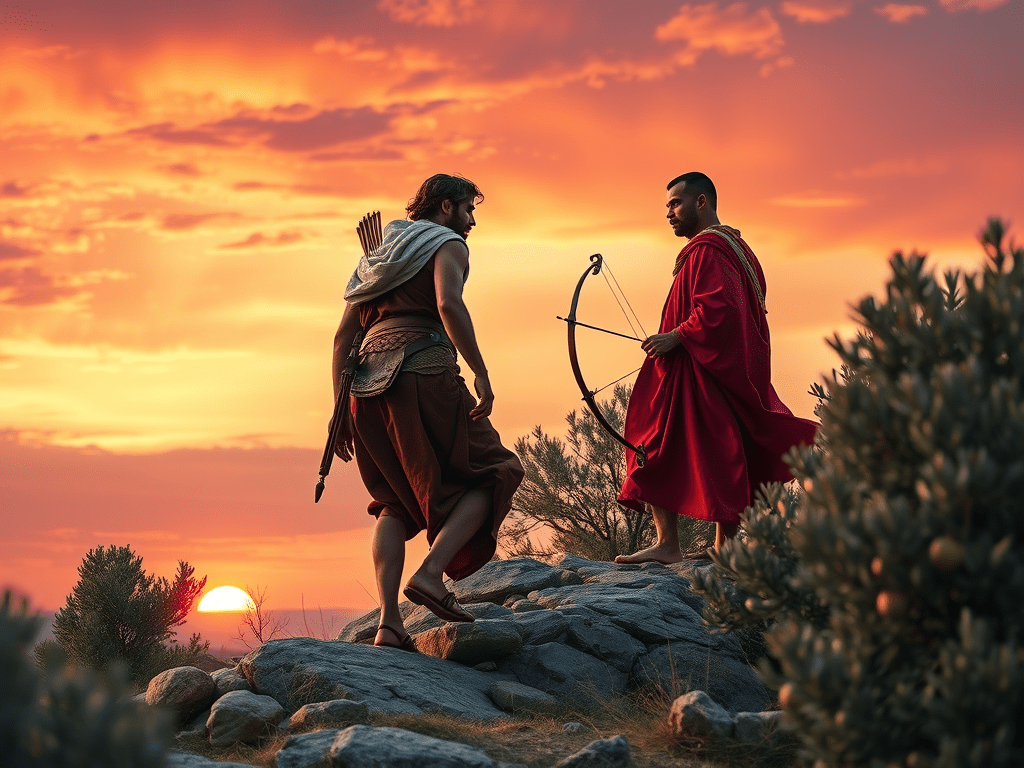
    The sun dipped below the hills of Gibeah, painting the sky in hues of crimson and gold. David, the shepherd-turned-warrior, climbed the rocky path toward the king’s encampment, his sling swaying at his side, a leather pouch slung over his shoulder. He’d been summoned again to play his harp for King Saul, whose spirit grew ever more restless. The echoes of his victory over Goliath still rang through Israel, a triumph that brought both praise and peril.

    At the hill’s crest, Jonathan, son of Saul, waited. His bow rested in his hand, his quiver slung across his back, and his dark eyes tracked David’s approach. His crimson tunic fluttered faintly in the breeze, simple yet regal, its edges catching the dying light. A faint smile curved his lips as David drew near.

    “You’re late,” Jonathan said, his tone light.

    David wiped sweat from his brow, grinning. “The sheep don’t heed royal commands. I had to pen them first.”

    Jonathan laughed softly, stepping forward to clasp David’s arm. “My father’s mood darkens hourly. Your music’s the only balm he knows.”

    David’s smile faded. “I’ll play, but I feel his gaze—like a wolf sizing up its prey.”

    Jonathan’s eyes flickered to the horizon. “He hears the songs. ‘Saul has slain his thousands, and David his ten thousands.’ It festers in him.”

    They walked toward the camp, the bond between them unspoken but palpable. They’d met weeks before, when David felled Goliath with a single stone, and Jonathan had watched, awestruck, as the shepherd claimed victory for Israel. In that moment, something kindled in Jonathan—a pull beyond rivalry. David was no ordinary man, and Jonathan, though heir to the throne, felt their souls tethered by a force divine.

    That night, in the dim glow of oil lamps, David sat before Saul, his fingers coaxing a melody from his harp. The king lounged on a cushion, his face haggard, his eyes shadowed. The music wove through the tent, a thread of peace battling the unseen torment gripping Saul’s mind. Jonathan lingered near the entrance, arms crossed, the scent of olive oil and dust thick in the air, watching his father’s tension ease, if only briefly.

    When the last note faded, Saul grunted a curt thanks and dismissed David with a wave. The shepherd bowed and slipped into the night. Jonathan followed, catching him near a grove of olive trees, their gnarled branches whispering in the breeze.

    “You’ve a gift,” Jonathan said, his voice hushed. “Not just with strings, but with souls. Even my father feels it.”

    David glanced at him, moonlight glinting in his eyes. “I seek only God’s favor, not man’s. But I’m glad to serve.”

    Jonathan nodded toward a path winding away from the camp. “Come with me.”

    They walked in silence, the camp’s clamor fading. Stars blazed overhead, a vast tapestry of light, and they stopped by a shallow stream, its waters shimmering like molten silver, the air tinged with pine and damp earth. Jonathan turned to David, his expression grave yet warm.

    “I’ve been thinking,” he began, hesitating. “About you. About Goliath. It wasn’t just skill or chance. The Lord stood with you.”

    David nodded. “He’s guided me since I was a boy, guarding my father’s flocks. Lions, bears—I’ve faced them. But that day… it was His hand.”

    Jonathan stepped closer, his voice dropping. “I’ve fought Philistines too, David. I’ve trusted the Lord to guide my bow. But you—you’re chosen. I see it. The people see it. And my father… he fears it.”

    David shifted, kicking a stone into the stream. “I’m no threat to him, Jonathan. I’m a shepherd, not a king.”

    “Not yet,” Jonathan murmured, the words heavy with portent.

    David met his gaze, searching for envy or doubt, but found only trust. Jonathan drew a small dagger from his belt, its blade catching the starlight. “I want you to know something. Whatever comes—whatever my father does—I stand with you. My heart is yours, as a brother’s.”

    David’s breath hitched. He had known loyalty, but this ran deeper, unyielding. “And mine is yours,” he said, his voice firm despite the swell of emotion.

    Jonathan held out the dagger. “Then let’s seal it—not with words alone, but with blood. A covenant before God.”

    David’s eyes widened, but he nodded. Such oaths were rare, sacred—binding beyond death. Jonathan pressed the blade to his palm, wincing as it bit into his flesh. Blood welled, dark and glistening, and he handed the dagger to David. The shepherd took it, mirroring the act, his hand trembling only slightly as the steel parted his skin.

    They clasped hands, blood mingling warm and wet between their palms. The pain was sharp, but it faded beneath the weight of their vow. “The Lord be between us,” Jonathan whispered, his grip tightening.

    “And between our houses forever,” David finished, his voice steady.

    Jonathan shed his crimson tunic, draping it over David’s shoulders, its fabric soft yet heavy with meaning. “Wear this,” he said. “Let it mark our bond.” David accepted it, the warmth a shield against the night’s chill. They stood there, hands locked, the stream murmuring beside them, their covenant sealed—blood and bond, a promise etched in flesh and spirit.

    Months passed, and Saul’s jealousy festered into madness. David’s victories swelled his fame, and the king’s heart turned black with envy. One evening, as David played his harp, Saul’s hand darted to a spear leaning nearby. Jonathan saw the glint of intent too late. The weapon flew, pinning David’s tunic to the tent wall as he dodged.

    “Father!” Jonathan cried, stepping forward, but Saul’s face twisted with rage.

    “Out!” the king bellowed, and David fled into the darkness, the crimson tunic trailing behind him.

    Jonathan found him later, hidden beneath a rocky overhang miles from Gibeah. David’s face was streaked with dirt, his eyes wide with betrayal, the tunic frayed at the hem from his flight.

    “He tried to kill me,” David said, his voice hollow.

    Jonathan knelt beside him, gripping his shoulder. “I know. His spirit’s warped—by fear, by something evil.” From his belt, he unslung David’s harp, scratched but whole, recovered from the tent. “I brought this. Keep it close.”

    David took it, fingers brushing the strings, a faint note rising into the night. “You risk too much.”

    “Nor will I let him take you,” Jonathan swore. “We need a plan.”

    They devised a signal under the stars: Jonathan would test Saul’s intent and warn David with arrows. Three shot beyond a stone would mean danger; one short of it, safety. Their scarred hands clasped again, the faint sting a reminder of their oath.

    David slipped deeper into the hills that night, the tunic his cloak, the harp slung across his back. Near a jagged slope, he lit a small decoy fire, sending it tumbling down with a push of stones, then vanished into the shadows as Saul’s scouts chased the glow.

    At the new moon festival, David hid near the stone Ezel, watching as Jonathan entered Saul’s tent. The prince sat at the king’s table, his pulse racing as he spoke of David’s absence.

    “He went to Bethlehem, to his family,” Jonathan said, feigning calm, his cloak hiding the dust of a dawn ride past Abner’s patrol to reach David earlier.

    Saul’s eyes narrowed, his grip tightening on a goblet. “You cover for him! That son of Jesse—he’ll steal my throne!”

    Jonathan’s gut churned, but he pressed on. “He’s loyal, Father. He fights for you.”

    Saul hurled the goblet, wine splashing across Jonathan’s chest. “You’d give your birthright to that shepherd?”

    The words pierced, but Jonathan stood tall. “I’d give it to God’s chosen.”

    Saul’s fury exploded, and he grabbed his spear. Jonathan dodged and ran, snatching his bow and quiver as he fled into the night. He reached the field at dawn, a boy in tow as a ruse, and nocked an arrow. David watched from his hiding place as the first arrow soared past the stone. Then the second. Then the third.

    Danger.

    Jonathan shouted to the boy, “Fetch the arrows!” As the lad ran off, he darted to David. “He wants you dead,” he whispered. “Go—into the hills, the caves. I’ll shield you as long as I can.”

    David’s eyes shimmered. “You shouldn’t have come. Abner—”

    “Guesses nothing,” Jonathan cut in. “I told him I scouted game.” He unslung his bow, its wood worn smooth from battles, and pressed it into David’s hands. “Take this too. It’s been with me in every fight. Let it remind you of me.”

    David gripped it, the curve fitting his palm. “I’ll carry it always.”

    They wept, their scarred hands pressed together, blood long dried but the bond unbroken. “The Lord be between us,” Jonathan murmured.

    “And our houses forever,” David replied.

    They parted—Jonathan to the boy, David to the wilderness, the bow over one shoulder, the harp over the other, the crimson tunic a fading banner.

    (Continued in Part 2 tomorrow)
  • Something Solid (chapter)

    Something Solid (chapter)

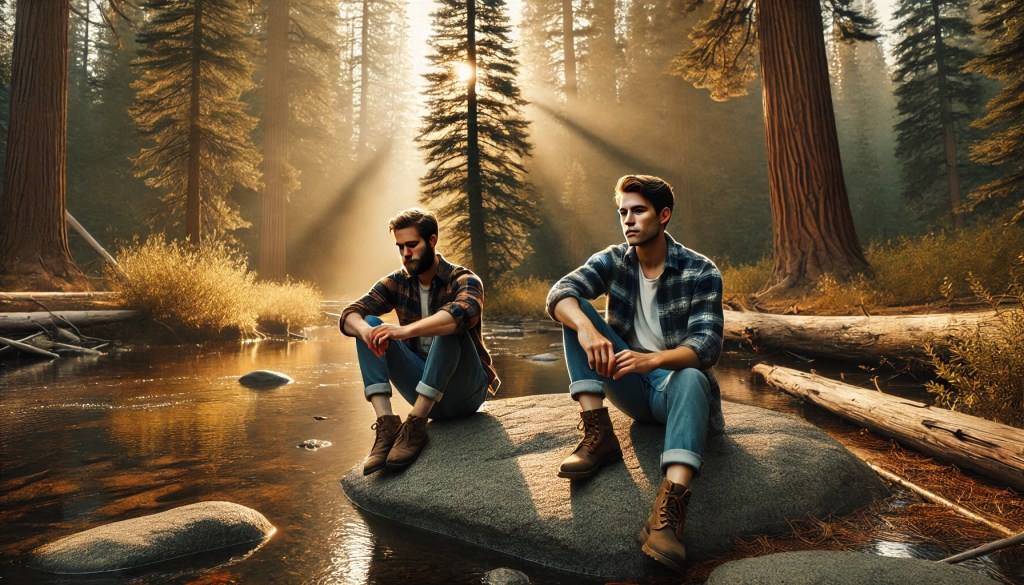
    The creek behind Ted’s property ran quiet that afternoon, low from a dry spell but steady all the same. Tyler crouched at the bank, skipping rocks like he used to as a kid, boots half-dusty, half-muddied. The air smelled of pine and old leaves, warm with a hint of coming fall.

    Clyde sat nearby on a flat boulder, arms resting on his knees, watching the ripples Tyler’s throws left behind.

    Neither had said much for a while.

    Ted had invited them both out—“just a fire and some quiet,” he’d said—but he’d ducked inside to check on supper and left the two of them alone not long after. Maybe on purpose.

    Tyler stood, brushing his hands off on his jeans. “Don’t know why, but this place always slows my brain down.”

    Clyde gave a small grunt of agreement. “Somethin’ about water and woods. Strips the noise off.”

    Tyler looked over at him. “You ever think maybe God designed it that way? Like… made these places to help us remember what matters?”

    Clyde shifted, his gaze on the water. “Reckon He did. World’s loud. We make it louder.” A pause. “Truth don’t shout much.”

    Tyler chuckled, quiet. “Nah. It doesn’t.”

    He walked over and sat down next to Clyde on the rock. Their shoulders didn’t touch, but they didn’t need to. The closeness wasn’t forced—it just was.

    “I’ve been thinkin’,” Tyler said after a minute, “about what you said last week. About prayin’ honest.”

    Clyde didn’t look over, but his brow lifted slightly.

    Tyler kept going. “I started tryin’. Not just talkin’ to God, but tellin’ Him stuff I’d never even admitted to myself.” He let out a breath. “Thought He might be mad. But it’s weird… it’s like He already knew. Like He was waitin’ on me to say it just so I could hear it too.”

    Clyde nodded slow. “He’s good like that.”

    Tyler glanced down at the water. “That book you gave me… it didn’t fix me.” He paused. “But it started somethin’.”

    Clyde nodded, voice quiet. “That’s all I hoped for.”

    They sat quiet again, a hawk crying faint somewhere overhead.

    “I don’t really know what this is,” Tyler said, glancing at Clyde. “Us. This… whatever we’re buildin’. But I know it ain’t shallow.”

    Clyde’s jaw worked a bit, like he was chewing on the words. Then he said, “Don’t gotta name it to know it’s real.”

    Tyler nodded. “I don’t feel like I gotta prove anything around you. That’s new.”

    Clyde’s voice was low, steady. “I don’t feel like I gotta hide.”

    The words landed like a stone sinking slow into deep water.

    Tyler looked away, blinked a few times. “I used to think I needed somebody to complete me. Like there was this hole that only another guy could fill. And I chased that. Thought it was love. But now…” He trailed off, shook his head. “Reckon I just needed a brother who’d stay.”

    Clyde glanced at him then—just a flicker—and the corner of his mouth tugged up slightly.

    “Sounds about right.”

    They sat there, side by side, while the sun shifted through the trees and the creek rolled on.

    Ted’s screen door creaked open behind them. “Food’s up,” he called.

    Clyde stood, offered Tyler a hand. Tyler took it without hesitation, letting Clyde pull him up. Their grip lingered a beat—firm, steady.

    “Come on,” Clyde said. “Let’s eat.”They walked toward the cabin—not side by side, but close enough.
    More than nothing.
    Solid enough to hold.

    (Chapter from Solid Enough To Hold in the Tyler and Clyde series. Contact me if you’d like to read the full story.)

  • Amos and Jonah (Part 1)

    Amos and Jonah (Part 1)

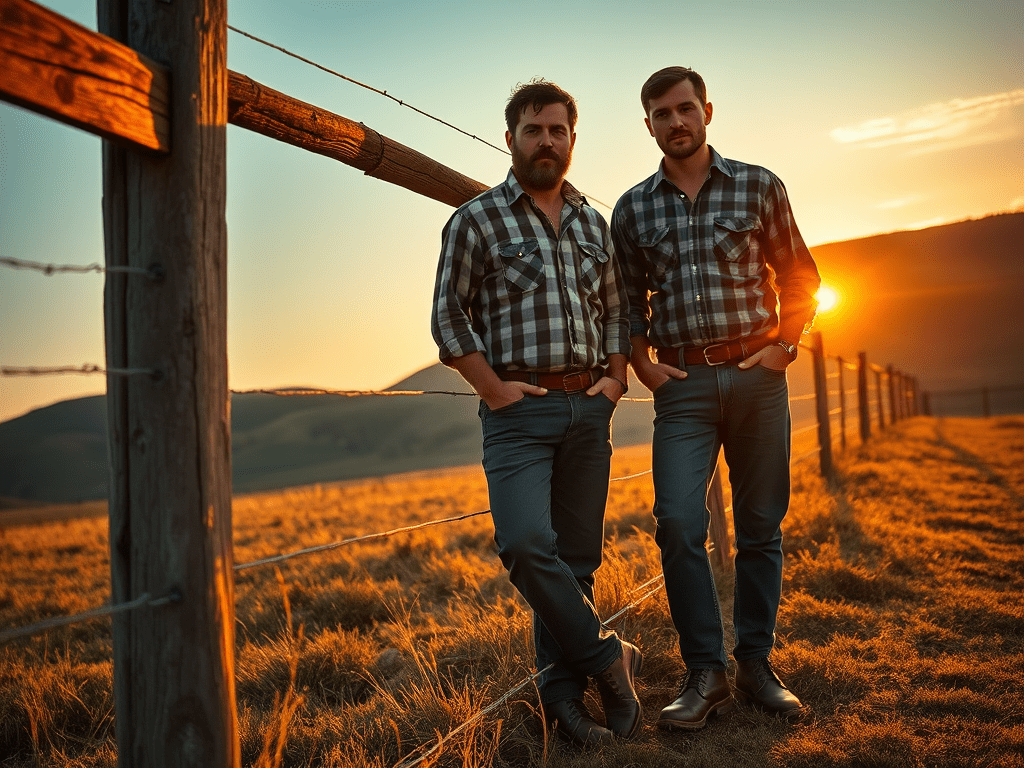
    The sun was dipping low over the rolling fields of eastern Kentucky, painting the sky with streaks of orange and violet. The air carried the earthy scent of freshly turned soil and the faint sweetness of clover. Two men stood at the edge of a weathered wooden fence, their boots caked with the red clay of the land they’d worked since dawn. Amos, broad-shouldered and sun-burned, leaned against a post, his calloused hands resting on the splintered wood. Beside him stood Jonah, leaner, with sharp cheekbones and eyes like the still waters of a pond at dusk. They were quiet for a moment, watching the last of the cattle amble toward the barn, their breaths visible in the cooling air.

    Amos broke the silence, his voice low and gravelly. “Good day’s work. Reckon the Lord’s pleased with hands that don’t idle.”

    Jonah nodded, pulling off his battered hat and running a hand through his sweat-damp hair. “Aye. Keeps the mind steady too. Idle hands, idle thoughts—ain’t no good comes from that.”

    They’d been working this land together for nigh on five years now, ever since Jonah had shown up at Amos’s doorstep, a drifter with a Bible tucked under his arm and a hunger for purpose. Amos had been alone then, his folks long gone, the farm too big for one man. Something about Jonah—his quiet strength, his unshakable faith—had made Amos offer him a place to stay. And stay he did. They’d built a life here, side by side, tilling the earth, raising livestock, and praying under the same roof each night.

    But there was something else too, something unspoken that lingered in the spaces between their words and glances. It had started small—a brush of hands when passing a tool, a lingering look across the supper table, the way Jonah’s laugh sent a warmth through Amos’s chest he couldn’t quite name. And for Jonah, it was Amos’s steady presence, the way he’d rest a hand on Jonah’s shoulder after a long day, firm and grounding, that stirred something deep within him. They both felt it, this pull, this ache. And they both knew it wasn’t simple.

    That night, after supper, they sat by the hearth in the small farmhouse. The fire crackled, casting shadows on the rough-hewn walls. Jonah had his Bible open on his lap, reading aloud from Proverbs, his voice steady and sure. Amos listened, whittling a piece of cedar with his pocketknife, the scent of the wood mixing with the smoke. When Jonah finished, he closed the book and set it aside, his eyes drifting to Amos.

    “You ever think about it?” Jonah asked, his tone careful, like he was stepping onto thin ice.

    Amos’s knife paused mid-stroke. He didn’t look up. “Think about what?”

    Jonah shifted in his chair, the floorboards creaking beneath him. “You know what I mean. Us. This… thing we don’t talk about.”

    The room went still, save for the pop of a log in the fire. Amos set the cedar and knife down on the table beside him, his hands resting on his knees. He met Jonah’s gaze, and there it was—the weight of it, the truth they’d both been circling like hawks over a field.

    “Yeah,” Amos said finally, his voice rough. “I think about it. More’n I should, maybe.”

    Jonah leaned forward, elbows on his knees, his fingers lacing together. “Me too. Ain’t easy, is it? Feelin’ somethin’ strong as this and knowin’ it don’t fit the way we’re meant to walk.”

    Amos nodded slow, his jaw tight. “Scripture’s clear. God’s design—it’s man and wife, family, fruitful land. Ain’t no room in that for… whatever this is.”

    “But it’s real,” Jonah said, his voice barely above a whisper. “I feel it when you’re near me, Amos. Like my soul’s tethered to yours. Ain’t lust, not all of it. It’s deeper. Like you’re kin, but more.”

    Amos stood abruptly, pacing to the window. He stared out at the dark fields, his broad frame silhouetted against the glass. “I know it,” he said, his back to Jonah. “I feel it too. Reckon I’d die for you, Jonah.”

    (Continued in Part 2)

  • Flesh and Bone: The Bond that Holds

    Flesh and Bone: The Bond that Holds

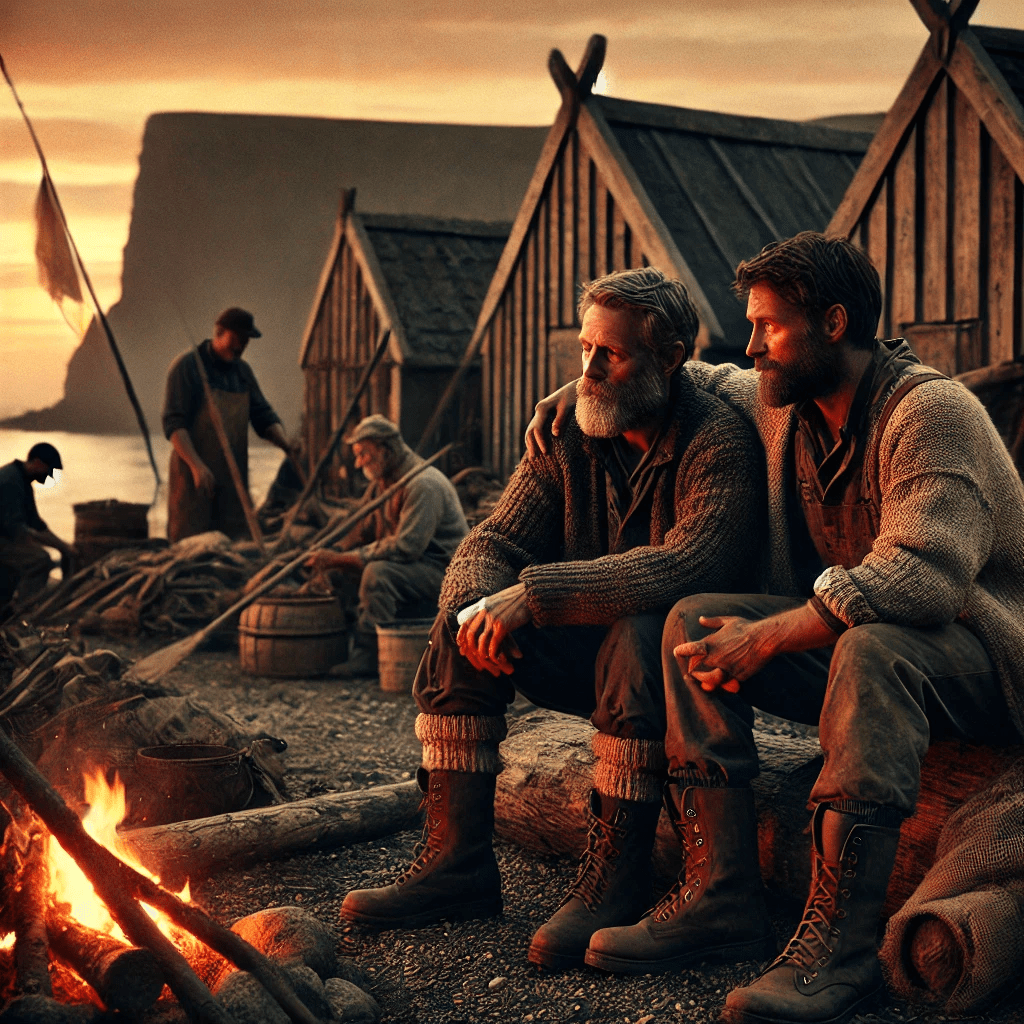
    The wind howled across the cliffs of Dunmoor, dragging salt and spray inland, where a village called Hearthglen clung to the land like a memory. Long before the world grew sharp and distant, the men of Hearthglen lived close—close to the earth, close to each other. They worked the fields and fished the sea, and when the day was done, they sat shoulder to shoulder by the fire, letting touch speak what words didn’t need to.

    Back then, no one questioned it. A hand on the back said, “I’m with you.” A grip on the arm meant, “We’re still standing.” Touch was strength shared, not stolen. The old elder Eamon called it God’s design: “He made us flesh and bone, lads—not just to toil, but to hold.”

    Torin and Calum weren’t brothers by blood, but they might as well have been. One loud, one quiet. One broad and brawny, the other lean and sharp-eyed. They moved through life like two halves of a single soul—until the world changed.

    Traders came with polished steel and slippery words. They sold more than goods; they sold a new idea of manhood: self-made, self-reliant, untouched. And slowly, the village followed. Arms that once held now hung at men’s sides. Brothers became rivals. Words replaced presence. The fire grew cold.

    Then the storm came.

    It tore through Hearthglen, ripping roofs, shattering boats, and leaving silence in its wake. Torin and Calum stood yards apart, working through the wreckage, silent, stiff, the space between them colder than the wind. And it was Eamon, bent and half-frozen, who limped into the heart of it all and shouted what everyone knew but had forgotten: “God gave us hands to hold—not just to hoard.”

    And when a boy named Finn—thin, trembling, alone—stepped into the square asking for help, no one moved… until Eamon did. He wrapped that boy in his frail arms and broke something open.

    Torin stepped toward Calum.

    “Brother,” he said—rough, unsure—and placed a hand on his shoulder.

    Calum flinched… then reached up and gripped Torin’s arm.

    And that was the spark.

    One by one, men followed. An embrace here, a clasp of arms there. Walls crumbled. Eyes softened. Voices rose. It wasn’t polished—it was raw, clumsy, honest. It was holy.

    They rebuilt the village, yes. But more than that, they rebuilt the bond. Shoulder to shoulder. Hand to back. Forehead to forehead in prayer. Touch, reclaimed. Pure. God-honoring.

    The traders came again, puzzled at what they found: not lonely men chasing coin, but a tribe forged in shared strength. They left, muttering. Hearthglen didn’t blink.

    Years passed. Eamon died, buried beneath the cliffs. They carved his words into stone:

    “Flesh and bone—meant to hold fast.”

    And they did.

    Men lingered after the work was done—not to compete, but to stay close. They taught the boys how to fish, how to plant, how to press a hand to a brother’s back when the weight got heavy. They didn’t call it covenant. They didn’t need to. It was carved in the way they leaned into each other. It was how God made them.

    Not just to stand tall.

    But to stand tall together.

  • Reflections of a Brother

    The water is still, reflecting the sky in endless hues of blue and gold. It cradles them, warm and living, flowing around their bodies like the breath of God Himself. Sunlight dances across the rippling surface, tracing golden lines over their bare skin, highlighting strength, form, and the undeniable reality of their shared manhood.

    Lior stands chest-deep in the water, facing Dain. The older man regards him with quiet intensity—not as a teacher measuring a student’s progress, but as a brother standing before an equal. The air between them hums with something unspoken, something weighty yet effortless, as natural as the rise and fall of their breath.

    For a long moment, neither speaks. They simply look—taking in the shape of the other, the lines of muscle honed by labor and trial, the subtle marks of experience that tell the story of their lives. There is nothing hidden, nothing obscured. Here, in the water, in the presence of the One who formed them, they are wholly seen and wholly known.

    Lior is the first to break the silence. “I see it now,” he says, his voice soft yet certain.

    Dain tilts his head, waiting.

    Lior’s eyes do not waver. “I see myself in you. And I see you in me.”

    Dain’s expression does not change, but something deepens in his gaze—pride, understanding, something beyond words.

    “This bond,” Lior continues, voice steady, “it’s not just about learning or growing. It’s about knowing. Knowing who we are. Knowing who God made us to be.” His lips twitch with the hint of a smile. “I thought I was just becoming a man. But I’ve come to see—I was made for brotherhood just as much as for strength.”

    Dain exhales, slow and full, as if hearing words he has long known but never spoken aloud.

    “You understand,” he says. It is not a question.

    Lior nods. “I do.”

    Dain steps forward, and Lior mirrors him instinctively. They meet in the center of the water, standing close enough that their reflections blend together in the shifting surface. Dain places a firm hand on Lior’s shoulder, the touch carrying both weight and warmth.

    “You are a man,” Dain says, his voice low and full of certainty. “You are my brother.”

    Lior lifts his own hand, mirroring the gesture, his grip strong, sure. “And you are mine.”

    The water ripples outward from them, as if the world itself acknowledges what has been spoken. The sky above is vast, the land around them unshaken. But in this moment, it is the reflection in the water that holds the greatest truth—two men, two lives, bound in purpose, in strength, in the love that God Himself has woven into the heart of their covenant.

    They linger a moment longer, their hands remaining where they are—two lives mirrored, two hearts beating as one. Then, with silent agreement, they lower their arms and turn toward the shore.

    The journey is not over. But when they leave the water, they do so as men who have seen and been seen—who have beheld their own reflection in the eyes of a brother and found something sacred there.

    (Chapter from the Unfallen Earth fantasy series. Contact me if you’d like to read the full story or series.)

  • Still Here

    Still Here

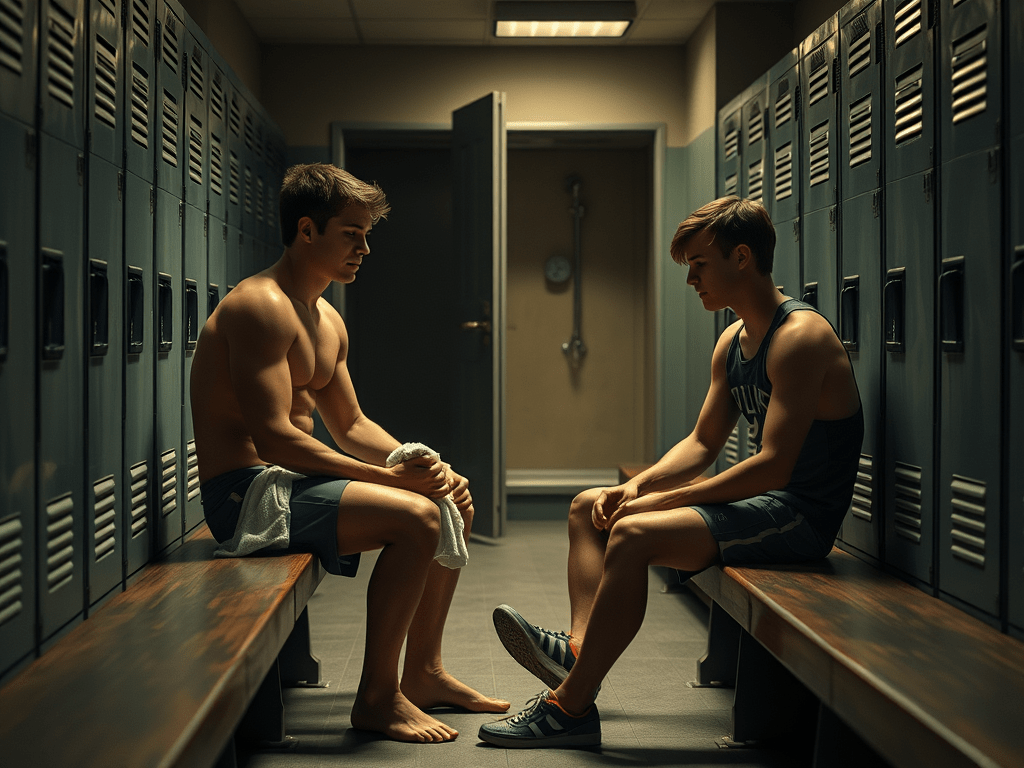
    The locker room wasn’t busy—just a handful of guys finishing their workouts, grabbing showers, heading out. Nothing out of the ordinary.

    Eli pulled off his shirt, grabbed his towel, and turned toward the showers. That’s when he noticed James—still in his gym clothes, sitting on the bench, tying and retying his shoe like he had nowhere to be.

    Something in Eli told him to wait.

    He sat down across from him, stretching out his legs. “You hitting the showers?”

    James glanced up, shrugged. “Might just rinse off at home.”

    Eli nodded, pretending not to notice the hesitation. He’d seen this before. A guy trying to decide if it was okay to just be a guy.

    The showers here were open—an old-school setup that hadn’t been remodeled like most places. Nothing weird about it. At least, there shouldn’t have been. But these days? It was different.

    Eli leaned back against the lockers. “You ever play sports?”

    James shook his head. “Nah. Never really into that scene.”

    Eli smirked. “Yeah, me neither. But I grew up around guys who were. And you know what I remember? They didn’t think twice about this kind of thing.” He gestured toward the showers. “Back then, no one was worried about being seen. It was just part of life.”

    James chuckled, rubbing the back of his neck. “Yeah… guess I never really thought about it.”

    But Eli could tell—he had thought about it.

    “I get it,” Eli said. “Somewhere along the way, we lost something. Got told to be careful, got trained to keep space between us. And now? Guys don’t even know what they’re missing.”

    James looked up. “What do you mean?”

    Eli exhaled, thinking. “Man, it’s hard to explain. It’s not about the showers. It’s about how normal it used to be—being unguarded around each other, not second-guessing every move.

    There was a kind of joy in it—the ease of just being, the trust that no one was watching, judging, or measuring. You don’t even realize how much you took it for granted… until it’s gone.”

    James nodded, quiet for a moment. “Yeah… I guess I do feel that. Like, I don’t even know why it feels weird. It just does.”

    Eli gave him a half-smile. “Yeah. But you know what? It doesn’t have to.”

    He stood up, grabbed his towel, and nodded toward the showers. “Still here, man. Ain’t going anywhere.”

    James hesitated, then smirked. “Yeah… guess I could use a rinse.”

    Eli clapped his shoulder, and together, they walked toward what had always been normal—what was still normal, underneath all the noise.

    Some things get lost.

    But not everything stays lost forever.