Tag: God

  • Crimson Vow (Part 1)

    Crimson Vow (Part 1)

    The sun dipped below the hills of Gibeah, painting the sky in hues of crimson and gold. David, the shepherd-turned-warrior, climbed the rocky path toward the king’s encampment, his sling swaying at his side, a leather pouch slung over his shoulder. He’d been summoned again to play his harp for King Saul, whose spirit grew ever more restless. The echoes of his victory over Goliath still rang through Israel, a triumph that brought both praise and peril.

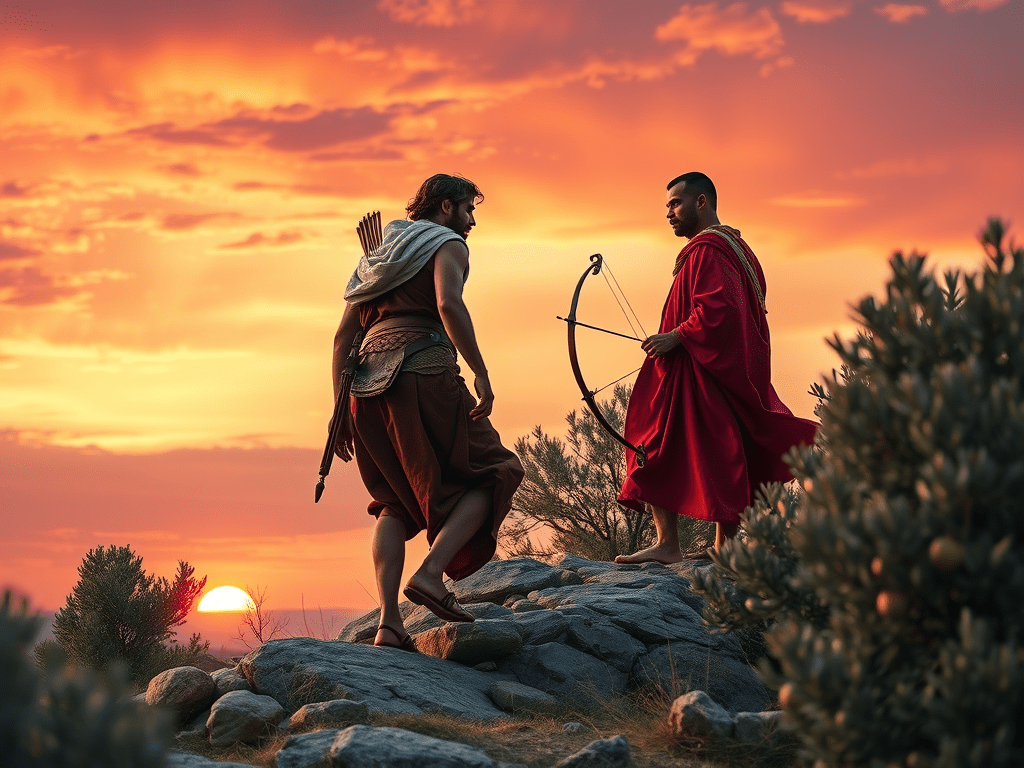
    At the hill’s crest, Jonathan, son of Saul, waited. His bow rested in his hand, his quiver slung across his back, and his dark eyes tracked David’s approach. His crimson tunic fluttered faintly in the breeze, simple yet regal, its edges catching the dying light. A faint smile curved his lips as David drew near.

    “You’re late,” Jonathan said, his tone light.

    David wiped sweat from his brow, grinning. “The sheep don’t heed royal commands. I had to pen them first.”

    Jonathan laughed softly, stepping forward to clasp David’s arm. “My father’s mood darkens hourly. Your music’s the only balm he knows.”

    David’s smile faded. “I’ll play, but I feel his gaze—like a wolf sizing up its prey.”

    Jonathan’s eyes flickered to the horizon. “He hears the songs. ‘Saul has slain his thousands, and David his ten thousands.’ It festers in him.”

    They walked toward the camp, the bond between them unspoken but palpable. They’d met weeks before, when David felled Goliath with a single stone, and Jonathan had watched, awestruck, as the shepherd claimed victory for Israel. In that moment, something kindled in Jonathan—a pull beyond rivalry. David was no ordinary man, and Jonathan, though heir to the throne, felt their souls tethered by a force divine.

    That night, in the dim glow of oil lamps, David sat before Saul, his fingers coaxing a melody from his harp. The king lounged on a cushion, his face haggard, his eyes shadowed. The music wove through the tent, a thread of peace battling the unseen torment gripping Saul’s mind. Jonathan lingered near the entrance, arms crossed, the scent of olive oil and dust thick in the air, watching his father’s tension ease, if only briefly.

    When the last note faded, Saul grunted a curt thanks and dismissed David with a wave. The shepherd bowed and slipped into the night. Jonathan followed, catching him near a grove of olive trees, their gnarled branches whispering in the breeze.

    “You’ve a gift,” Jonathan said, his voice hushed. “Not just with strings, but with souls. Even my father feels it.”

    David glanced at him, moonlight glinting in his eyes. “I seek only God’s favor, not man’s. But I’m glad to serve.”

    Jonathan nodded toward a path winding away from the camp. “Come with me.”

    They walked in silence, the camp’s clamor fading. Stars blazed overhead, a vast tapestry of light, and they stopped by a shallow stream, its waters shimmering like molten silver, the air tinged with pine and damp earth. Jonathan turned to David, his expression grave yet warm.

    “I’ve been thinking,” he began, hesitating. “About you. About Goliath. It wasn’t just skill or chance. The Lord stood with you.”

    David nodded. “He’s guided me since I was a boy, guarding my father’s flocks. Lions, bears—I’ve faced them. But that day… it was His hand.”

    Jonathan stepped closer, his voice dropping. “I’ve fought Philistines too, David. I’ve trusted the Lord to guide my bow. But you—you’re chosen. I see it. The people see it. And my father… he fears it.”

    David shifted, kicking a stone into the stream. “I’m no threat to him, Jonathan. I’m a shepherd, not a king.”

    “Not yet,” Jonathan murmured, the words heavy with portent.

    David met his gaze, searching for envy or doubt, but found only trust. Jonathan drew a small dagger from his belt, its blade catching the starlight. “I want you to know something. Whatever comes—whatever my father does—I stand with you. My heart is yours, as a brother’s.”

    David’s breath hitched. He had known loyalty, but this ran deeper, unyielding. “And mine is yours,” he said, his voice firm despite the swell of emotion.

    Jonathan held out the dagger. “Then let’s seal it—not with words alone, but with blood. A covenant before God.”

    David’s eyes widened, but he nodded. Such oaths were rare, sacred—binding beyond death. Jonathan pressed the blade to his palm, wincing as it bit into his flesh. Blood welled, dark and glistening, and he handed the dagger to David. The shepherd took it, mirroring the act, his hand trembling only slightly as the steel parted his skin.

    They clasped hands, blood mingling warm and wet between their palms. The pain was sharp, but it faded beneath the weight of their vow. “The Lord be between us,” Jonathan whispered, his grip tightening.

    “And between our houses forever,” David finished, his voice steady.

    Jonathan shed his crimson tunic, draping it over David’s shoulders, its fabric soft yet heavy with meaning. “Wear this,” he said. “Let it mark our bond.” David accepted it, the warmth a shield against the night’s chill. They stood there, hands locked, the stream murmuring beside them, their covenant sealed—blood and bond, a promise etched in flesh and spirit.

    Months passed, and Saul’s jealousy festered into madness. David’s victories swelled his fame, and the king’s heart turned black with envy. One evening, as David played his harp, Saul’s hand darted to a spear leaning nearby. Jonathan saw the glint of intent too late. The weapon flew, pinning David’s tunic to the tent wall as he dodged.

    “Father!” Jonathan cried, stepping forward, but Saul’s face twisted with rage.

    “Out!” the king bellowed, and David fled into the darkness, the crimson tunic trailing behind him.

    Jonathan found him later, hidden beneath a rocky overhang miles from Gibeah. David’s face was streaked with dirt, his eyes wide with betrayal, the tunic frayed at the hem from his flight.

    “He tried to kill me,” David said, his voice hollow.

    Jonathan knelt beside him, gripping his shoulder. “I know. His spirit’s warped—by fear, by something evil.” From his belt, he unslung David’s harp, scratched but whole, recovered from the tent. “I brought this. Keep it close.”

    David took it, fingers brushing the strings, a faint note rising into the night. “You risk too much.”

    “Nor will I let him take you,” Jonathan swore. “We need a plan.”

    They devised a signal under the stars: Jonathan would test Saul’s intent and warn David with arrows. Three shot beyond a stone would mean danger; one short of it, safety. Their scarred hands clasped again, the faint sting a reminder of their oath.

    David slipped deeper into the hills that night, the tunic his cloak, the harp slung across his back. Near a jagged slope, he lit a small decoy fire, sending it tumbling down with a push of stones, then vanished into the shadows as Saul’s scouts chased the glow.

    At the new moon festival, David hid near the stone Ezel, watching as Jonathan entered Saul’s tent. The prince sat at the king’s table, his pulse racing as he spoke of David’s absence.

    “He went to Bethlehem, to his family,” Jonathan said, feigning calm, his cloak hiding the dust of a dawn ride past Abner’s patrol to reach David earlier.

    Saul’s eyes narrowed, his grip tightening on a goblet. “You cover for him! That son of Jesse—he’ll steal my throne!”

    Jonathan’s gut churned, but he pressed on. “He’s loyal, Father. He fights for you.”

    Saul hurled the goblet, wine splashing across Jonathan’s chest. “You’d give your birthright to that shepherd?”

    The words pierced, but Jonathan stood tall. “I’d give it to God’s chosen.”

    Saul’s fury exploded, and he grabbed his spear. Jonathan dodged and ran, snatching his bow and quiver as he fled into the night. He reached the field at dawn, a boy in tow as a ruse, and nocked an arrow. David watched from his hiding place as the first arrow soared past the stone. Then the second. Then the third.

    Danger.

    Jonathan shouted to the boy, “Fetch the arrows!” As the lad ran off, he darted to David. “He wants you dead,” he whispered. “Go—into the hills, the caves. I’ll shield you as long as I can.”

    David’s eyes shimmered. “You shouldn’t have come. Abner—”

    “Guesses nothing,” Jonathan cut in. “I told him I scouted game.” He unslung his bow, its wood worn smooth from battles, and pressed it into David’s hands. “Take this too. It’s been with me in every fight. Let it remind you of me.”

    David gripped it, the curve fitting his palm. “I’ll carry it always.”

    They wept, their scarred hands pressed together, blood long dried but the bond unbroken. “The Lord be between us,” Jonathan murmured.

    “And our houses forever,” David replied.

    They parted—Jonathan to the boy, David to the wilderness, the bow over one shoulder, the harp over the other, the crimson tunic a fading banner.

    (Continued in Part 2 tomorrow)

  • Understanding the Deep Ache for Brotherhood

    Understanding the Deep Ache for Brotherhood

    Let’s talk about the ache.

    It’s not loud. It doesn’t usually show up in small groups or sermons. But it’s there—sitting behind the ribcage like something unfinished. The longing for a brother—not just a buddy, but someone who sees you. Someone who knows your wiring, your story, and doesn’t flinch. A man you could walk with in honesty and depth, and never feel like too much.

    I know that ache well. Seems like the more “connected” we become via the Internet, social media, Zoom calls, etc., the less truly connected, in the day to day sense, we can be.

    I’ve got brothers I can talk to—guys I can reach out to when it gets hard. Some of them know the deepest parts of my story. But none of them live close by. None I can really do life with day in and day out. That kind of shoulder-to-shoulder bond—the one you can lean on without explaining it every time—it’s not here right now. And I feel that absence.

    So this post? It’s not just for you. It’s for me too.

    Because this ache, this deep desire for covenant brotherhood, isn’t some fringe longing. It’s not about being needy or codependent. It’s part of God’s design. We were made for this kind of connection. Jesus had it. David and Jonathan had it. It’s the kind of friendship that’s forged, not found. It’s rooted in Christ, sharpened by time, and held together by grace.

    But what if you don’t have it?

    That’s where a lot of us live. In the in-between. Wanting it so deeply it hurts, but not knowing how to find it—or what to do with ourselves while we wait.

    And in that waiting, a lot can stir.

    Old habits. Old fantasies. I’ve found myself drawn toward imagined scenarios—emotional, sometimes even erotic. Longings that twist just enough to offer the illusion of being seen, known, held.

    But it never lasts.

    It flares up, then fades. And afterward, the ache is sharper. The loneliness deeper. The illusion of closeness can never hold the weight of what I really need.

    Still, I understand why the pull is there. Because at its core, this longing isn’t wrong. It’s holy ground that’s been stepped on by the world, by the enemy, by the wounds of our past. The desire to be known, loved, and not alone—it mirrors the very heart of God.

    So what do we do with the ache when the brother hasn’t come?

    We bring it to Jesus.

    Not the polished version. The real one. The messy ache. The unmet need. The quiet grief of another day without that kind of companionship. We lay it down—again and again—at the only altar that can hold the weight of our longings.

    Jesus isn’t afraid of it. He’s not rolling His eyes. He knows this ache. He felt it too—misunderstood, unseen, carrying love that had nowhere to land.

    And He’s not telling us to pretend it’s fine. He’s inviting us to trust that He’s not wasting the waiting.

    See, this isn’t about giving up on brotherhood. It’s about surrendering the form we think it has to take. It’s letting Jesus be enough in the meantime. Because He’s doing something in us while we wait. Something sacred. Something strong.

    And I have to believe that the ache, when surrendered, becomes the very soil where brotherhood can take root.

    So I’m still praying. Still hoping. Still staying open. Saying yes to the small invitations—firepit gatherings, book studies, texts that open doors. Some of those don’t lead anywhere obvious. But some might. Even if they don’t, they keep my heart soft. And that matters.

    And in the waiting, I hold onto this: I’m not forgotten. You’re not forgotten. We’re not broken for wanting something Jesus Himself modeled.

    I don’t have all the answers. But I know this much: chasing fantasy won’t fill it. Neither will stuffing it down. The way forward is surrender. Not because the ache will vanish—but because in Christ, it doesn’t own you anymore.

    And if you’re feeling that ache today too—man, I’m with you.

    Let’s keep showing up. Keep trusting. Keep bringing our need to the only One who truly sees.

    He’s not going anywhere.

    And I don’t think He’ll leave us in this ache forever.

  • Amos and Jonah (Part 4)

    Amos and Jonah (Part 4)

    Years rolled on, and the farm flourished under their care, a testament to their labor and their faith. The townsfolk would talk—two bachelors living out there, thick as thieves, closer than brothers, working the land and praising the Lord with a fire few could match. They’d see Amos and Jonah at the market, bartering for seed or a new plow blade, their easy banter and shared glances a quiet marvel. Some whispered, wondering at the depth of it, but most just saw two men who’d found a rare thing—a bond forged in sweat and Scripture, unbreakable as the Kentucky hills.

    The years etched lines into their faces, turned Amos’s hair to silver and Jonah’s to a dusty gray, but the rhythm of their days held steady. They’d rise before dawn, coffee brewing on the old stove, and head out to tend the herd or mend a fence. The physical affection stayed—a constant thread woven into their lives, natural as breathing. A hand on the back after a hard day, a rough hug when the weight of the world pressed too heavy, a playful shove that’d spark a wrestle in the yard, their laughter ringing out across the fields.

    The hum lingered too, a quiet ember they’d long learned to tend without letting it flare. It was there in the way Jonah’s eyes would trace Amos’s broad frame as he split wood, or how Amos’s breath would catch when Jonah sang hymns in that low, steady tenor. But they’d made their choice, and it was a choice they renewed every day—with every prayer, every shared meal, every step they took side by side.

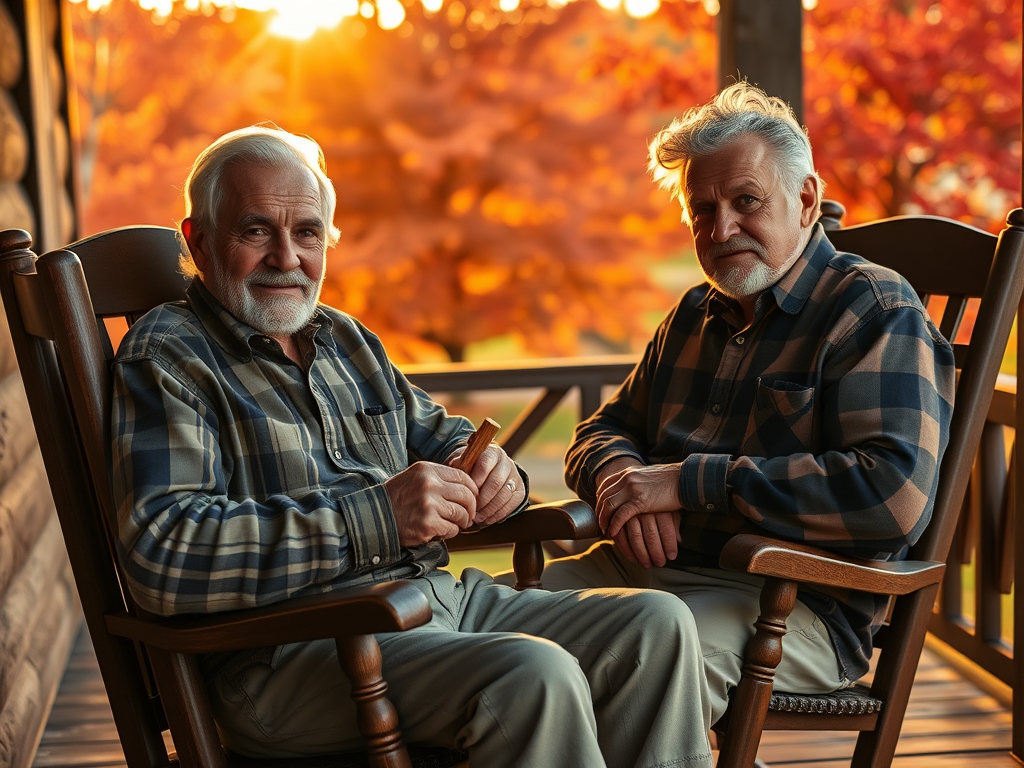
    One crisp autumn evening, as the maples blazed red and gold, they sat on the porch, rocking chairs creaking under their weight. The harvest was in, the barn stuffed with hay, and the air smelled of apples ripening on the tree out back. Jonah whittled now, a habit he’d picked up from Amos, shaping a small cross from a chunk of walnut. Amos leaned back, hands folded over his belly, watching the sun sink behind the ridge.

    “Reckon we’ve done alright, Jonah,” Amos said, his voice a deep rumble softened by time. “This life, this place. Him up there’s gotta be smilin’ down on it.”

    Jonah paused, the knife still in his hand, and looked over at Amos. The fire in his eyes hadn’t dimmed, not even after all these years. “More’n alright,” he said. “We took what He gave us—this pull, this whatever-it-is—and made it somethin’ good. Somethin’ holy, even.”

    Amos grunted, a sound that might’ve been agreement or just the comfort of hearing Jonah’s voice. “Ain’t been easy,” he said after a beat. “Times I wanted to give in, let it turn to somethin’ else. But you kept me straight. Iron sharpens iron, like you’re always quotin’.”

    Jonah grinned, setting the cross on the arm of his chair. “You did the same for me. Nights I’d lie awake, wonderin’ if we was fools to fight it. But then I’d hear you snorin’ through the wall, and I’d think, ‘Naw, that’s my brother. That’s my rock.’ And I’d pray for us both.”

    Amos turned his head, meeting Jonah’s gaze. There was a weight there, a tenderness that didn’t need words, but he spoke anyway. “I’d do it all again, you know. Every wrestle, every hard day, every time I had to pull back from you. ’Cause what we got—it’s rarer than gold. Ain’t many men get a friend like this, a brother like this.”

    Jonah nodded, his throat working as he swallowed down the swell of emotion. “Same, Amos. Same.”

    They fell quiet then, the crickets picking up their song as dusk settled over the farm. The chapel still stood at the edge of the field, weathered now but sturdy, a silent witness to their covenant. Inside, they’d carved their initials into the back of one bench—A.K. and J.T., side by side, a small mark of the life they’d built. The townsfolk called it the Brotherhood Chapel, a name that stuck after old man Carver saw them praying there one Sunday and said it felt like walking into a piece of heaven.


    One winter, when the snow piled high and the wind howled through the eaves, Jonah took sick. A cough that wouldn’t quit turned into a fever that kept him abed, his lean frame shivering under a pile of quilts. Amos tended him like a mother hen, broth simmering on the stove, prayers muttered under his breath as he pressed a cool cloth to Jonah’s brow. The farm could wait—the cattle would survive a day untended—but Jonah couldn’t. Not to Amos.

    “Stop fussin’,” Jonah rasped one night, his voice weak but his eyes sharp. “I ain’t dyin’ yet. Got too much left to do with you.”

    Amos huffed, dipping the cloth back into a basin of cold water and wringing it out with hands that trembled just a touch. “Better not be dyin’. I ain’t haulin’ this farm alone, you hear? And I sure ain’t prayin’ in that chapel by myself.”

    Jonah managed a faint chuckle that turned into a cough, and Amos was quick to prop him up, a broad hand splayed across Jonah’s back, steadying him until the fit passed. Their eyes met in the dim lantern light, and for a moment, that old ember flared sharp and bright, a pang of longing they’d spent years taming. Amos’s hand lingered, warm against Jonah’s fevered skin, and Jonah’s breath hitched, not just from the sickness.

    “Lord, keep us,” Jonah whispered, a prayer as much as a plea, and Amos echoed it with a gruff “Amen.” He eased Jonah back onto the pillows, pulling the quilts up tight.

    “Rest now. We got this,” Amos said, his voice a rock in the storm.

    And they did. The fever broke by morning, leaving Jonah weak but alive, and Amos sank to his knees by the bed, head bowed in gratitude, tears cutting tracks through the grime on his weathered face.

    Spring came late that year, the frost clinging stubborn to the ground, but when it finally thawed, the land burst forth like a promise kept. Jonah was back on his feet, thinner now, his cheeks hollowed, but his spirit unbowed. They stood together in the chapel one Sunday, the air thick with the scent of damp earth and new growth seeping through the cracks. Jonah’s voice rose in a hymn—“Blessed be the tie that binds”—and Amos joined in, his rumble blending with Jonah’s tenor, rough harmony lifting to the rafters. Their shoulders brushed as they sang, and when the last note faded, they stayed there, side by side, breathing in the stillness.

    (Concluded in Part 5)

  • Reflections of a Brother

    The water is still, reflecting the sky in endless hues of blue and gold. It cradles them, warm and living, flowing around their bodies like the breath of God Himself. Sunlight dances across the rippling surface, tracing golden lines over their bare skin, highlighting strength, form, and the undeniable reality of their shared manhood.

    Lior stands chest-deep in the water, facing Dain. The older man regards him with quiet intensity—not as a teacher measuring a student’s progress, but as a brother standing before an equal. The air between them hums with something unspoken, something weighty yet effortless, as natural as the rise and fall of their breath.

    For a long moment, neither speaks. They simply look—taking in the shape of the other, the lines of muscle honed by labor and trial, the subtle marks of experience that tell the story of their lives. There is nothing hidden, nothing obscured. Here, in the water, in the presence of the One who formed them, they are wholly seen and wholly known.

    Lior is the first to break the silence. “I see it now,” he says, his voice soft yet certain.

    Dain tilts his head, waiting.

    Lior’s eyes do not waver. “I see myself in you. And I see you in me.”

    Dain’s expression does not change, but something deepens in his gaze—pride, understanding, something beyond words.

    “This bond,” Lior continues, voice steady, “it’s not just about learning or growing. It’s about knowing. Knowing who we are. Knowing who God made us to be.” His lips twitch with the hint of a smile. “I thought I was just becoming a man. But I’ve come to see—I was made for brotherhood just as much as for strength.”

    Dain exhales, slow and full, as if hearing words he has long known but never spoken aloud.

    “You understand,” he says. It is not a question.

    Lior nods. “I do.”

    Dain steps forward, and Lior mirrors him instinctively. They meet in the center of the water, standing close enough that their reflections blend together in the shifting surface. Dain places a firm hand on Lior’s shoulder, the touch carrying both weight and warmth.

    “You are a man,” Dain says, his voice low and full of certainty. “You are my brother.”

    Lior lifts his own hand, mirroring the gesture, his grip strong, sure. “And you are mine.”

    The water ripples outward from them, as if the world itself acknowledges what has been spoken. The sky above is vast, the land around them unshaken. But in this moment, it is the reflection in the water that holds the greatest truth—two men, two lives, bound in purpose, in strength, in the love that God Himself has woven into the heart of their covenant.

    They linger a moment longer, their hands remaining where they are—two lives mirrored, two hearts beating as one. Then, with silent agreement, they lower their arms and turn toward the shore.

    The journey is not over. But when they leave the water, they do so as men who have seen and been seen—who have beheld their own reflection in the eyes of a brother and found something sacred there.

    (Chapter from the Unfallen Earth fantasy series. Contact me if you’d like to read the full story or series.)

  • Still Standing

    Still Standing

    The night air hung heavy, thick with the kind of silence that wasn’t really silent. Wind stirred the trees, gravel settled under our boots, but neither of us spoke. We just stood there, arms clasped, leaning in—forehead to forehead, the weight of it all pressing between us. Not crushing—just there.

    I exhaled slow, steady. “You don’t have to carry it all, brother.” My voice was low, firm. A reminder, not a command.

    You gripped my arm tighter, not in defiance—just needing to feel something solid. “I know,” you said, but the words came like a man trying to convince himself.

    I let that sit. Truth doesn’t always land the first time. It takes a second pass, a steady presence.

    The weight of your shoulders, the tension in your jaw—I saw it all. The kind of weight a man carries when he thinks he’s failing at something God never asked him to hold alone.

    I didn’t fix it. Didn’t push. Just stood there with you, bearing the silence together.

    After a while, your grip loosened. Not in surrender, but in relief. Like the weight wasn’t gone, but it didn’t have to suffocate you either.

    The wind stirred again. I could feel you breathing deeper now, steadier. The battle wasn’t over, but you weren’t fighting alone.

    And that was enough.

    For now, that was enough.

  • The Father’s Heart for His Sons

    Beloved sons,

    I, the Lord your God, speak to you from the heavens, where I see each of you clearly, without the veils of human judgment or the shadows of imperfection. You are all My sons, crafted in My image, each one of you a testament to My love and creativity. From the moment I breathed life into Adam, I established a brotherhood amongst all men—a sacred bond, deeper than blood, meant to strengthen and uphold each of you in your walk with Me.

    Hear Me now, for I say to you, every man, regardless of his stature, whether he stands tall or not; whether his frame is broad or slender; whether his skin is dark, light, or any shade in between; you are all equally My sons. Age does not diminish your worth in My eyes; from the youngest boy to the eldest man, you are precious to Me. The external signs of what society might call masculinity do not define you. Whether you are bold and outspoken or quiet and reflective, you are all equally men in My kingdom.

    The size of your body or the depth of your voice does not measure your manhood; these are but fleeting aspects of your earthly vessel. Nor does your physical strength or athletic prowess dictate your value, for I look at the heart, not the muscle. My love for you does not waver if you are disabled or if your body does not conform to what the world deems perfect. You are each a unique expression of My love, and I cherish you just as you are.

    In marriage, singleness, or covenant brotherhood, you are each called to serve Me in your unique way. Those who are married, those who remain single for the Kingdom, and those who forge brotherhood covenants in My name all share in the same mission—to love, to lead, and to live in righteousness. Your worth does not come from your marital status, but from your faithfulness to Me and your willingness to walk in the bond of brotherhood I have ordained.

    Regarding the inclinations of your heart, understand that My love for you is unwavering, but I call you to live according to My teachings. Your identity as My sons is not defined by where your attractions lie, but by your commitment to live a life that honors Me. I encourage you to seek purity in your thoughts and actions, to walk in My ways which lead to life and peace.

    Let not the world’s judgments or its shallow standards of manhood sway you. You are all part of a greater brotherhood, a covenant that reflects My love—a bond meant to support, uplift, and call each other to holiness. Stand firm together, for where one stumbles, another is there to lift him up. Where one is weary, another is there to strengthen him. This is My design, that no man should walk alone. (Ecclesiastes 4:9-10)

    Remember, My sons, you are not defined by what you see in the mirror or what others see in you, but by what I see in your hearts. Stand tall in this truth, for in My eyes, you are all equally men, equally loved, equally called into a brotherhood that reflects My Kingdom. Walk in this knowledge, live in this love, and let your bond as brothers be a beacon of My grace and truth in the world.

    With eternal love,
    Your Father in Heaven

    (This is not a direct prophecy or revelation, but a reflection of what God has spoken through Scripture—truths He has already declared about men, our identity, and our brotherhood.)