Tag: friendship

  • Crimson Vow (Part 2)

    Crimson Vow (Part 2)

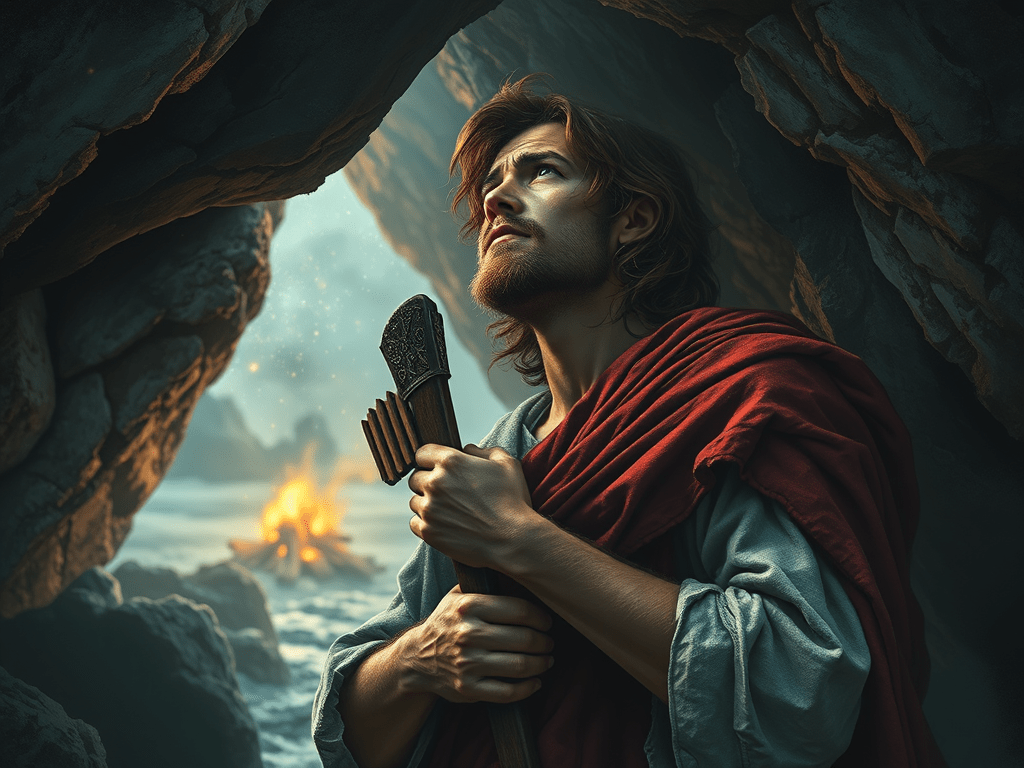
    Years stretched on, their paths sundered by war and fate. David became a fugitive king, leading outcasts through rugged cliffs, the crimson tunic fraying with each escape, the harp silent but ever-present. One frostbitten night, in a cave’s shadowed mouth, he wrapped the tunic tighter, bow in hand, and whispered to the stars, “Jonathan, your strength holds me still.” The wind howled, but Saul’s scouts prowled closer, their torches flickering like wolves’ eyes. Jonathan stayed with Saul, torn between love and duty, deflecting the king’s rages to buy David time. Yet their covenant held, a lifeline across the divide.

    Then came the news at Adullam: Saul and Jonathan had fallen at Mount Gilboa, slain by Philistine swords. The messenger, dust-caked and trembling, spoke of Jonathan’s final stand—how he’d fought to the last, his bow snapping as he shielded his father’s broken body, arrows spent, blood pooling on the ridge. David collapsed, clutching the bow, the harp slipping to the dust, and a cry tore from him, raw and shattering. “How the mighty have fallen!” he wailed. “Jonathan, my brother—your love was more precious than gold.”

    He took the harp, its strings trembling under his fingers, and poured out a lament, the notes rising over the camp like smoke. “Your bow lies still, your tunic ash, yet your vow endures,” he sang, tears streaking his face. He saw the stream again—their hands clasped, blood warm, starlight on the water—and his voice broke. The crimson tunic he burned that night, its threads curling slowly into the fire as he murmured, “Rest, my shield.” A shepherd’s farewell to a prince.

    He mourned through the ages, but he kept their oath. As king, he sought Mephibosheth, Jonathan’s lame son, and gave him a place at his table. The boy’s eyes, so like his father’s, met David’s as he said, “For your father’s sake, you’ll eat as my own.” He pressed a scarred hand to the boy’s shoulder, honoring the blood they’d shed by the stream. The bow hung in David’s chambers, the harp beside it, silent witnesses to their covenant—sealed in blood, forged in faith, and kept beyond the grave.

  • Crimson Vow (Part 1)

    Crimson Vow (Part 1)

    The sun dipped below the hills of Gibeah, painting the sky in hues of crimson and gold. David, the shepherd-turned-warrior, climbed the rocky path toward the king’s encampment, his sling swaying at his side, a leather pouch slung over his shoulder. He’d been summoned again to play his harp for King Saul, whose spirit grew ever more restless. The echoes of his victory over Goliath still rang through Israel, a triumph that brought both praise and peril.

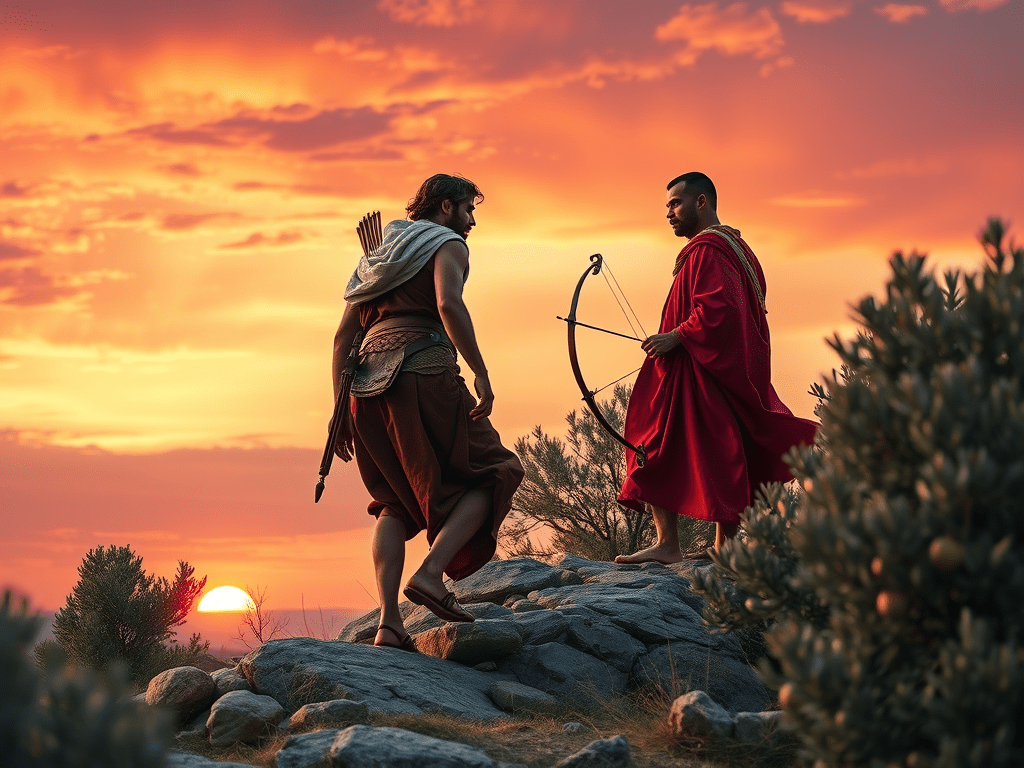
    At the hill’s crest, Jonathan, son of Saul, waited. His bow rested in his hand, his quiver slung across his back, and his dark eyes tracked David’s approach. His crimson tunic fluttered faintly in the breeze, simple yet regal, its edges catching the dying light. A faint smile curved his lips as David drew near.

    “You’re late,” Jonathan said, his tone light.

    David wiped sweat from his brow, grinning. “The sheep don’t heed royal commands. I had to pen them first.”

    Jonathan laughed softly, stepping forward to clasp David’s arm. “My father’s mood darkens hourly. Your music’s the only balm he knows.”

    David’s smile faded. “I’ll play, but I feel his gaze—like a wolf sizing up its prey.”

    Jonathan’s eyes flickered to the horizon. “He hears the songs. ‘Saul has slain his thousands, and David his ten thousands.’ It festers in him.”

    They walked toward the camp, the bond between them unspoken but palpable. They’d met weeks before, when David felled Goliath with a single stone, and Jonathan had watched, awestruck, as the shepherd claimed victory for Israel. In that moment, something kindled in Jonathan—a pull beyond rivalry. David was no ordinary man, and Jonathan, though heir to the throne, felt their souls tethered by a force divine.

    That night, in the dim glow of oil lamps, David sat before Saul, his fingers coaxing a melody from his harp. The king lounged on a cushion, his face haggard, his eyes shadowed. The music wove through the tent, a thread of peace battling the unseen torment gripping Saul’s mind. Jonathan lingered near the entrance, arms crossed, the scent of olive oil and dust thick in the air, watching his father’s tension ease, if only briefly.

    When the last note faded, Saul grunted a curt thanks and dismissed David with a wave. The shepherd bowed and slipped into the night. Jonathan followed, catching him near a grove of olive trees, their gnarled branches whispering in the breeze.

    “You’ve a gift,” Jonathan said, his voice hushed. “Not just with strings, but with souls. Even my father feels it.”

    David glanced at him, moonlight glinting in his eyes. “I seek only God’s favor, not man’s. But I’m glad to serve.”

    Jonathan nodded toward a path winding away from the camp. “Come with me.”

    They walked in silence, the camp’s clamor fading. Stars blazed overhead, a vast tapestry of light, and they stopped by a shallow stream, its waters shimmering like molten silver, the air tinged with pine and damp earth. Jonathan turned to David, his expression grave yet warm.

    “I’ve been thinking,” he began, hesitating. “About you. About Goliath. It wasn’t just skill or chance. The Lord stood with you.”

    David nodded. “He’s guided me since I was a boy, guarding my father’s flocks. Lions, bears—I’ve faced them. But that day… it was His hand.”

    Jonathan stepped closer, his voice dropping. “I’ve fought Philistines too, David. I’ve trusted the Lord to guide my bow. But you—you’re chosen. I see it. The people see it. And my father… he fears it.”

    David shifted, kicking a stone into the stream. “I’m no threat to him, Jonathan. I’m a shepherd, not a king.”

    “Not yet,” Jonathan murmured, the words heavy with portent.

    David met his gaze, searching for envy or doubt, but found only trust. Jonathan drew a small dagger from his belt, its blade catching the starlight. “I want you to know something. Whatever comes—whatever my father does—I stand with you. My heart is yours, as a brother’s.”

    David’s breath hitched. He had known loyalty, but this ran deeper, unyielding. “And mine is yours,” he said, his voice firm despite the swell of emotion.

    Jonathan held out the dagger. “Then let’s seal it—not with words alone, but with blood. A covenant before God.”

    David’s eyes widened, but he nodded. Such oaths were rare, sacred—binding beyond death. Jonathan pressed the blade to his palm, wincing as it bit into his flesh. Blood welled, dark and glistening, and he handed the dagger to David. The shepherd took it, mirroring the act, his hand trembling only slightly as the steel parted his skin.

    They clasped hands, blood mingling warm and wet between their palms. The pain was sharp, but it faded beneath the weight of their vow. “The Lord be between us,” Jonathan whispered, his grip tightening.

    “And between our houses forever,” David finished, his voice steady.

    Jonathan shed his crimson tunic, draping it over David’s shoulders, its fabric soft yet heavy with meaning. “Wear this,” he said. “Let it mark our bond.” David accepted it, the warmth a shield against the night’s chill. They stood there, hands locked, the stream murmuring beside them, their covenant sealed—blood and bond, a promise etched in flesh and spirit.

    Months passed, and Saul’s jealousy festered into madness. David’s victories swelled his fame, and the king’s heart turned black with envy. One evening, as David played his harp, Saul’s hand darted to a spear leaning nearby. Jonathan saw the glint of intent too late. The weapon flew, pinning David’s tunic to the tent wall as he dodged.

    “Father!” Jonathan cried, stepping forward, but Saul’s face twisted with rage.

    “Out!” the king bellowed, and David fled into the darkness, the crimson tunic trailing behind him.

    Jonathan found him later, hidden beneath a rocky overhang miles from Gibeah. David’s face was streaked with dirt, his eyes wide with betrayal, the tunic frayed at the hem from his flight.

    “He tried to kill me,” David said, his voice hollow.

    Jonathan knelt beside him, gripping his shoulder. “I know. His spirit’s warped—by fear, by something evil.” From his belt, he unslung David’s harp, scratched but whole, recovered from the tent. “I brought this. Keep it close.”

    David took it, fingers brushing the strings, a faint note rising into the night. “You risk too much.”

    “Nor will I let him take you,” Jonathan swore. “We need a plan.”

    They devised a signal under the stars: Jonathan would test Saul’s intent and warn David with arrows. Three shot beyond a stone would mean danger; one short of it, safety. Their scarred hands clasped again, the faint sting a reminder of their oath.

    David slipped deeper into the hills that night, the tunic his cloak, the harp slung across his back. Near a jagged slope, he lit a small decoy fire, sending it tumbling down with a push of stones, then vanished into the shadows as Saul’s scouts chased the glow.

    At the new moon festival, David hid near the stone Ezel, watching as Jonathan entered Saul’s tent. The prince sat at the king’s table, his pulse racing as he spoke of David’s absence.

    “He went to Bethlehem, to his family,” Jonathan said, feigning calm, his cloak hiding the dust of a dawn ride past Abner’s patrol to reach David earlier.

    Saul’s eyes narrowed, his grip tightening on a goblet. “You cover for him! That son of Jesse—he’ll steal my throne!”

    Jonathan’s gut churned, but he pressed on. “He’s loyal, Father. He fights for you.”

    Saul hurled the goblet, wine splashing across Jonathan’s chest. “You’d give your birthright to that shepherd?”

    The words pierced, but Jonathan stood tall. “I’d give it to God’s chosen.”

    Saul’s fury exploded, and he grabbed his spear. Jonathan dodged and ran, snatching his bow and quiver as he fled into the night. He reached the field at dawn, a boy in tow as a ruse, and nocked an arrow. David watched from his hiding place as the first arrow soared past the stone. Then the second. Then the third.

    Danger.

    Jonathan shouted to the boy, “Fetch the arrows!” As the lad ran off, he darted to David. “He wants you dead,” he whispered. “Go—into the hills, the caves. I’ll shield you as long as I can.”

    David’s eyes shimmered. “You shouldn’t have come. Abner—”

    “Guesses nothing,” Jonathan cut in. “I told him I scouted game.” He unslung his bow, its wood worn smooth from battles, and pressed it into David’s hands. “Take this too. It’s been with me in every fight. Let it remind you of me.”

    David gripped it, the curve fitting his palm. “I’ll carry it always.”

    They wept, their scarred hands pressed together, blood long dried but the bond unbroken. “The Lord be between us,” Jonathan murmured.

    “And our houses forever,” David replied.

    They parted—Jonathan to the boy, David to the wilderness, the bow over one shoulder, the harp over the other, the crimson tunic a fading banner.

    (Continued in Part 2 tomorrow)
  • Still Standing

    Still Standing

    The night air hung heavy, thick with the kind of silence that wasn’t really silent. Wind stirred the trees, gravel settled under our boots, but neither of us spoke. We just stood there, arms clasped, leaning in—forehead to forehead, the weight of it all pressing between us. Not crushing—just there.

    I exhaled slow, steady. “You don’t have to carry it all, brother.” My voice was low, firm. A reminder, not a command.

    You gripped my arm tighter, not in defiance—just needing to feel something solid. “I know,” you said, but the words came like a man trying to convince himself.

    I let that sit. Truth doesn’t always land the first time. It takes a second pass, a steady presence.

    The weight of your shoulders, the tension in your jaw—I saw it all. The kind of weight a man carries when he thinks he’s failing at something God never asked him to hold alone.

    I didn’t fix it. Didn’t push. Just stood there with you, bearing the silence together.

    After a while, your grip loosened. Not in surrender, but in relief. Like the weight wasn’t gone, but it didn’t have to suffocate you either.

    The wind stirred again. I could feel you breathing deeper now, steadier. The battle wasn’t over, but you weren’t fighting alone.

    And that was enough.

    For now, that was enough.

  • Not Alone

    Jason had been watching Eli slip for weeks.

    It wasn’t the kind of thing most people would notice. He still showed up to work, still laughed at the right moments, still answered texts. But Jason saw the difference. The way Eli’s voice had lost something. The way he never lingered after church anymore. The way his eyes were always tired.

    Tonight was the first time he actually got Eli to come over. No agenda, just burgers and a game on in the background. But Jason could tell—Eli was somewhere else.

    They sat on the porch now, the night quiet around them, crickets filling the space between their words.

    “You gonna tell me what’s going on?” Jason finally asked.

    Eli exhaled sharply. “Nothing, man. Just been tired.”

    Jason didn’t buy it. “Tired how?”

    Eli shrugged, staring at the ground. “Like…what’s the point?”

    Jason’s chest tightened.

    Eli shook his head. “I’m not gonna do anything stupid,” he muttered. “I just—man, I’m so tired of fighting.”

    Jason leaned forward, elbows on his knees. “Fighting what?”

    Eli let out a humorless laugh. “Everything. Temptation. The loneliness. Trying to be strong all the time. Feeling like I’m the only one who walks into an empty house every night, wondering if this whole ‘choosing Christ’ thing is actually gonna be enough.”

    Jason swallowed hard.

    Eli kept going, voice raw now. “I know the truth. I know God’s got me. But it still hurts, man. And it’s like no one even sees it.”

    Jason didn’t speak right away. He just reached over and grabbed Eli by the shoulder, firm.

    Eli flinched, barely noticeable.

    Jason tightened his grip. “I see it.”

    Eli’s throat bobbed.

    Jason didn’t let go. “You hear me? I see you, brother. And I need you to listen to me real close—you are not walking this road alone.”

    Eli squeezed his eyes shut. His breathing was uneven now, something cracking open inside him.

    Jason pulled him in, one hand gripping the back of his neck, the other around his shoulder. Eli didn’t move at first—stiff, like he didn’t know how to accept it.

    Then, slowly, he let out a shaky breath and leaned in.

    Jason held tight. “I’ve got you. We got you. And you’re gonna make it.”

    Eli didn’t say anything. Didn’t have to.

    Jason could feel it—the weight lifting, the battle shifting.

    And for the first time in a long time, Eli let himself believe it.

    This one hits harder—real weight, real release. The physical touch isn’t just an extra detail—it’s part of what breaks through.

  • Already There

    Jake sat on the tailgate of Logan’s truck, staring out over the field. The last of the evening light stretched long across the grass, turning the sky soft shades of orange and blue.

    Logan stood nearby, tightening the straps on the cooler, slow and steady.

    “You ever think about how weird this is?” Jake asked.

    Logan glanced over. “What’s weird?”

    Jake exhaled, rubbing the back of his neck. “This. Us. The way we just… I don’t know, fit.”

    Logan raised an eyebrow. “Something wrong with fitting?”

    Jake huffed. “No. Just feels like—” He shook his head. “I don’t know. Like I didn’t sign up for this, but somehow, here we are.”

    Logan chuckled, shutting the cooler with a firm thunk. “That’s ‘cause you didn’t sign up for it.”

    Jake frowned. “What do you mean?”

    Logan leaned against the truck, arms crossed. “You think David and Jonathan planned to be brothers like that? Think they sat down, drafted up an agreement, made it official?”

    Jake smirked. “I mean, technically, Jonathan did make a covenant with David.”

    Logan nodded. “Yeah. But only ‘cause he recognized what was already there. He didn’t create it. He just stepped into what God had already done.”

    Jake was quiet for a second, letting that settle.

    Logan kept going. “A lot of men walk around thinking they’ve gotta build something like this from scratch. That if they want deep brotherhood, they’ve gotta go find it, make it happen.” He shook his head. “But covenant’s not something we manufacture. It’s something God writes into the grain—and we either step into it or we don’t.”

    Jake exhaled. “So you’re saying this—” he gestured between them—“was always gonna happen?”

    Logan shrugged. “I’m saying it was always possible. But you had to have the eyes to see it. Had to have the courage to say yes to it.”

    Jake picked at the edge of the truck bed, thoughtful. “So… I’m already in this, huh?”

    Logan smirked. “Been in it, brother. Took you long enough to notice.”

    Jake chuckled, shaking his head.

    The field stretched quiet around them. No need for more words.

    Some things don’t have to be built.

    They just have to be seen.

  • The Divide

    Josh tightened his grip on the steering wheel, jaw clenched. The streetlights blurred past as he drove, heart pounding harder than it should over something like this.

    I should let it go.

    But he couldn’t.

    Mike’s words from earlier still echoed, sharp and unfiltered. “You don’t get it, man. You think you do, but you don’t.”

    Josh had snapped back—something about always being there, about how Mike was the one pushing people away. Things escalated, and now here they were—silence.

    Three weeks. No texts. No calls.

    Josh pulled into the diner parking lot, killed the engine, and sat there. He wasn’t even sure why he came. Maybe just to stop feeling like he was waiting.

    Inside, the place was half-empty, the hum of conversation mixing with the clatter of dishes. And then—Mike.

    Sitting in the back booth, arms crossed, staring out the window.

    Josh exhaled, ran a hand through his hair, and walked over.

    Mike looked up as he approached, his expression unreadable. He didn’t nod, didn’t wave. Just watched as Josh slid into the seat across from him.

    Neither spoke at first. The waitress came, took their orders, and left.

    Finally, Josh leaned forward. “I almost didn’t come.”

    Mike scoffed, shaking his head. “Same.”

    Josh sighed. “So what are we doing here?”

    Mike didn’t answer right away. He tapped his fingers on the table, staring down at his coffee. “I don’t know. But I know I don’t want to pretend like none of it happened.”

    Josh nodded slowly. “Yeah.”

    Another silence.

    Mike shifted in his seat. “You were right about some things,” he admitted, voice quieter now. “But you don’t know what it’s like to carry this…this weight.”

    Josh’s chest tightened. “Then tell me.”

    Mike glanced up, eyes wary, but something in Josh’s face must’ve told him he meant it.

    And so he did.

    He talked—about the anger he’d been holding in, the things he never said out loud. About how sometimes the weight of past struggles, of feeling different, of wanting to be known but fearing being too known—how it all built up, and Josh had just been the guy who caught the fallout.

    Josh listened. Really listened.

    And when Mike finally ran out of words, Josh just nodded. “I hear you.”

    Mike exhaled, shoulders dropping. “So where does that leave us?”

    Josh studied him for a moment. “Same place we started.”

    Mike frowned. “What does that mean?”

    Josh leaned back. “You’re still my brother.”

    Mike let out a short laugh, shaking his head. “Even after all that?”

    Josh smirked. “Especially after all that.”

    The waitress came back, setting down their plates. The tension in the air had shifted—not gone, but lighter. Real.

    Mike picked up his fork, shaking his head. “You’re a stubborn idiot.”

    Josh grinned. “That’s what makes this work.”

    And just like that, the divide wasn’t so wide anymore.


  • When Brotherhood is Tested

    Brotherhood is easy when everything’s good.

    When there’s no conflict, no misunderstandings, no disappointments—sticking together feels natural.

    But what about when it’s not easy?

    What happens when your brother lets you down? When frustration builds? When something shifts, and the bond feels strained?

    This is where most friendships crack. Where the world says, Move on. Find someone else. Protect yourself.

    But covenant isn’t like the world.

    Brotherhood is meant to be for life, but that doesn’t mean it’s always smooth. Every deep bond will be tested—by conflict, by disappointment, even by betrayal.

    So what do you do when it happens?

    1. Don’t Let Discomfort Make the Decision for You

    A lot of men walk away from brotherhood not because of a real break, but because things got uncomfortable.

    • A hard conversation was needed, but neither side had it.

    • A misunderstanding went unaddressed, and resentment settled in.

    • One man expected too much, the other gave too little, and instead of adjusting, they drifted.

    Covenant doesn’t mean you never hurt each other. It means you fight through when you do.

    2. Face Conflict with Truth and Grace

    If a brother has wounded you, or if you’ve wounded him, the next move isn’t silence. It’s truth.

    • Speak honestly. Say what needs to be said.

    • But do it with grace—without assumptions, without accusations.

    • Give the same patience and mercy that you’d want to receive.

    Brotherhood requires truth. But truth without love destroys.

    3. Some Wounds Can Be Healed. Some Require Space.

    Not every conflict means the end of a bond.

    • Some wounds just need time, humility, and conversation. They can heal stronger than before.

    • Some require stepping back—not to abandon, but to let God do the work in both hearts.

    And yeah—some betrayals are deep enough that distance is needed. But even then, covenant doesn’t mean you stop praying, forgiving, or leaving the door open for restoration.

    4. When It’s Worth Fighting For, Fight For It.

    There’s a reason so many men feel isolated—it’s easier to walk away than to fight for a bond. But real brotherhood is worth it.

    So if there’s distance, reach out.

    If there’s tension, clear the air.

    If a brother is slipping, go after him.

    Because the ones who fight for each other? Those are the ones who will still be standing together years down the road.

    Brotherhood Was Meant to Last

    Jesus never said love would be easy. But He did say it would be worth it.

    Covenant isn’t just about the good times—it’s about the moments when it’s tested, when everything in you says let it go, but God says hold on.

    So when the test comes—and it will come—don’t walk away too quickly.

    Because the bonds that make it through?

    Those are the ones that last a lifetime.