Tag: covenant brotherhood

  • The Return (Chapter)

    The Return (Chapter)

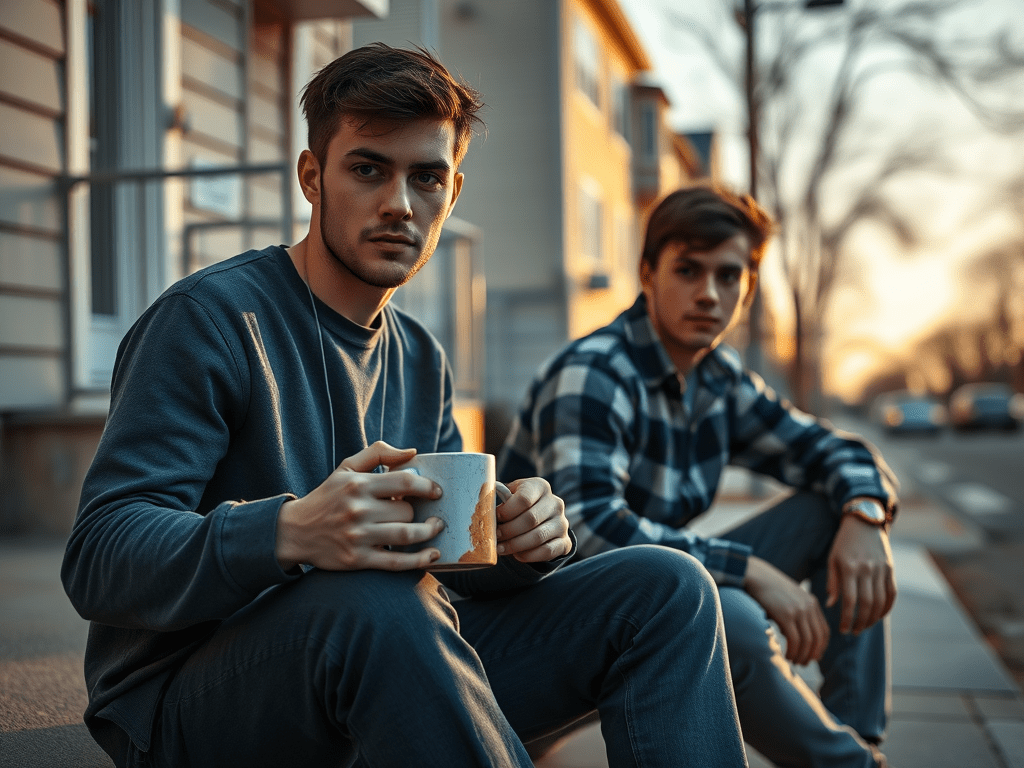
    The morning came slow, like it didn’t want to wake the world all at once. Ezra sat on the curb outside Jake’s apartment, shoulders rounded forward, hands cupped around a chipped mug of coffee. The sun hadn’t broken fully over the rooftops, but the sky was soft with promise—blue pressed gently into the dark, like something sacred starting over.

    Jake stepped out a minute later, flannel thrown on over a t-shirt, the sleeves rolled just high enough to catch the light at his forearms. He carried his own mug, no lid, no rush, and dropped down beside Ezra without a word.

    For a while, they sat in the kind of silence that didn’t need anything added to it. Just the scrape of tires in the distance, the tick of the cooling engine behind them, and the early morning breeze cutting faintly through the heat that still lived in the pavement.

    Jake took a sip. “Feels different today.”

    Ezra didn’t answer right away. He let the warmth in his hands anchor him for a second longer, then nodded. “Yeah. I can feel it pulling. Like it’s time.”

    Jake looked ahead at nothing in particular. “Yeah. I figured.”

    “It’s not about leaving,” Ezra said. “It’s just… I don’t think I was meant to stay here.”

    Jake nodded slowly. “Nah. I know.”

    He didn’t try to argue, didn’t ask when. Just let it be.

    They finished their coffee without speaking. It wasn’t heavy. Just still.

    When they stood, Jake hooked a thumb into his pocket, gave Ezra a look that carried more than it said. “We walking?”

    Ezra gave a faint smile. “Yeah.”

    They moved side by side through streets that didn’t belong to either of them, not really. Past the corners where the crew had laughed too loud, past the bars where echoes still lingered in the floorboards. They weren’t rushing anywhere. Just walking—like you do when something real has ended.

    When they reached the lot, it looked the same. Same cracked dirt. Same broken fence. Same forgotten piece of land that somehow held more weight than it should’ve. It  felt different now—not just like a place, but a witness. Like it remembered both of them, even if neither could name all the ways they’d belonged to it.

    But Ezra could feel it stirring.

    There was a shift, deep and low, like the world had tilted a degree inward.

    He stepped closer.

    The ground didn’t move, but something in him did. The air thickened. Not hotter, just denser. Alive.

    And then it started to reappear—not all at once, but slowly, the way breath returns after we’ve forgotten to take it. Trees forming like memory. Orange blossoms catching the early light. The smell, faint and holy, rising in the warmth like incense.

    Jake stayed a few steps back, watching the shape of the grove come into view.

    “You sure?” he asked, voice lower than before.

    Ezra nodded. “I have to.”

    They stood there, nothing between them now but the knowing.

    Jake didn’t hesitate. He reached forward, one hand to the back of Ezra’s neck, the other drawing him in. Ezra stepped into the embrace, arms folding across Jake’s back. 

    “You’re closer than a brother,” Jake said—like it was the truest thing he knew.

    Their embrace was a seal. A weight pressed evenly between them—grief and grace, shared without speech.

    They stood like that for a long time.

    When they pulled apart, Ezra didn’t look away. The scar’s ache was still there, but gentler now. Like something had been acknowledged, not erased. He took a final breath and whispered, ‘Lord, thank You. 

    He stepped into the light.

    And the grove received him.

    It didn’t vanish this time. It folded slowly, like a page turning. The trees dimmed, the air eased, and then it was just a lot again.

    Jake stayed where he was, standing in dust, boots planted, hands at his sides.
    He looked out across the empty space.
    The lot was quiet again. Still familiar. But thinner, somehow.
    Like something had been breathing there beside him—and now it was gone.
    It wasn’t grief or emptiness—just the sense of a center no longer shared.

    His hand lifted, almost on its own, and rubbed the back of his neck.

    He didn’t move.
    And something in him stayed full.
    He didn’t know why, but a faint pressure sat behind his ribs—like something that had once been torn was learning how to rest.

    As he finally turned to leave, the dust on his boots caught the light—faint and gold, like citrus before the fall.

    (Chapter from The Grove. Contact me if you’d like to read the full story.)

  • The River Haul

    The River Haul

    The river was a beast, gorged on three days of rain, chewing the East Tennessee bank with mud and branches. Jake, 34, stood on the volunteer dock, boots sinking into the mire, his fisherman’s hands restless. Riverside Aid’s boat—loaded with food and medicine for a flood-cut hamlet upriver—was snagged on a fallen oak downstream, its hull groaning. Jake wasn’t into heroics, but his buddy Cal, who ran the volunteer group, had pleaded, and Jake knew the river better than most.

    Tim, 31, hustled up, glasses fogged, flannel too neat for the chaos. A high school teacher, he’d swapped fishing tales with Jake at the gas station, his quiet calm grating like a dull hook. Cal had paired them, and Jake wasn’t happy. “Don’t slow me,” he muttered, slinging a rope over his shoulder.

    “Tim,” Tim said, wiping his glasses, voice steady as the river’s deep pull. “I’m in.”

    The dock rocked as they piled into Jake’s skiff, spray stinging their faces. Jake rowed, muscles straining, while Tim gripped the sides, knuckles white. The current bucked, slamming them toward a rock. Jake cursed, but Tim leaned hard, balancing the boat. Jake shot him a glance, respect flickering. “Not bad.”

    They reached the volunteer boat, its bow snarled in the oak’s roots, water lapping crates—canned goods, insulin, the hamlet’s lifeline. Jake tied the skiff, rope rough on his palms, and waded in, the cold biting his thighs. Tim followed, slipping but catching himself, flannel soaked. They hacked at the roots with a hatchet, wood chips flying, but the boat held. Jake’s temper flared. “River’s got it,” he growled.

    Tim, panting, shook his head. “Folks upriver need us.” He climbed aboard, checking the cargo, glasses glinting. “We keep going, Jake.”

    Jake grunted, but Tim’s fire lit something. He joined him, shoulders brushing as they shoved the hull. The boat creaked, unmoved. Jake’s mind flashed to his sister, lost to fever years ago, when he’d been too proud for help. “I let her down,” he said, voice low, nearly lost in the river’s roar. “Didn’t fight enough.”

    Tim paused, drizzle dripping. “You’re fighting now.” He touched the cross in his pocket, Psalm 46 whispering—God as refuge. “You’re not alone.”

    Jake’s throat tightened, but he grabbed the hatchet. “Move.” They hacked in sync, Jake’s raw power, Tim’s steady cuts, spray a cold baptism. A root snapped, then another, and the boat broke free, rocking in the current. Jake whooped, grin splitting, and Tim laughed, clapping his back like kids.

    Towing the boat back was brutal, rapids fighting every pull. Jake steered, shouting, but Tim’s calm steadied them, hands sure on the rope. At the dock, volunteers cheered, unloading crates for the hamlet, ready once roads cleared. Jake’s boots squelched, arms aching, but he felt lighter, like the river had carried off a weight.

    Tim wiped his glasses, grinning. “Good team, fisherman.”

    Jake snorted, eyes soft. “Maybe, bookworm.” He clapped Tim’s shoulder, heavy with thanks. “Fish with me Saturday? River’s calm then.”

    Tim nodded, cross glinting. “Deal.” A few nights later, by a riverside campfire, flames warm against the damp, they shared coffee. Tim murmured Psalm 46, Jake nodding, his rough voice joining the prayer, their bond sealed—not just by the river, but by hauling together, flood or calm.

  • The Bunkhouse Bet

    The Bunkhouse Bet

    The bunkhouse was a sauna of sweat, pine, and machine oil, its walls groaning under the Tennessee summer of 1944. Cal, 24, a welder with a grin sharp as a switchblade, sprawled on his cot, tossing a baseball against a rafter with a rhythmic thud. Amos, 22, a chemist with glasses that slid down his nose, hunched over a book, muttering about isotopes like they were poetry. The other workers at the secret Oak Ridge plant—Building X, they called it——snored or slapped cards, but Cal and Amos were brewing trouble, a bet taking shape.

    “Bet you can’t sneak a radio past the guards,” Cal said, his drawl dripping mischief, baseball frozen mid-air. “Some Glenn Miller’d make this dump feel alive.”

    Amos snorted, adjusting his glasses. “And get us fired? Pass, hotshot.” But his eyes flicked to the door, where Guard Jenkins’ flashlight swept the gravel. The thought of swing music cutting the monotony sparked something.

    “Double or nothing,” Cal leaned in, cot creaking. “You win, I shine your boots a month. I win, you sneak it in. Deal?”

    Amos sighed, but a grin betrayed him. “Deal, lunatic.” The bunkhouse, a low-slung box of cots and secrets, became their stage. Cal, all swagger, schemed: hide a scratched Philco radio in a scrap metal crate, slip it past Jenkins at shift change. Amos, brainy but hooked, timed it—6:17 p.m., Jenkins’ yawn o’clock.

    Next day, they lugged the crate to the gate, Cal whistling loud to drown Amos’ fidgeting. Jenkins, burly and scowling, tapped the crate. “What’s this?”

    “Scrap for the shop,” Cal lied, smooth as creek water. Amos nodded, sweating buckets. Jenkins’ flashlight lingered, then swung away. Clear—until Amos tripped, the crate crashing, a radio hum buzzing out. Cal’s gut twisted, but he slung an arm around Jenkins, spinning a yarn about loose bolts. “Gotta fix it, boss, or the line’s toast!”

    Jenkins grunted, waving them off. Cal shot Amos a glare, then a stifled laugh. Back in the bunkhouse, they unpacked the radio, its dial glowing like a firefly. Workers crowded round, Glenn Miller’s trombone swinging, boots tapping planks. Amos, flushed, punched Cal’s shoulder. “Told you I’d do it.”

    “‘Cause I saved your clumsy hide,” Cal grinned. They sprawled, music weaving through Cal’s jalopy-racing tales and Amos’ shy confession of flunking dance class. The bunkhouse felt less like a cell, more like kin.

    Two nights later, a new guard, Ramsey, stormed in, catching the radio’s hum. “Whose?” he barked, yanking the cord. Silence fell, workers scattering. Amos froze, glasses glinting, knowing a write-up could end him. Cal sat up, lazy-like.

    “Mine,” he said, calm. “Scrap find. My bad.” Ramsey scribbled Cal’s name, not Amos’, and took the radio. The bunkhouse exhaled. Amos stared, mouth agape.

    “Could’ve ratted me,” Amos whispered later, snores rising. “Why?”

    Cal tossed his baseball, shrugging. “You’re my partner, specs. Ain’t leaving you.” His grin softened. “You’d look awful in shackles.”

    Amos chuckled. “Crazier than a June bug.” He slid a hymn sheet from his book—Abide with Me, from chapel. “For you. Figured you’d need it, with your luck.”

    Cal took it, fingers brushing the page, no joke for once. “Thanks, Amos.” Next night, by the bunkhouse stove, its warmth cutting the chill, they shared a smoke and sang, Cal’s baritone shaky, Amos’ tenor clear. Others joined, voices weaving a pact—not just for music, but for each other, through shifts and secrets.

    Sunday, in the chapel, Cal and Amos shared a hymnal, shoulders brushing, grins a vow. The radio was gone, but they’d won something better—a brother for the next bet, the next night, the next war.

  • The Ridge Run

    The Ridge Run

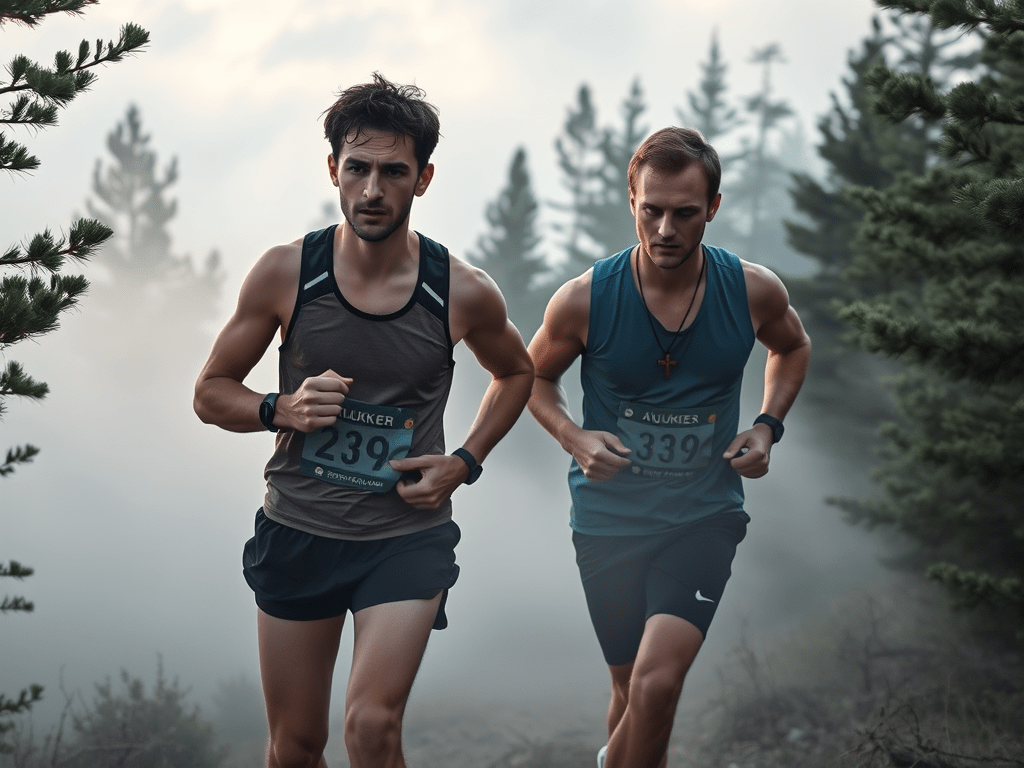
    The fog was a living thing, curling through the pines like it had a mind of its own, swallowing the dawn and the trail with it. Tucker, 28, ran hard, sneakers pounding the damp earth, his breath sharp in the East Tennessee chill. He’d signed up for the town’s fitness challenge to outrun the dead-end grind of his delivery job, not to play buddy with some ranger. Ben, 32, kept pace, his strides steady, eyes scanning the trees like they whispered secrets. The church had paired them, and Tucker wasn’t thrilled—Ben’s calm, Psalm-quoting vibe felt like a chain on his speed.

    “Keep up, ranger,” Tucker grunted, brushing past a cedar, its bark rough under his palm. The trail, a scar through the ridge, was meant to be a quick 5K, but the fog turned it into a maze. Ben just nodded, his cross necklace catching the faint light, unbothered.

    They were barely two miles in when the mist thickened, blotting out the markers. Tucker cursed, his ankle twisting on a root. Pain shot up his leg, and he stumbled, catching himself on a moss-slick rock. “Great,” he muttered, sinking down, the fog coiling around him. Ben crouched, checking the ankle, his hands gentle but sure, face calm as a still creek.

    “Ain’t broken,” Ben said, voice low, like soothing a spooked colt. “Can you walk?”

    Tucker glared, pride stinging worse than the pain. “I’m fine.” But standing brought a wince, and he slumped back, the fog’s chill creeping in. “This was dumb. Town’s dumb. I’m stuck, delivering to nowhere.”

    Ben sat cross-legged, pulling granola from his pack. “Eat. Then we move.” He handed Tucker a bar, eyes steady. “You’re not stuck. You’re running. That’s something.”

    Tucker snorted but took it, the wrapper crinkling. Silence fell, heavy with mist, and Ben spoke—about the ridge, how he’d found peace patrolling it after losing his brother to addiction. “Wished I’d done more,” Ben said, voice catching, “but I was running my own race.” He touched his cross, a Psalm 23 whisper slipping out.

    Something cracked in Tucker. “I’m running from nothing,” he admitted, staring into the fog. “Job’s a cage, town’s a dead end. Ain’t got no one to run with.” His voice softened, raw, and he looked away, embarrassed.

    Ben didn’t push, just nodded. “You got me now,” he said, simple. “We’ll get out together.”

    Tucker’s throat tightened, but he muttered, “Whatever, ranger.” Ben helped him up, Tucker leaning on his shoulder, the fog a gray wall. Ben mentioned a cave Old Man Holt, the trail hermit, had told him about—a shelter nearby. “Holt says it’s sure,” Ben said, half-smiling. “Crazy coot, but he knows these hills.”

    They hobbled on, Ben’s arm steady, his calm cutting Tucker’s panic. The cave loomed, a dark mouth in the ridge. Inside, the air was damp but warm, and Tucker sank against the wall, ankle throbbing. Ben’s flashlight danced on the rock, and they shared the last granola, the crunch loud. Tucker talked—about his dad bailing at ten, driving empty roads, chasing freedom he couldn’t name.

    Ben listened, his cross glinting. “Freedom’s not out there,” he said, tapping his chest. “It’s here. With Him. With folks who stay.”

    Tucker didn’t answer, but the words sank deep. A rustle at the cave mouth—Old Man Holt, lantern swinging, beard wild. “Y’all lost?” he cackled, eyes kind. “Trail’s this way. Stick together.” He led them out, fog thinning, the church steeple poking through like a promise.

    At the finish line, hours late, crowd gone, Tucker limped, grinning, Ben propping him up. The gas station’s neon buzzed, and Tucker clapped Ben’s shoulder, a silent thanks. “Next run, you’re chasing me,” he said, half-laughing.

    Ben smirked. “Deal.” Sunday, they shared a pew, a nod sealing their pact—not just to run, but to keep showing up, fog or no fog.

  • The Junkyard Signal

    The Junkyard Signal

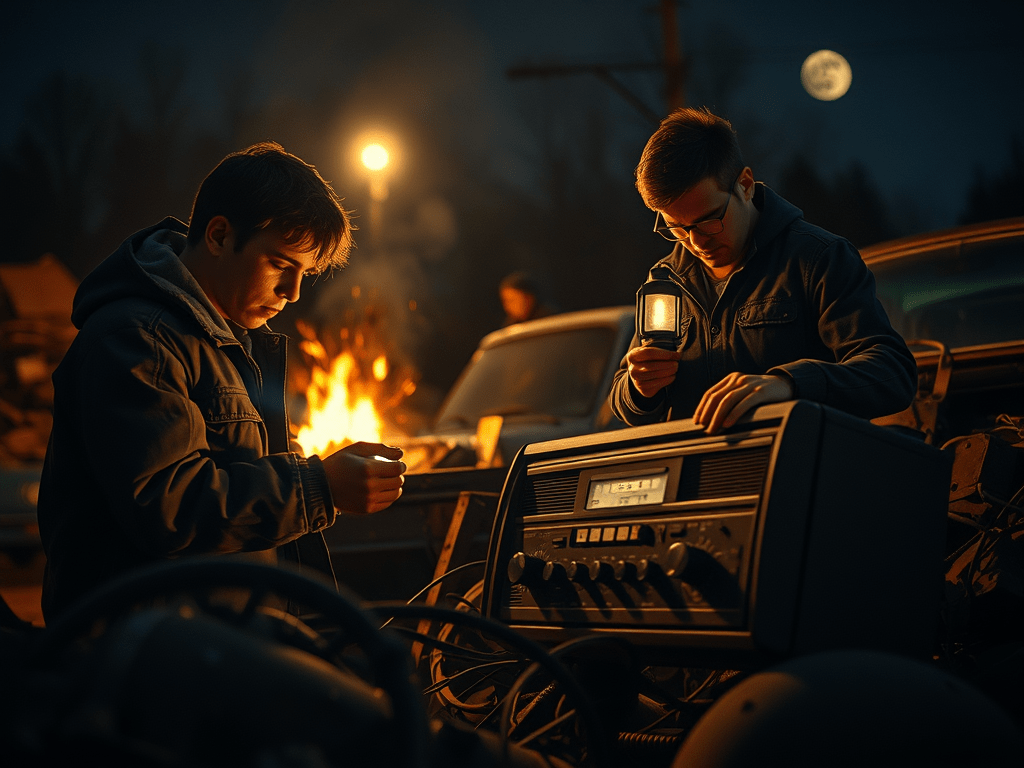
    The junkyard sprawled like a forgotten kingdom, rusted car husks glinting under a half-moon, their shadows pooling around a flickering bonfire. Micah kicked a hubcap, its clang swallowed by the East Tennessee night, a faint pine breeze cutting the tang of oil and metal. Levi crouched by a pile of radios, his flashlight beam dancing over cracked dials, muttering about signals like a man possessed. Miss Clara’s shack loomed at the yard’s edge, her silhouette watchful through a curtained window.

    “Levi, this is nuts,” Micah said, hands shoved in his jacket, breath fogging. “Sneaking in here for your ghost voices? We’re gonna get caught.”

    Levi grinned, his glasses catching the firelight, a wiry guy who’d talk your ear off about ham radios and Bible verses. “Ain’t ghosts, Micah. It’s God’s whispers, maybe. Heard ‘em last week—static, then words. Somethin’ about a hiker.” He twisted a knob on a rusted set, static crackling like a storm.

    Micah snorted, but he stayed, boots crunching gravel. They’d met at a Bible study, Levi’s puns and Micah’s gruff fixes for the church’s busted AC forging an odd bond. He didn’t buy Levi’s “divine signal” talk, but the guy’s faith had a pull, like a gear clicking into place. Plus, the junkyard at night was kinda cool, like a playground for broken things.

    The radio spat a burst of noise, then a voice—clear, desperate. “Lost… ridge trail… help.” Micah froze, his wrench slipping in his hand. Levi’s eyes widened. “Told ya,” he whispered, scrambling to tweak the dial. The voice faded, static returning, but it was real—no prank.

    “Could be some kid messing with us,” Micah said, but his pulse said otherwise. He grabbed a coil of wire from a nearby pile, mind racing. “Fine. Let’s boost this thing, see if it talks again.”

    Levi nodded, no I-told-you-so, just focus. They hauled scraps—a car battery, a busted antenna—piling them by the radio like an offering. Micah’s hands moved fast, splicing wires, his mechanic’s knack turning junk into purpose. Levi muttered frequencies, half-prayer, half-tech, his flashlight shaking. “Micah, you ever think God uses stuff like this? Radios, I mean. To point us somewhere?”

    Micah shrugged, tightening a bolt. “If He’s talkin’, I ain’t heard Him. But I ain’t leavin’ you out here alone, so let’s move.” His voice softened, a grin tugging. “Your puns are bad enough without ghosts.”

    Levi chuckled, and the radio hummed again, the voice clearer: “Cold… near the old oak…” Micah’s skepticism cracked—someone was out there, lost on the ridge. They boosted the signal, Levi calling coordinates into his handheld, Micah rigging a makeshift amplifier from a Chevy’s alternator. The work felt good, like fixing a truck with your best friend, hands dirty, purpose clean.

    Footsteps crunched behind them. Miss Clara, gray braid swinging, stood with a lantern, her eyes sharp but warm. “Y’all makin’ a racket in my yard,” she said, voice like gravel and honey. “What’s this nonsense?”

    Levi stammered, but Micah stepped up. “Radio picked up a hiker, Miss Clara. Lost on the ridge. We’re tryin’ to help.” He braced for a scolding, but she tilted her head, lantern casting shadows.

    “My daddy heard a voice like that, ‘62,” she said. “Found a hiker half-dead by the creek. Never explained it. You boys keep at it.” She turned back to her shack, leaving the lantern by the fire.

    Micah and Levi stared, then got back to work, the radio spitting directions. They relayed the spot to the sheriff’s office, Levi’s voice steady, Micah’s hands still on the wires. By dawn, word came—a hiker, safe, found by that old oak, hypothermia but alive. The junkyard felt different, the bonfire’s glow softer, like it held a secret.

    They sat by the fire, coffee from Levi’s thermos bitter but warm. Micah rubbed his knuckles, oil-stained, and looked at Levi. “That was… somethin’. You really think God’s in the static?”

    Levi shrugged, glasses fogged. “Don’t know, man. But we heard it together, didn’t we? That’s enough for me.” He held out the thermos, a quiet offer.

    Micah took it, their fingers brushing, a pact unspoken. “Yeah. Enough for me too.” He nodded at the radio. “We keepin’ this thing tuned?”

    “Bet,” Levi said, grinning. “Next call’s ours.”

    Miss Clara watched from her shack, a smile creasing her face. The junkyard settled, its rust and radios silent, but the air hummed with something alive—a signal, a vow, a brother’s promise to listen again.

  • Not the First (chapter)

    Not the First (chapter)

    The garage was still.

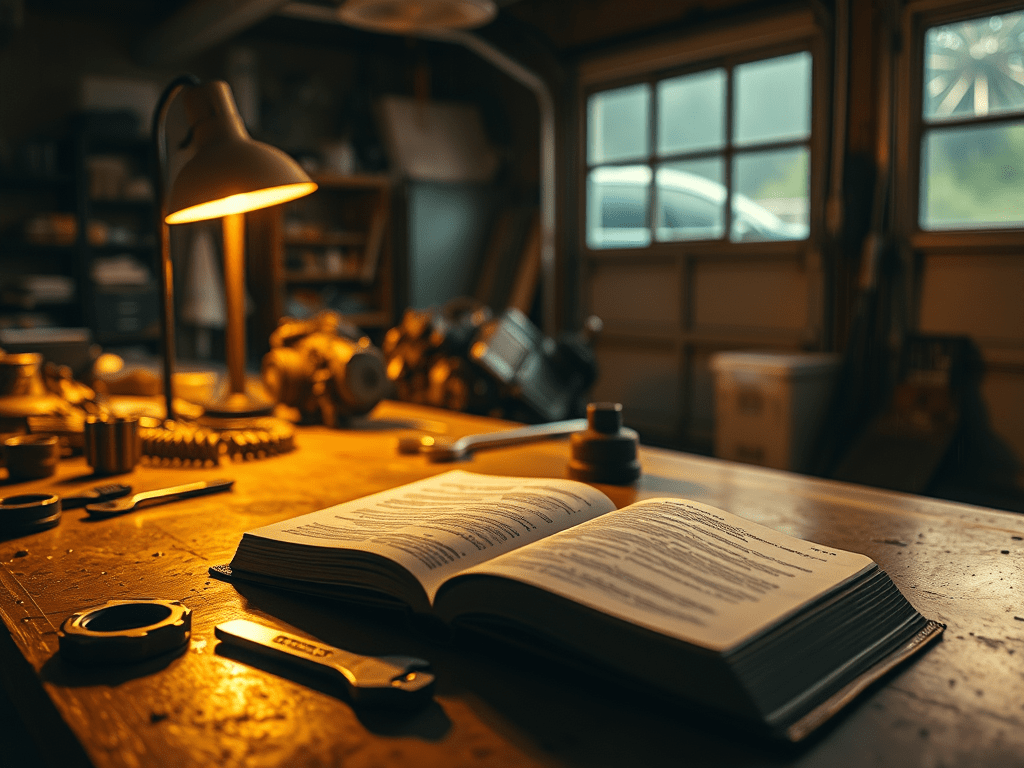
    Rain tapped the metal roof in soft syncopation, the kind that made you feel like the night itself had settled in to stay. Caleb didn’t bother with the overheads—just the single lamp over the workbench, its glow golden against the steel and concrete.

    He sat alone, engine parts half-sorted on the table, a socket wrench resting beneath his hand like it had dozed off mid-sentence. He wasn’t fixing anything tonight. Just sitting with the pieces.

    Jonah hadn’t said much that morning. Just passed him a small, folded scrap and nodded once. No explanation. No weight to it—at least not in his voice. But the way his eyes lingered—that said enough.

    Now, with the quiet all around him, Caleb took the note from where he’d tucked it inside the worn pages of his Bible. The spine was cracked, the pages softened from years of oil-stained hands and Sunday dust. It looked like it had been carried through more than one man’s storm.

    He unfolded the note slow.

    Psalm 27:1
    “The Lord is my light and my salvation—whom shall I fear?”

    He read the next line slower.
    You don’t have to name it.

    Something in him exhaled.

    Then:
    You’re still my brother.

    He wasn’t sure what that line broke—but it broke something gently.
    He stared at the note a long time. Long enough for the rain to change tempo. Long enough for the silence to grow familiar.

    He read the note again.
    That lady at the Spoon had said you didn’t have to name it. Just show up where it lives.
    He pressed the paper to his chest and held it there, steady as the rain.

    He wasn’t the first to carry something unnamed.
    That ache you don’t have a word for.
    That bond you can’t quite explain.
    But he carried it still.

    Then he tucked the note back into the Bible’s spine, stood, and switched off the bench light.

    He rolled the garage door shut. The rain kept on, soft and steady.

    Behind him, the lamplight glowed against the walls—warm, human, and quietly whole.

    And somewhere out there, Jonah was still showing up—

    where it lived.

    (chapter from Not the First in the Caleb and Jonah series. Contact me if you’d like to read the full chapter.)

  • The Storm Doesn’t Knock (chapter)

    The Storm Doesn’t Knock (chapter)

    The rain hit like it didn’t care who heard.
    Not a drizzle. Not a soft soaking. Just a hard, hammering Tennessee storm that turned streets into rivers and roofs into drums.
    It was the kind of storm that didn’t ask. Just showed up loud, and stayed.

    Caleb was already half-awake when the phone buzzed.
    Not a text. A call.
    Jonah’s name lit up the screen, glowing through the dark.

    He answered on the second ring. “Yeah.”

    There was a pause. Then Jonah’s voice — tight, low.
    “It’s Langston. They moved him to ICU about an hour ago.”

    Caleb didn’t ask questions. Didn’t say sorry.
    He just said, “You need a ride?”

    Jonah didn’t answer right away.
    Then: “Yeah.”

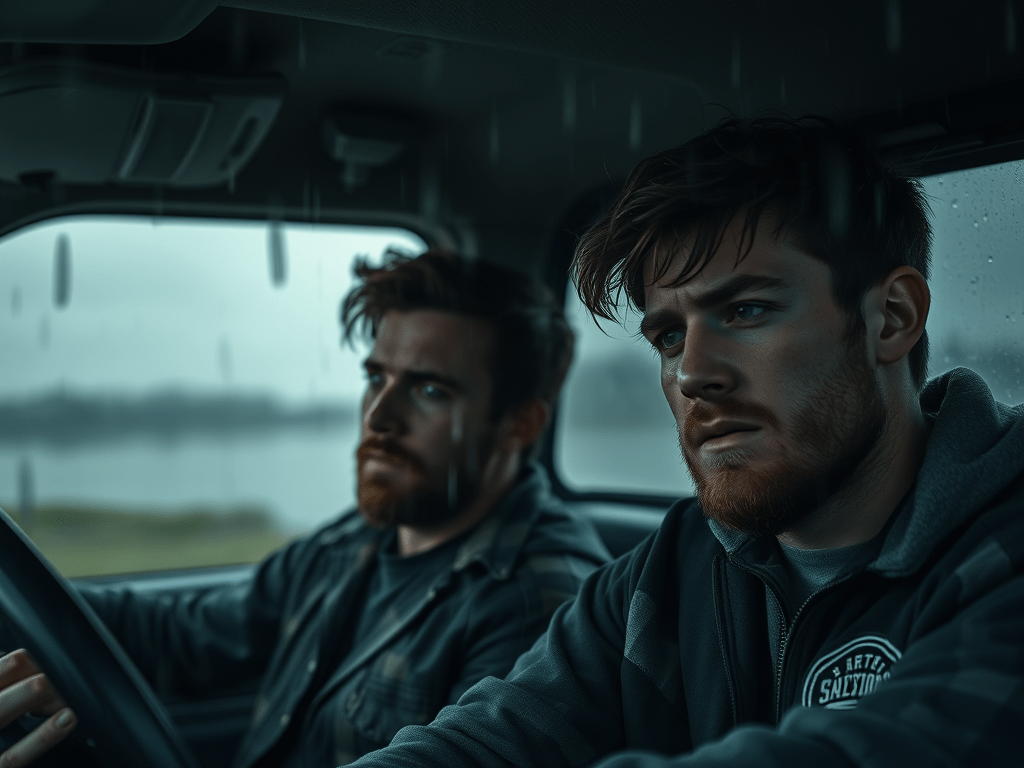
    Fifteen minutes later, the truck lights cut through the rain like they had something to prove. Jonah climbed in, already soaked through, hair plastered to his forehead, jaw clenched too tight. Water ran off his cuffs and pooled on the mat. Steam rose faint from his shoulders.

    Caleb didn’t say anything. Just turned up the defrost and eased them onto the road.

    The drive to Knoxville took longer than usual. Between the storm and the tension, neither of them reached for the radio.

    Jonah sat with his hands clasped between his knees, knuckles white.

    Caleb glanced once, caught the slight tremble in them. Said nothing.

    At one point, Jonah muttered, “He was stable yesterday.”

    Caleb nodded once. “Things change.”

    The words sounded harsher than he meant them to, but Jonah didn’t flinch.

    They pulled into the hospital garage, headlights sweeping wet concrete. Caleb parked without speaking. Jonah opened the door too fast and nearly slipped. Caleb caught his elbow without thinking.

    They didn’t speak. But neither shook it off.

    Inside, everything smelled like bleach and overwork.
    The lights were too bright.
    The waiting room too quiet.

    Jonah stood near the coffee machine, unmoving, staring at a styrofoam cup that had overflowed without him noticing.

    Caleb sat. Didn’t ask him to.

    After a while, Jonah walked over and lowered himself into the seat beside him. Not close. But not far either.

    “I prayed,” he said.

    Caleb looked at him.

    “For weeks,” Jonah added. “Laid hands on him. Psalm 41. Psalm 30. Anointed his hands, his forehead. He let me.”

    Caleb didn’t speak.

    Jonah looked down. “Now he’s hooked up to a machine, and I’m trying to remember what faith felt like when it didn’t feel like a fight.”

    Caleb shifted slightly in his seat.
    He didn’t speak. But he stayed. And sometimes, that was louder.

    “You think God cares if I’m tired of believing for people who don’t get better?” Jonah asked, quieter now.

    Caleb answered after a long silence.
    “I think he already knows.”

    Jonah’s shoulders moved, barely. Like something almost broke loose and didn’t.

    He leaned slightly — not a collapse, not a cry for help. Just enough that his shoulder pressed into Caleb’s arm, heavy with the kind of tired words couldn’t fix.

    The weight pressed into him, and something in Caleb tightened—not in fear, just memory.

    He didn’t shift away. Didn’t say a word.
    Just stayed still, like something in him understood what that weight meant.

    That was it.
    No comfort offered.
    But none withheld, either.

    When the nurse came out forty minutes later and said Langston was stable, Jonah let out a breath that sounded more like a collapse.

    He didn’t speak on the way back to the truck.

    Caleb just kept the heater running and let the silence ride with them.

    At the first red light, Jonah finally said, “Thanks for coming.”

    Caleb kept his eyes on the light. Not everything needed saying.

    “Didn’t need an invite.”The rain had slowed now. Just mist on the windshield.
    But it felt like the storm had settled somewhere else.

    (Chapter from Not the First in the Caleb and Jonah series. Contact me if you’d like to read the full story!)

  • The Spoon’s Heart (Chapter)

    The Spoon’s Heart (Chapter)

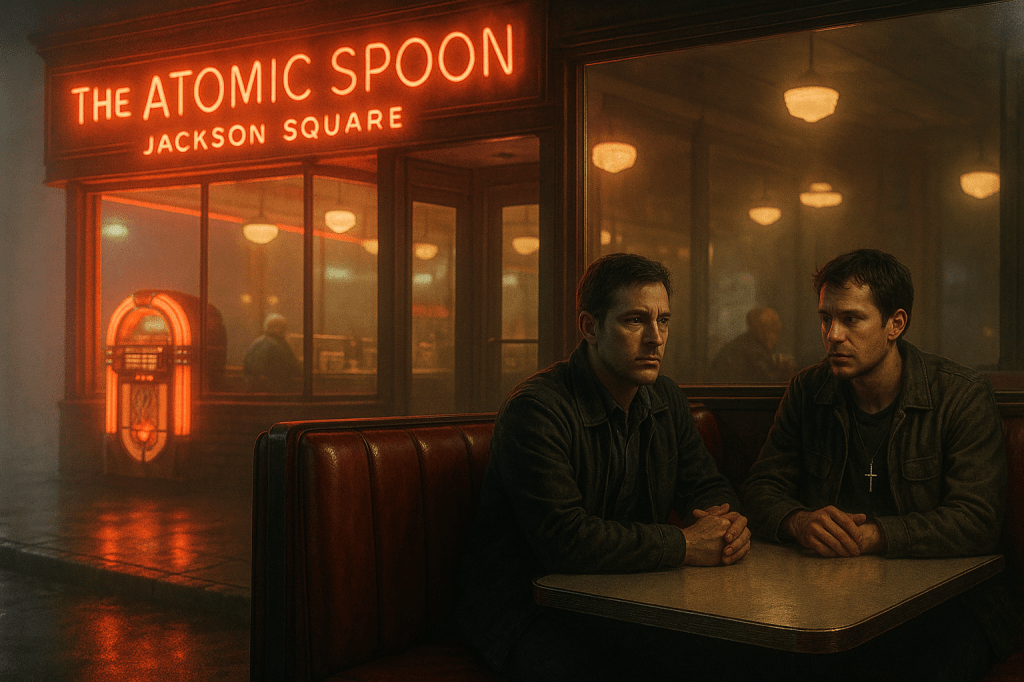
    The Atomic Spoon’s red neon buzzed in Jackson Square, a bloody glow piercing the fog that clung to the windows like a living thing, its tendrils curling inward as if drawn by the warmth inside. The air inside carried the heavy scent of fryer grease and burnt coffee, undercut by a faint chemical tang from Y-12 that seeped through the cracked window frames, a scar of Oak Ridge, Tennessee’s buried history that never fully faded. 

    The vinyl booths creaked under the group’s weight, their red surfaces worn smooth by decades of hands, the jukebox in the corner silent but looming, its glass reflecting the neon’s flicker like a watchful eye. Retirees at the counter sipped coffee, their murmurs about the weather—“Fog’s thicker than ‘73”—clashing with the tension that hung over the diner, a fragile normalcy that felt like a held breath.

    Caleb slouched in their usual booth, his broad frame taut as wire, gray eyes scanning the mist’s uneasy churn beyond the glass, its shapes twisting like shadows with intent. A grease streak on his jacket, a faint trace from his shop, felt like a tether to a world he could still touch, but X-10’s warped halls clung tighter—Ruth’s doppelgänger, her taunt of his failure a blade in his chest. He’d let her slip away—her glowing mark a scar, her laugh on the porch under starlight now a fading echo. 

    A memory surfaced as he watched the fog: Ruth leaning against her truck, her smile warm as she handed him a wrench, her trust a weight he’d failed to carry. The fear of losing Jonah, too, gnawed at him, a quiet dread that sharpened his gaze as he glanced at the man beside him.

    Jonah sat across, the small weight of his cross pressing against him, X-10’s rift hum still a claw in the Spoon’s quiet, now a faint buzz that seemed to vibrate in the neon’s flicker. His dark eyes traced the fog’s glow, its light stirring doubt from Ruth’s taunt, his faith fraying like threadbare cloth. 

    A memory rose: his first sermon at sixteen, his father’s stern gaze silencing his words of light, a failure that echoed now in The Hollow’s shadow. “This place feels off… again,” he said, his cadence soft but strained, fingers brushing the cross, the buzzing in his bones a reminder of past encounters in Jackson Square, a weight of unanswered prayers that pressed heavier with each moment.

    Miss Ida settled beside them, her Y-12 pin catching the neon’s fire, her gaze steady as stone but softened by regret, her hands resting on the table with a quiet strength. The chemical tang in the air stirred a memory—Amos in ‘73, his laugh warm over coffee at this very counter before Y-12’s lights took him, her warning ignored, a failure that now fueled her resolve to protect these boys. 

    “Ruth loved this booth,” Miss Ida said, her drawl warm but tight, her voice carrying the diner’s whispered secrets, the weight of Amos’s loss a scar that drove her to shield Caleb and Jonah from the same fate.

    Eli leaned against the counter, his ORNL badge swaying, the resonance emitter in his bag a tether to Ruth’s fight. Her absence stung, her questions alive in X-10’s waveform, a fire in his chest that burned brighter with each step. 

    A memory flickered—Ruth at the Spoon, her dark hair catching the neon as she teased him over his coffee, her determination a spark he now carried. “Fog’s worse than my lab notes,” he said, his tone crisp, a quip slicing through the unease, his grief for Ruth fueling a hope that the emitter could honor her legacy, a step toward closing the rift.

    The neon flickered outside, casting warped shadows across the diner’s linoleum floor, a low hum seeping from the radio, cold and wrong, the notes of an unplayed song twisting into dissonance. Caleb squinted at the windows, his shoulders tensing, the haze wavered beyond the glass, the shapes pressing like skeletal fingers against it. 

    Jonah’s fingers tightened on his cross, the buzzing in his bones deepening, a quiet dread settling in his chest. Miss Ida gripped her coffee mug, her gaze sharpening, the industrial bite sharp as memory. Eli froze, the diner’s warmth turning to ice, the hum intensifying as the mist flickered, twisting into unnatural forms.

    Two doppelgängers emerged from the haze—Caleb’s, gray eyes glinting with malice, its flannel stained with grease that bled green, and Jonah’s, its cross warped, the metal glowing sickly, their forms flickering like broken static, the air around them rippling with a heatwave that didn’t belong.

    Caleb’s doppelgänger stepped closer, its voice a rasp that cut through the retirees’ chatter: “You failed Ruth, let her fall.” Caleb’s fists clenched, guilt flaring, her porch vivid in his mind, her trust a wound that bled fresh. Jonah’s doppelgänger sneered, its voice a distorted echo: “Your prayers are empty, preacher. Your God abandoned Ruth, and you’re alone.” Jonah’s breath caught, faith cracking like brittle glass—God left her, left me. He sank into the booth, the cross slipping from his fingers. 

    His voice broke as a memory rose: that failed sermon at sixteen, his father’s stern gaze, words of light lost to silence, now mirrored in The Hollow’s taunt. “I can’t pray this away,” he whispered, despair a tide, faith a fraying thread in his bones, the rift’s drone drowning his hope, a dark night engulfing his light.

    Caleb’s doppelgänger pressed further, its gray eyes glinting with malice: “You want him closer than vows allow, but you’re too weak to face it.” Caleb’s breath caught in his chest, gray eyes darting away, Jonah’s hand trembling, their bond straining under the taunt’s weight, the fog outside pulsing in time with the radio’s hum. 

    Miss Ida stood, her Y-12 pin glinting like a blade, stepping forward with fire in her eyes, her voice fierce: “I failed Ruth and Amos, but I ain’t losing you boys.” A doppelgänger of her own flickered briefly—gray bun, eyes hollow, Amos’s shadow whispering her failure—before she gripped her pin, banishing it with a glare, her vow a shield for the group, resolve a beacon in the haze, the retirees’ murmurs falling silent as the air grew heavier.

    Caleb’s voice broke, a low rumble: “You’re not me.” His eyes locked on Jonah’s, raw and pleading, guilt shared in the dim light of the Spoon. “I’m scared I’ll fail you too, Jonah,” he confessed, voice raw, hand reaching out, fear laid bare, the memory of Ruth’s trust a weight he couldn’t shake. Jonah’s prayer faltered, John 1:5 a trembling whisper—“The light shineth in darkness”—his fingers shaking, but Caleb’s touch steadied him, a memory rising: Ruth at the Spoon, her hand on Jonah’s shoulder, affirming his sermon, her faith a light in his doubt. 

    “We’re in this together,” Jonah murmured, his voice trembling, quieter than usual, the doppelgänger’s taunt still echoing in his mind, a shadow he couldn’t fully shake. Caleb nodded, his gray eyes softening with concern as he noticed Jonah’s subdued state, the tremble in his voice, but he said nothing, holding back, trusting their bond to carry them forward.

    Eli stepped forward, his voice steady despite the surreal haze: “For Ruth’s fight.” Miss Ida nodded, her vow echoing: “For them all.” Their covenant flared, a quiet flame against the dark, binding them as one. Caleb clasped Jonah’s hand, his voice a quiet snap: “We’re enough.” Jonah’s prayer surged, John 1:5 trembling but persistent—“The light shineth in darkness, and the darkness comprehended it not.” 

    The cross glinted faintly, the doppelgängers’ marks dimming, Caleb’s doppelgänger dissolving into the fog with a fading rasp, but Jonah’s lingered, its warped cross glowing sickly, staring with hollow eyes that seemed to pierce through the diner’s warmth. It tilted its head, a slow, deliberate motion, the fog wrapping around it like a shroud, before it melted backward into the haze, its form disappearing into the chill mist, leaving a lingering unease in the air—a silent question that hung heavy: was it retreating, or planning something worse? 

    The radio silenced, the burnt metal stench lifting, the neon steadying, the Spoon a haven reclaimed, though the fog outside still whispered, its shapes more restless now, a shadow that refused to fully die.

    Miss Ida stood, resolve blazing, Esther’s journal vivid in her mind, Amos’s laugh a quiet echo she carried with pride. “I’ll find Kline’s device at Y-12, like Esther’s journal said,” she said, her voice warm, slipping out into the fog. Her sedan rattled down Bear Creek Road, a fifteen-minute drive to Y-12’s abandoned wing, the industrial bite sharp in her throat, the mist crowding her windows. 

    Her years at Y-12 guided her past a rusted gate near the old calutron section, to a hidden vault where Kline’s resonance device gleamed, its waveforms etched, tied to the Friendship Bell’s frequency. Miss Ida’s breath steadied, a memory surfacing: “In ‘73, Amos saw lights here, then vanished. I should’ve listened.” Her guilt faded, resolve a beacon for Ruth, for Amos, for the boys she’d protect, her vow a fire in her chest.

    Half an hour later, Miss Ida returned to the Spoon, device in hand, the group waiting, Caleb and Jonah’s hands still clasped, reflecting on the confrontation’s strain, Jonah’s silence heavier now, his dark eyes distant as he traced his cross, the doppelgänger’s taunt a lingering shadow. “Found it,” Miss Ida said, setting it by Eli, her voice warm but edged with the weight of Y-12’s scars. 

    Eli traced its etchings, hope flaring: “This’ll sync with the emitter.” Ruth’s fight burned in him, grief eased by purpose, her memory a spark in the neon’s glow. Two workers passed, their voices low, uneasy: “That hum’s like ’44’s tests.” Their words hung thick, Jackson Square’s fog heavier, a living pulse that seemed to watch them.

    The group rose, their bond reaffirmed, their covenant sealed with a shared vow: “For Ruth, together.” Caleb’s hand lingered on Jonah’s shoulder, his resolve firm as stone. Yet concern for Jonah’s quietness still clouded his gray eyes. 

    Miss Ida’s eyes shone, her protector’s fire steady, Amos’s memory a quiet strength. Eli’s posture stood tall, the device a path to The Hollow, Ruth’s determination alive in his chest. The fog pulsed outside, Y-12’s tang sharp in their throats, a rift’s whisper—“It sees you”—urging them on, the Spoon’s warmth a fragile shield against the gathering dark.

    (Chapter from The River’s Double in the Secret City series. Contact me if you’d like to read the full story)
  • The Road Ahead (Chapter)

    The Road Ahead (Chapter)

    The call came midweek—landline, crackly like always.

    Joel answered. Jed listened from across the table, one eye on the newspaper, one ear tilted toward the tone in Joel’s voice.

    When Joel hung up, he said, “Amos needs a hand with hay. Out near his uncle’s pasture.”

    Jed raised an eyebrow. “He ask for both of us?”

    Joel gave a small shrug. “Said he could use a second truck. Didn’t say which.”

    Jed folded the paper. “Then he knows who he’s gettin’.”

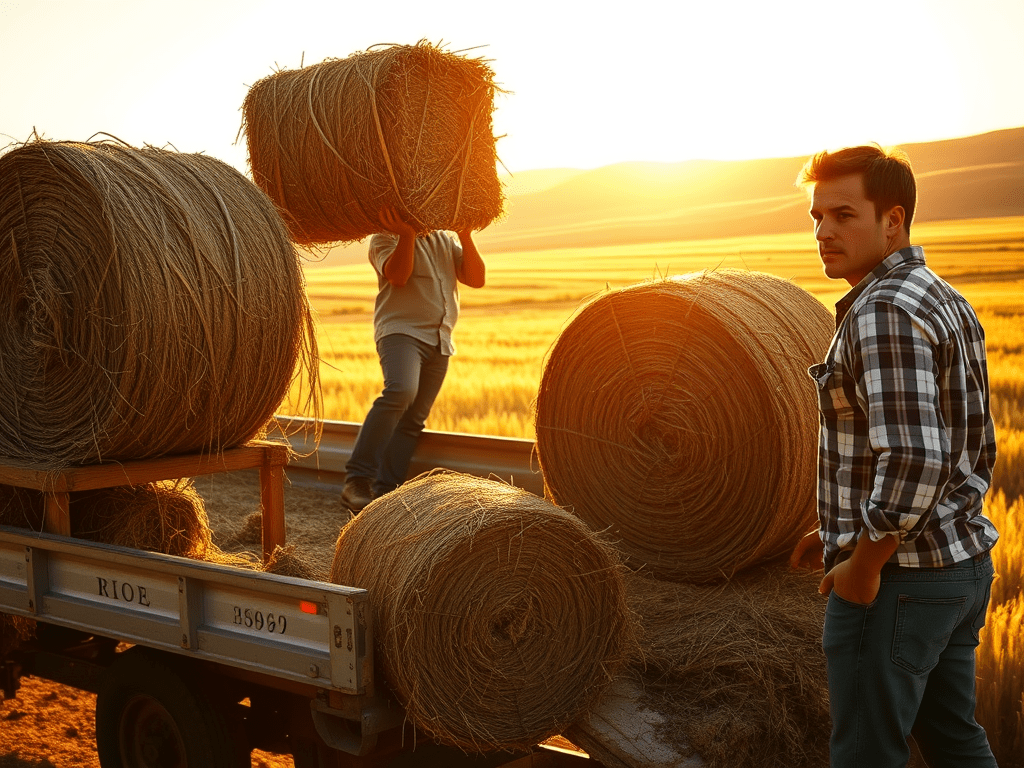
    The pasture stretched wide near the back of a valley Joel hadn’t driven through in months. The grass was already cut and drying in long golden strips. Amos was there, stacking bales at the edge of the flatbed, sweat darkening the back of his shirt. His usual grin was gone—just a quiet nod now. Earnest, not casual. He looked up as they pulled in and gave a nod—no smirk, no comment. Just a nod.

    Jed backed the truck beside the first and climbed out slow, his ribs still not perfect but holding. Joel joined him, tossing gloves from the cab.

    They worked without fanfare—Jed and Amos loading from one end, Joel from the other. The sun sat hot above them, clouds hanging off in the distance like they were waiting their turn.

    The bales were dense from the last rain, heavy but clean. The kind of labor that didn’t give you time to think about much else.

    After the first load, Amos broke the quiet.

    “Didn’t know if you’d come.”

    Jed looked over. “You asked.”

    Amos nodded, eyes back on the hay. “Just wasn’t sure if askin’ was still allowed.”

    Joel didn’t say anything, but his hands kept moving.

    Amos didn’t push further. Just worked. And that said more than it needed to.

    When they were done, Joel rinsed off at the pump while Jed sat on the tailgate, one hand pressed against his side. Amos handed him a bottle of water, cracked open.

    “Thanks for showin’ up,” Amos said.

    Jed took the bottle. “We tend what needs tendin’.”

    Amos nodded, then turned back toward his truck.

    Joel glanced at Jed. “Think that was an apology?” He didn’t say it out loud, but part of him felt it—a crack in the wall he’d built around old church wounds. Amos hadn’t fixed anything. But he’d looked him in the eye, and that mattered more than he expected.

    Jed grunted. “Close enough.”

    Back home, the light slanted long across the yard. Dust trailed them like a second shadow as they pulled in. Joel stepped out and went to rinse the sweat from his arms. Jed moved slower, walking toward the shed.

    Inside, he pulled a small cedar plank from the scrap pile. Ran his fingers over the grain, thumb brushing a knot near the center.

    He didn’t sketch. Didn’t plan.

    Just carved.

    That night, the house was quiet. No fire, no fuss. Just low light and the steady hum of the record player.

    “Be Thou My Vision” played soft in the background—old recording, faint scratch between verses. It filled the space without asking anything in return.

    Joel stood in the doorway between kitchen and living room, a towel over one shoulder, tea in hand. Jed was seated at the table, something in his hands.

    A cedar box. Small. Sanded smooth. Corners tight. The lid carved with a subtle ridge line—nothing fancy, just enough to catch light if it wanted to.

    Jed didn’t say anything. Just set it on the windowsill beside Joel’s mug.

    No note.

    No explanation.

    Just wood. Weight. Gesture.

    Joel looked at it a moment, then sat down across from him. Jed reached out, rested his hand briefly on the windowsill near the box—then on the edge of the table between them. Not claiming. Just anchoring.

    The record spun. The house held.

    Outside, the wind picked up through the trees, brushing past the eaves like a hand through old hair.

    Neither man said much the rest of the evening.

    They didn’t need to.

    The world might still talk.

    But the box on the sill and the hymn in the air said more than judgment ever could.

    (Chapter from Weathered Fields in the Jed and Joel series. Contact me if you’d like to read the full story!)

  • The Fire’s Bond (chapter)

    The Fire’s Bond (chapter)

    Jed stood alone behind the barn, hands deep in his coat pockets, the ridgeline fading into shadow. The cedar branch leaned against the shed wall, still damp in spots from where he’d rinsed off the silt.

    He didn’t know why he’d brought it in, not exactly. Just that it felt right to burn something that had been through floodwater and still held together.

    The wind cut low through the trees. He turned, picked up the branch, and headed toward the house.

    The frost came early that night, settling over the pasture like breath held too long. The stars hung sharp overhead, not twinkling but steady, cold and clear.

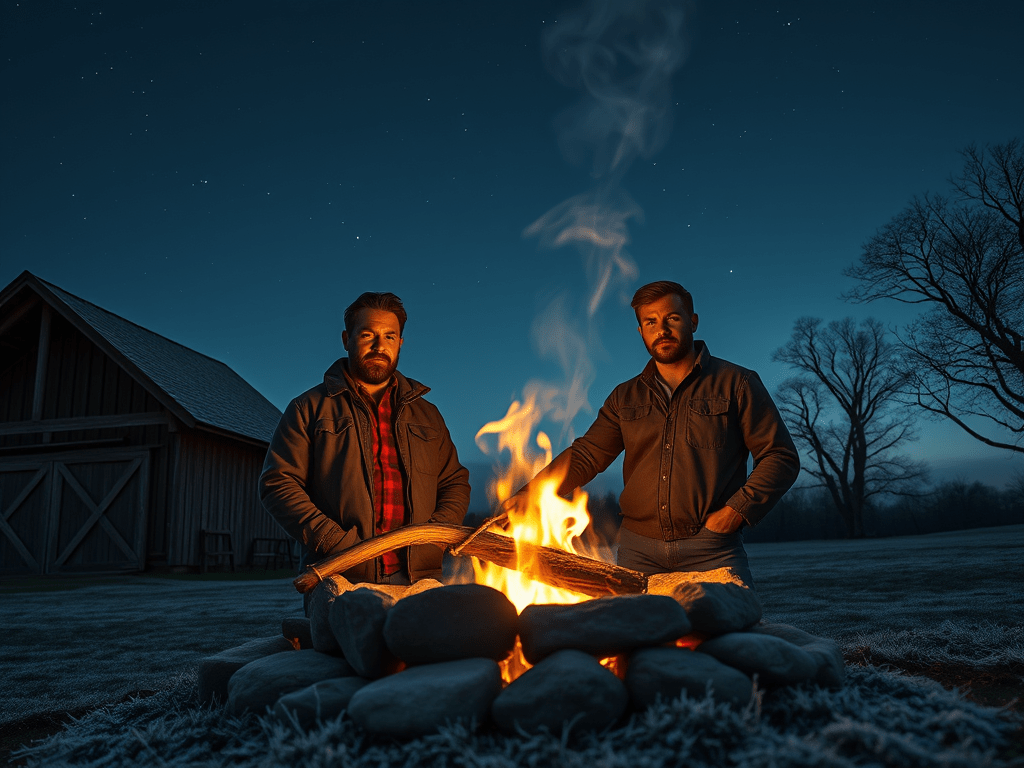
    Joel struck the match, shielding the flame from the breeze as it caught on the edge of kindling. The fire-pit had been his idea—simple stones ringed around a bare patch of earth near the edge of the ridge. Jed had helped stack them earlier that day, one-handed but stubborn, muttering the whole time about symmetry and heat flow.

    Now the flames licked upward, slow at first, then sure.

    Jed stepped out from the house with a thick cedar branch in one hand. Not fresh, but not old either—weathered just enough to crack loud when it burned. He’d found it near the creek, half-buried in silt from the last flood. Same bend where things had once gone wrong. It wasn’t clean wood—it was carried wood. But it burned.

    Joel moved aside to let him through.

    Jed laid the branch across the top of the fire, not saying a word.

    The flames took hold.

    The cedar popped and hissed, sap still trapped deep in the grain. Smoke curled white into the night air, rising toward stars that did not blink.

    They stood in silence, faces lit orange and gold.

    Joel finally spoke, voice low. “Feels like the kind of night you don’t get again.”

    Jed nodded. “It is.”

    He reached into his coat pocket, pulled out the same carving knife Joel had once found on the porch rail. He didn’t open it—just held it a moment, then set it beside the fire.

    “I don’t want to carry anything unclear anymore,” Jed said. “Not with you. Not with God.”

    Joel watched the fire.

    Jed went on. “I’ve prayed a lot of prayers these past weeks. Some loud. Most not. But I keep comin’ back to the same one.”

    He looked up.

    “Create in me a clean heart, O God…”

    His voice didn’t shake. But it was rough from the inside out.

    “Give me the strength to be your brother, not your temptation. To build with you, not burn.”

    Joel’s eyes stayed on the fire, glassy in the glow.

    Then he spoke—quieter, but thick at the edges.

    “I’m done runnin’.”

    Jed looked at him.

    Joel didn’t blink. “I ran from Athens. From the church. From the ache. Even from this—whatever this is.”

    He stepped forward, closer to the heat.

    “But I ain’t runnin’ anymore. I don’t want to pretend I don’t feel what I feel. But I want to walk it different. Carry it clean.”

    Jed swallowed hard, throat tight.

    Joel extended a hand.

    Not soft. Not trembling.

    Just strong and open.

    Jed reached out and clasped it.

    Not like a greeting.

    Not like goodbye.

    But like something being bound in place.

    Their hands gripped firm, and the fire cracked louder—one loud pop like a punctuated amen.

    (Chapter from Weathered Fields in the Jed and Joel series. Contact me if you’d like to read the full story!)

  • The Weight of Care (chapter)

    The Weight of Care (chapter)

    Late spring pressed down on the ridge, warm enough to sweat but not yet thick with summer. The land was greening fast—hedgerows filling out, fence posts shading over, weeds growing where the rows hadn’t been turned yet. It was the kind of season that didn’t wait for anyone.

    Joel ran the farm alone that week. Jed’s shoulder and ribs were still too tender for anything more than slow steps and short sentences. He spent most days on the porch, sorting tools with his good hand or whittling pieces of cedar from the scrap pile. He didn’t complain, didn’t moan—just stayed still. Which, for Jed, said plenty.

    Joel hauled feed. Turned compost. Replaced a post near the creek where the frost had split it too deep. Every day ended with him bone-tired and half-drenched in sweat.

    Some days, he thought of his uncle’s land back in Georgia—how he’d spent one summer there as a boy, swinging a hoe he was too small for, trying to earn a man’s nod. He remembered the ache in his arms, the blistered palms, the way no one told him he’d done well—just let him keep coming back. Maybe that’s when it started, the belief that staying was the only way to be seen.

    He didn’t mind the work. But it felt different without Jed beside him—no rhythm to match, no shared silence to lean into. The quiet felt more hollow when you were the only one moving.

    That afternoon, after dumping the last load of hay, Joel stepped inside and dropped the keys on the counter. Jed sat in his chair by the window, knife in hand, shaping a piece of cedar into something small and simple.

    “Fence holdin’?” Jed asked.

    Joel nodded, wiping his neck with a dish towel. “For now.”

    Jed didn’t press further.

    Joel poured water into the kettle and set it to boil.

    Jed watched him a moment, then looked back at the piece in his hand.

    “I ever tell you about the time my dad got pinned under the tractor?”

    Joel raised a brow. “No.”

    Jed nodded slowly. “I was twelve. He was clearin’ brush down near the creek. Wet ground, bad angle, wheel caught and tipped the whole rig sideways. Pinned his leg under the axle.”

    Joel leaned against the counter. “How’d he get out?”

    “He didn’t. Not by himself.” Jed paused. “I found him an hour later, yellin’ so hoarse he couldn’t get words out. Thought he was done for. But he didn’t cry. Didn’t beg. Just looked at me and said, ‘You better figure it out.’”

    Joel’s face twitched in something like a smile. “Sounds about right.”

    “I rigged a jack under the back axle and used fence boards to wedge it. Took me twenty minutes to get him loose. My hands were shaking the whole time.”

    He paused again. The knife rested still against the wood.

    “After that, he never told me I wasn’t strong enough to handle things.”

    Joel watched him, the kettle beginning to hiss behind him.

    Jed looked up. “Point is, sometimes grit ain’t loud. Sometimes it’s just not leavin’.”

    Joel turned and poured two mugs, brought one over, set it in front of Jed.

    “You’re sayin’ I’m not leavin’.”

    Jed met his eyes. “I’m sayin’ you don’t need to carry it like you’re proving something.”

    Joel sat, the mug warm in his hands. He stared down at it for a long moment.

    “I think part of me’s still scared it could all break,” he said finally. “Not just the farm. Us.”

    Jed didn’t flinch. “I know.”

    Joel’s voice dropped. “It’s not that I don’t trust you. It’s that I don’t trust what the world does to things like this.”

    Jed nodded once. “Yeah.”

    They sat with it.

    Outside, a breeze kicked up, pushing warm air through the open screen.

    Joel stood, crossed the room, and switched on the old radio that sat on the shelf beside the stove. The dial was touchy, but he worked it slow. Static gave way to faint harmony. A familiar tune—slow, faithful.

    “I’ll fly away…”

    Jed smiled faintly. “Your mama used to sing that, didn’t she?”

    Joel nodded. “Every Saturday morning, whether we wanted her to or not.”

    Jed closed his eyes, the smile still there.

    They let the song play through. Didn’t sing. Just listened.

    When it ended, Joel turned the dial off again. The room settled back into the hush of late evening.

    Jed’s knife returned to the cedar. The rhythm of the carving resumed—soft, patient, steady.

    Joel sipped his tea, the warmth working slow into his chest.

    He was tired. But not running.

    Not tonight. 

    Something in him had shifted. Not loudly, not all at once—but like a stone set in place. He wasn’t owed a promise. But maybe he’d stay long enough to offer one.

    (Chapter from Weathered Fields in the Jed and Joel series. Contact me if you’d like to read the full story!)

  • Forgiveness in the Dust

    Forgiveness in the Dust

    Some things don’t mend loud. They just start holdin’ again, slow and steady.

    The morning was cooler than it had been in weeks. Sky still pale, light slipping over the ridge slow, like it wasn’t in a hurry to see what the day would hold.

    They’d been fixing fence since dawn—nothing urgent, just one of those sections that’d gone soft with rain and time. A corner post leaning wrong, wire sagging like tired shoulders. Jed had said it needed shoring up. Joel hadn’t argued.

    They worked steady, boots wet with dew, breath visible in the shade.

    Not much was said. But it didn’t feel like before. The silence had changed shape.

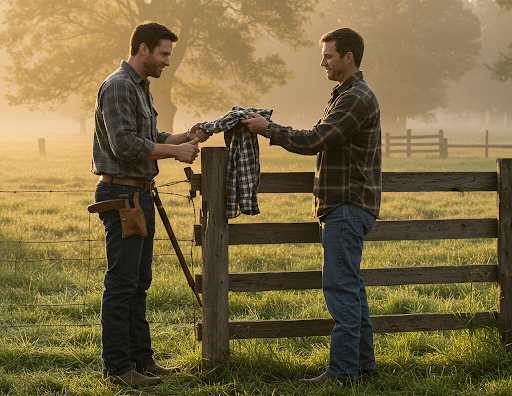
    When the last nail was in, Joel stepped back, brushed off his hands, and walked to the truck. He rummaged a second, then came back holding something folded.

    Jed squinted. “That my old flannel?”

    Joel held it out—clean, sun-dried. “Figured you might want it back.”

    Jed took it without a word. Held it a beat longer than he needed to, thumb brushing the worn edge like he was feeling something older than fabric. Then he looked up.

    “Thanks,” he said. 

    Joel nodded once, started to turn—then paused.

    “You still want me here?”

    Jed didn’t hesitate. “You wouldn’t still be here if I didn’t.”

    Joel looked at the ground, then back at Jed. “Alright.”

    Jed moved past him toward the barn, but halfway there, he reached back and tapped Joel’s arm lightly with the folded shirt.

    “Put that in the house, will you?”

    Joel took it. Tucked it under his arm like something that still had weight.

    Later, when they were both back inside, Jed poured the coffee. Poured Joel’s too—no need to ask how he took it. He slid the mug across the table like he had a hundred times before.

    Joel caught it. Held it a second. “Thanks.”

    Jed nodded, still standing. “Good to have you back at the table.”

    That was all.

    But it was enough to start again.

    (Chapter from First Light in the Jed and Joel series. Contact me if you’d like to read the full story!)

  • Time, Silence, and Bonds (chapter)

    Time, Silence, and Bonds (chapter)

    Years Later. Older, quieter. But never alone.

    The cabin hadn’t changed much. But they had.
    The trail was a little more overgrown. The porch leaned in the same stubborn way. The firepit still held their stories. So did the trees.

    They’d been back to the cabin since that first trip. A few times. But this one felt different.This was the place where silence cracked them open.Where fire asked questions they hadn’t dared to say out loud.They weren’t chasing something undone.They were returning to witness what had held.

    The gravel crunched under the tires as Clyde eased the truck into the clearing. The sun was low, casting long fingers of light across the ridge. Early fall again—cool in the shade, warm where it touched the skin.

    Tyler climbed out from the passenger side. His beard was fuller now, flecked with gray. His frame had filled out a little over the years—stronger, steadier. He moved with less hurry. With more knowing.

    Clyde rounded the front of the truck, duffel in hand. “Still leans,” he said, nodding toward the porch steps.

    Tyler gave a soft smile. “So do we.”

    The door creaked open before they knocked. Ted stood in the frame, coffee mug in hand, silver hair catching the last of the light. “Well, look who dragged in.”

    Ethan stepped up beside him, arm slipping around Ted’s waist like it belonged there. “Took you long enough,” he said, grinning.

    Clyde shook his head. “Some things are worth not rushin’.”

    Inside, the cabin still smelled like pine and ash. A few upgrades—fresh paint, firmer cushions—but the bones were the same. Familiar. Honest.

    They spent the afternoon catching up. Talk meandered—work, aches, the stubbornness of aging knees. Ethan and Ted had moved east a few years back when Ethan took a position at the university. Still kept the cabin, though. Called it their retreat place. Said it was where things always made sense again.

    “We wanted this one with y’all,” Ethan said. “Felt like time.”

    Later that evening, they built the fire. Just the four of them. Clyde and Tyler dragged logs into a ring, same as they’d done all those years ago. The smoke rose in steady plumes, and the crackle of wood filled the silence like a hymn.

    Rachel came by before dinner. Hugged each of them. Handed Ted a tin of cinnamon rolls and Ethan a jar of her blackberry jam. She lingered at the edge of the clearing for a while after her goodbyes, eyes trailing to the four men circled around the flame.

    The firelight caught their faces in turn—creased with time, softened with years. Tyler and Clyde sat nearest each other, shoulders brushing now and then, not from habit but from history.

    Rachel murmured, “Whatever it is they’ve got… it held.”
    Then she turned and disappeared down the trail.

    Later that night, after the dishes were done and the air turned crisp, the four men circled the fire again. No one rushed the conversation. No one needed to.

    Ted was the first to break the stillness. “You ever think we’d end up like this?”

    Clyde gave a small grunt. “Not exactly like this.”

    Ethan leaned forward, the light catching in his eyes. “I did. Didn’t know how. But I believed we could.”

    They fell quiet again—not because there was nothing left to say, but because some truths were better shared in silence. It wasn’t awkward. It was earned.

    Eventually, Ted and Ethan rose, stretched, murmured something about sleep. Tyler and Clyde stayed behind.

    The fire was lower now. Glowing. Breathing.

    Tyler leaned in, elbows on his knees. “Remember that first time we were out here? Just us?”

    Clyde nodded. “After Ted and Ethan couldn’t come. Porch was saggin’. Silence so thick we couldn’t breathe through it at first.”

    Tyler’s mouth lifted. “Until it cracked us open.”

    Clyde didn’t respond with words. Just reached over and passed him a stick. Tyler took it, stirred the coals absently.

    After a while, Clyde said, voice quiet but sure, “I used to think silence meant somethin’ was broken. Now I think… maybe it just means it’s holdin’.”

    Tyler nodded, eyes still on the fire.

    They sat like that for a long time, the fire painting them in gold and emberlight. The woods whispered. The stars held watch.

    When they finally stood, Clyde’s knees cracked. Tyler offered a hand—not because he needed to, but because he could. Clyde took it.

    They walked toward the cabin, slow and shoulder to shoulder.

    “Still with you,” Clyde said, eyes on the porch.

    Tyler smiled. “Always.”

    The porchlight flickered on as they climbed the steps.
    Not just habit. Not just homecoming.
    A covenant that hadn’t loosened, even when words failed.

    Still with you.
    Still.

    (Final chapter from Held Fast in the Tyler and Clyde series – Contact me if you’d like to read the full story!)

  • A New Kind of Fire (chapter)

    A New Kind of Fire (chapter)

    The fire was already going when Tyler showed up—low and steady, crackling in the pit behind Ted’s place. It was dusk, the sky dimming slow, bruised purple at the edges. The air smelled like pine smoke and damp leaves, like the woods were remembering something.

    Clyde was sitting on one of the big split logs circling the fire, shoulders hunched, arms resting on his knees. He looked up when Tyler approached but didn’t say anything at first.

    Tyler gave a soft, familiar nod. “Figured you might be out here.”

    “Didn’t feel like bein’ inside,” Clyde said. His voice was low, steady. “Didn’t want to be around folks who expect me to smile and nod like I ain’t still workin’ this out.”

    Tyler sat on the log beside him—not too close, not distant. Just near enough to be known.

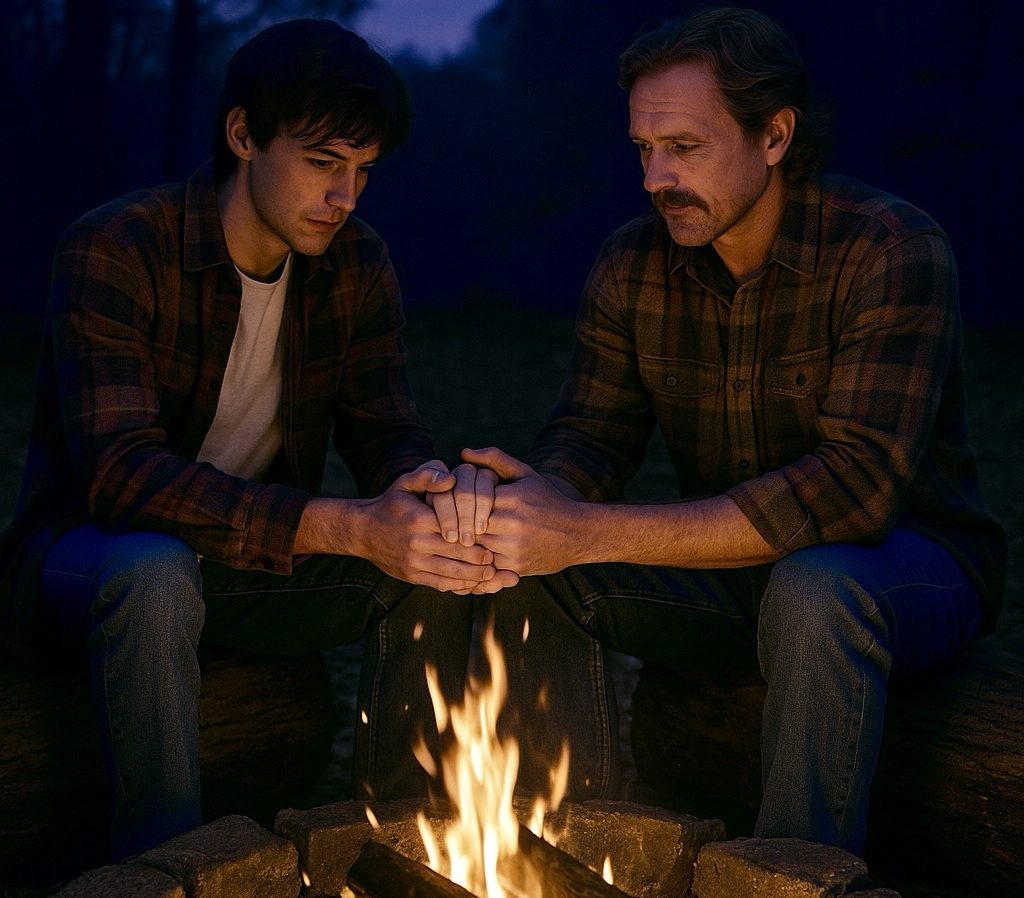
    For a while, they didn’t talk. Just watched the flames rise and settle. Sparks danced up into the darkening sky like prayers they didn’t have words for yet.

    After a while, Clyde cleared his throat. “You ever wish it had turned out different?” he asked. “That night in the cabin. Or the one after the storm.”

    Tyler didn’t answer right away. He looked into the fire like it was telling the story for them.

    “I used to,” he said finally. “Used to think maybe if we hadn’t pulled back, it’d feel more certain now. More defined.”

    Clyde nodded slowly, eyes on the flames. “But it wouldn’t’ve been clean.”

    “No,” Tyler said. “It wouldn’t’ve been holy either.”

    They sat with that.

    “I still feel it,” Clyde admitted, barely audible. “That ache. That pull. It don’t own me like it did, but it ain’t gone.”

    Tyler’s voice was soft. “I know.”

    A long breath passed between them. The fire cracked. The trees swayed.

    “I spent too long thinkin’ desire was the same as failure,” Clyde said. “But I don’t want to keep shovin’ it down like it’s poison. I want to name it. Lay it down. Not ‘cause I’m ashamed—but ‘cause I want somethin’ better.”

    Tyler reached down and tossed another log on the fire. “We don’t need to burn it down.”

    Clyde turned to him, eyes wet and bare in the firelight.

    “No,” he said. “We just need to bring it to the altar.”

    And there it was.

    Tyler leaned forward, elbows on his knees, voice thick. “You know I’ve loved you, right? In all kinds of ways.”

    Clyde nodded. “Yeah. I’ve felt it. I’ve carried it.”

    He paused, eyes locked on the fire. Then, softer:

    “And I’ve loved you back. In ways I didn’t have words for ‘til now. But it’s been there. Still is.”

    The fire crackled, filling the quiet that settled between them. Tyler looked over—not startled, not unsure—just moved. Like something in him had finally been met.

    “But the only part I want to last,” Tyler said, “is the part that holds.”

    Clyde looked away, jaw trembling. He scrubbed a hand across his face, then reached out—awkward at first, but sure—and gripped Tyler’s hand in both of his.

    They stayed that way, hands clasped between them, firelight flickering across worn knuckles and calloused palms.

    “I want to walk this out,” Clyde said. “Fully known. Fully brother.”

    Tyler’s eyes shone. “Then let’s name it for what it is. Not what it could’ve been.”

    A breeze stirred. A log popped.

    Neither of them moved to let go.

    After a while, Clyde whispered, “Would it be alright if I prayed?”

    Tyler nodded. “Yeah. More than alright.”

    Clyde didn’t bow his head. Didn’t close his eyes. He just looked up into the dark sky and spoke like he was talking to Someone who had seen the whole thing unfold and still chose to stay.

    “Lord… You know what this is. What it’s been. What we’ve wrestled and hoped and feared. We’re layin’ it down. Not ‘cause we don’t care—but ‘cause we do. Help us guard what You’ve built. Keep it strong. Keep it pure. Help us hold each other the right way.”

    His voice caught on that last line, and he didn’t try to push through it. Just let it hang there, trembling like an offering.

    Tyler whispered, “Amen.”

    They didn’t hug. Didn’t cry loud or fall into each other’s arms.

    But when Clyde finally let go of Tyler’s hand, he leaned sideways—just enough that their shoulders touched.

    And this time, the closeness didn’t need explaining.

    The fire kept burning.

    But it was a new kind of fire now.

    (From Held Fast, from the Tyler and Clyde series. Contact me if you’d like to read the full story!)

  • Late-Night Drive (chapter)

    Late-Night Drive (chapter)

    The road out past the county line was empty at this hour—just gravel hum and headlights stretching out into darkness. Clyde gripped the wheel loosely, arms tired but restless. The windows were down enough to let in the cool night air, and Tyler’s elbow rested on the sill, fingers drumming absently to a tune that wasn’t playing.

    They hadn’t said much since leaving the diner. Just a shared glance over the check. A quiet “Wanna drive a while?” from Clyde. And now here they were—suspended somewhere between farmland and forest, the kind of in-between that made it easier to say things you couldn’t in daylight.

    Clyde broke the silence first. “Used to think if I kept busy enough, I’d never have to sit with what was underneath.”

    Tyler didn’t respond. He didn’t need to. Just turned slightly in his seat, watching Clyde’s profile in the dim glow of the dash lights.

    “I didn’t grow up with language for any of this,” Clyde went on. “Didn’t have categories. Just a gut full of fear and a church that said ‘don’t’ louder than it ever said ‘belong.’” His voice cracked faintly. “So I shoved it all down. Called it victory.”

    The truck bumped over a stretch of washboard road, but neither of them flinched.

    Clyde’s hands tightened on the wheel. “There was this preacher once—revival tent kind. Said somethin’ like, ‘Holiness is when you stop wantin’ the wrong things.’ I held onto that like it was gospel truth. Figured if I could just hate the ache hard enough, I’d be holy.”

    Tyler shifted, his voice low. “Did it work?”

    Clyde’s laugh was dry. “I got good at denyin’. Real good. Thought wantin’ made me weak. Turns out denyin’ it made me bitter.”

    They drove a few more beats in silence, the sound of tires and cicadas filling the gaps.

    “I think I ruined some good things,” Clyde said. “Pushed folks away who might’ve stayed. Punished myself for wantin’ to be known.”

    “You weren’t wrong to want it,” Tyler said gently. “Just… wrong to think you had to kill it to be worthy.”

    Clyde blinked, eyes fixed on the road. “Then what do I do with it now? That ache, that pull. It’s still in me.”

    “You bring it to the fire,” Tyler said. “Let it burn what needs burnin’. But don’t throw yourself on the flames to prove you’re faithful.”

    Clyde swallowed hard.

    “You don’t have to keep punishing yourself to prove you’re holy,” Tyler added, voice even softer. “That’s not the kind of holiness God’s after.”

    They reached a bend in the road and Clyde pulled off, gravel crunching beneath the tires as he eased the truck to a stop. They sat there, engine idling, facing a stretch of trees silhouetted against the moonlit sky.

    Clyde stared out at nothing. “I’m tired of bein’ scared of my own soul.”

    Tyler nodded slowly. “Then maybe it’s time to stop runnin’ and start lettin’ it be healed.”

    The engine ticked as it cooled. Somewhere in the distance, a barred owl called once.

    Clyde exhaled, long and slow. “I ain’t got the answers.”

    “I don’t need you to,” Tyler said. “I just need you not to walk off again.”

    A pause. Then Clyde reached for the keys and turned the engine off. The silence that followed wasn’t empty.

    They sat there for a long while in the stillness. Two men, shoulder to shoulder in the dark, finally letting the ache breathe.

    And for once, neither tried to fix it.

    (From Held Fast, from the Tyler and Clyde series. Contact me if you’d like to read the whole story!)

  • The Storm and the Shelter (chapter)

    The Storm and the Shelter (chapter)

    The thunder came low and steady at first—more a warning growl than a threat. By the time Clyde swung the church’s side door shut behind them, the sky had split full open. Sheets of rain hammered the tin roof like it had something to prove.

    The power had flickered twice during the evening men’s gathering, and Ted had called it early, shooing everyone out before the worst of it hit. Everyone except Clyde and Tyler, who’d stayed behind to gather chairs and clean up—same as always. Familiar rhythm. Shared silence. And now, the storm.

    “Guess we’re waitin’ it out,” Clyde muttered, glancing toward the windows streaked with water.

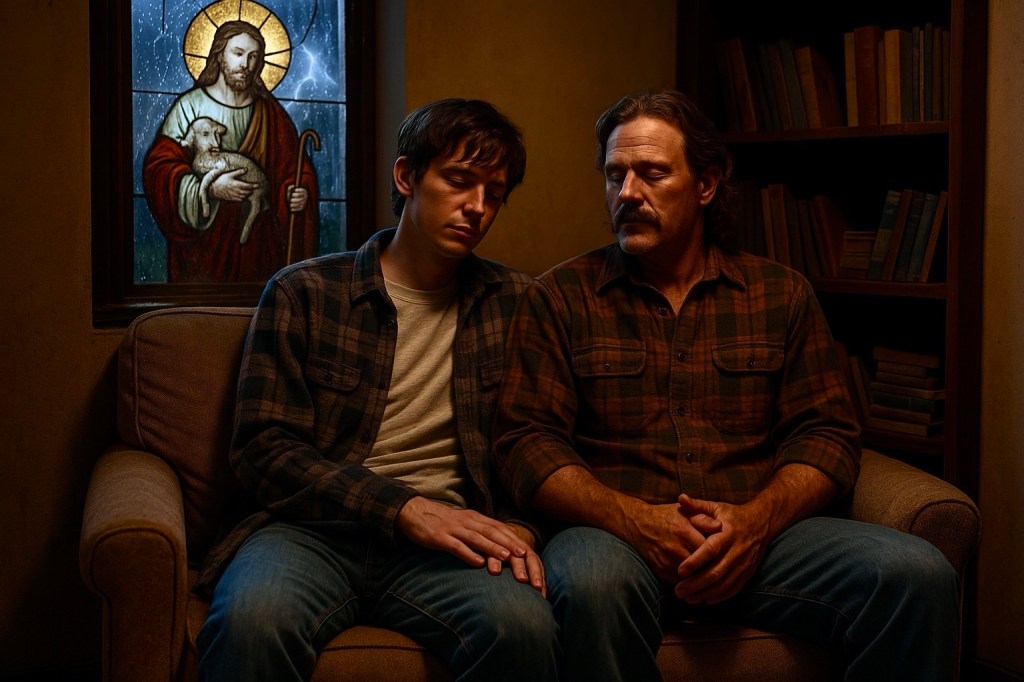
    Tyler didn’t answer at first. He was watching the lightning flash behind the stained glass—Christ the Shepherd lit up in flickers of blue and gold. “Not a bad place to get stuck,” he said softly.

    They settled into the little room off the back hallway—part storage, part prayer nook. A loveseat sat against one wall, old and sunken in places, and a shelf of dusty devotionals lined the opposite wall like forgotten psalms.

    Tyler sat first, curling one leg under him. Clyde followed, stiff at first. The air smelled of wood polish and rain.

    Neither spoke for a while.

    The thunder moved closer.

    Tyler’s voice came quiet. “Storms used to scare me. When I was a kid.”

    Clyde looked over. “Me too.”

    Tyler gave a faint smile. “Not the thunder. Just… the feeling like something was comin’ for me. Like the house couldn’t quite hold.”

    Clyde nodded slowly. “Yeah.”

    The silence returned, but it wasn’t empty.

    Then Clyde said, voice low and unsure, “There’s nights I still feel it. That ache. Not just for someone beside me… but for someone who sees it all and doesn’t flinch.”

    Tyler didn’t move. Just listened.

    Clyde went on. “I spent half my life tryin’ to shut that down. To be a man nobody had questions about. And I was good at it, mostly.” He gave a rough breath of a laugh. “Guess the trouble came when I stopped wantin’ to be unseen.”

    Lightning lit the windows again, and the thunder came close behind.

    Tyler reached over—just a hand on Clyde’s knee, quiet and steady. Not pulling. Not asking. Just… there.

    Clyde looked at it. Then at Tyler. His voice shook a little. “I still want it sometimes.”

    Tyler held his gaze, warm and unswerving.

    “But not as much,” Clyde whispered, “as I want it to be holy.”

    Something passed between them then—heavier than want, lighter than fear. Like grace threading through the air.

    They both leaned back into the worn cushions, shoulders touching now–warm and steady. Tyler let his hand fall away, but the closeness remained, no longer needing to ask for space.

    “We’re not wrong for needing,” he said gently. “But we’re free to choose what we do with it.”

    They sat there, the storm drumming above like it was testing the roof. Clyde let his eyes close for a moment.

    When he opened them, he said, “Would you pray?”

    Tyler nodded once, then bowed his head—not in performance, but in offering.

    The words were soft. Just enough to be heard above the rain.

    “Lord, be near. In the ache, in the waiting. Make this bond more Yours than ours. Keep it steady. Keep it clean. Amen.”

    They didn’t speak after that.

    Just sat together as the storm ran its course.

    Two men under one roof, shoulder to shoulder.

    Choosing peace.

    Choosing light.

    (Chapter from Held Fast, from the Tyler and Clyde series. Contact me if you want to read the whole story!)

  • Spring Thaw (chapter)

    Spring Thaw (chapter)

    The thaw came slow that year.

    Winter hadn’t bowed out so much as lingered, leaving behind half-frozen puddles and sullen banks of gray snow. But the sun was out today, and the breeze, while cool, no longer bit. It was the kind of day that hinted—just hinted—that spring wasn’t far off.

    It had been a few months since the cabin trip. Enough time for the heat of that night to fade into something quieter. Not forgotten. Just settled—like ash after flame.

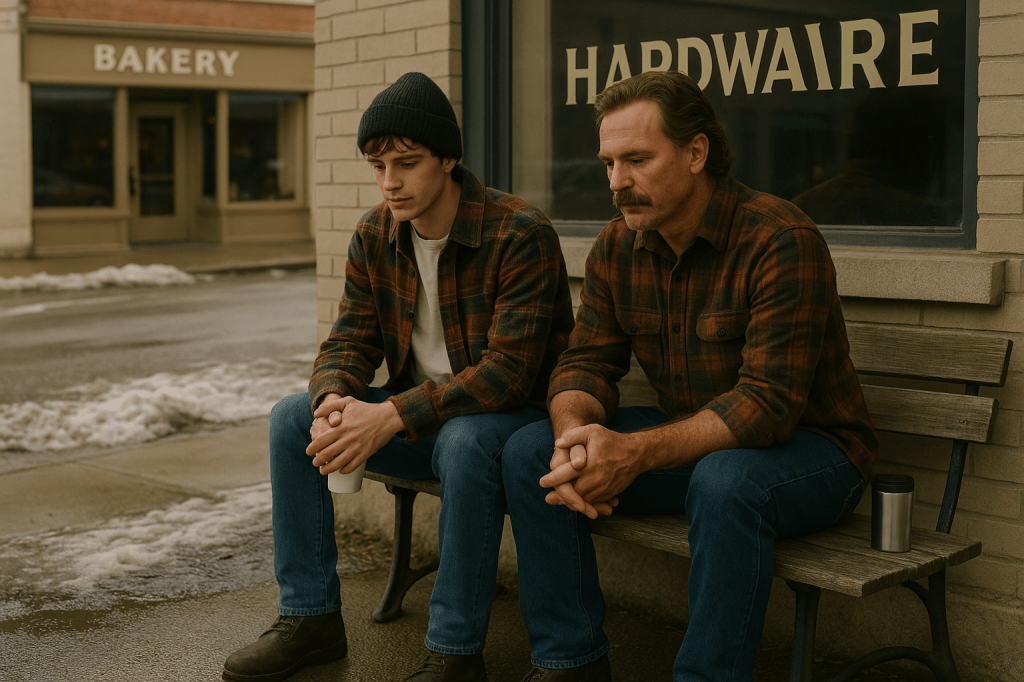
    Clyde sat on the bench outside the hardware store, thermos resting on the space between them. His boots were planted wide, hands folded, eyes half-focused on the traffic crawling through town. The kind of watching that wasn’t about what passed by, but what stirred underneath.

    Tyler showed up without ceremony—coffee in one hand, other tucked into the pocket of his flannel. He dropped into the seat beside Clyde like it wasn’t a decision at all. Just where he belonged.

    For a while, they didn’t say much. Cars passed. A breeze stirred wrappers along the sidewalk. Across the street, someone stepped out of the bakery with a bag of rolls and a cigarette already lit.

    “You ever notice,” Clyde muttered, “how things look softer once the snow starts pulling back? Like the ground’s rememberin’ how to breathe.”

    Tyler nodded, eyes on the slush-glazed curb. “Yeah. It’s messy, but… honest. Like nothin’s pretendin’ anymore.”

    Clyde made a low sound of agreement and reached for the thermos, taking a long sip before passing it over. Tyler drank and didn’t offer it back right away. His shoulder bumped Clyde’s, barely.

    He let it stay.

    “It’s been quiet,” Tyler said finally. “Not in a bad way. Just… quieter since we got back.”

    Clyde nodded once. “Different kind of quiet.”

    “You good with it?” Tyler asked.

    A beat passed.

    “I am,” Clyde said. “Not sure I know what to call it yet. But I’m at peace.”

    Tyler gave a soft hum of agreement. “I don’t regret it. That night. Not even the part that maybe shouldn’t’ve happened.”

    Clyde didn’t look over. Just let out a long, slow breath. “Me neither.”

    They lapsed into silence again, but this one felt full—like the space between them had grown wide enough to hold what they weren’t saying out loud.

    “You ever think,” Tyler said, “that peace don’t always come clean? Sometimes it just shows up in the not-runnin’.”

    Clyde smiled faintly, almost to himself. “Feels like that now.”

    Tyler leaned back slightly, his shoulder easing against Clyde’s again. Not heavy. Not meant to test anything. Just… there.

    And Clyde stayed where he was.

    Overhead, water dripped from the awning, landing with a soft tap between their boots. Down the street, a bell jingled as someone stepped out of the diner. Life kept moving, slow and ordinary.

    But for the first time in weeks, it felt like they weren’t chasing clarity. Just resting in the middle of it.

    The thaw had started.

    And neither of them moved to hurry it.

    (Chapter from Held Fast, from the Tyler and Clyde series. Contact me if you want to read the whole story!)

  • Bonds in the Wild

    Bonds in the Wild

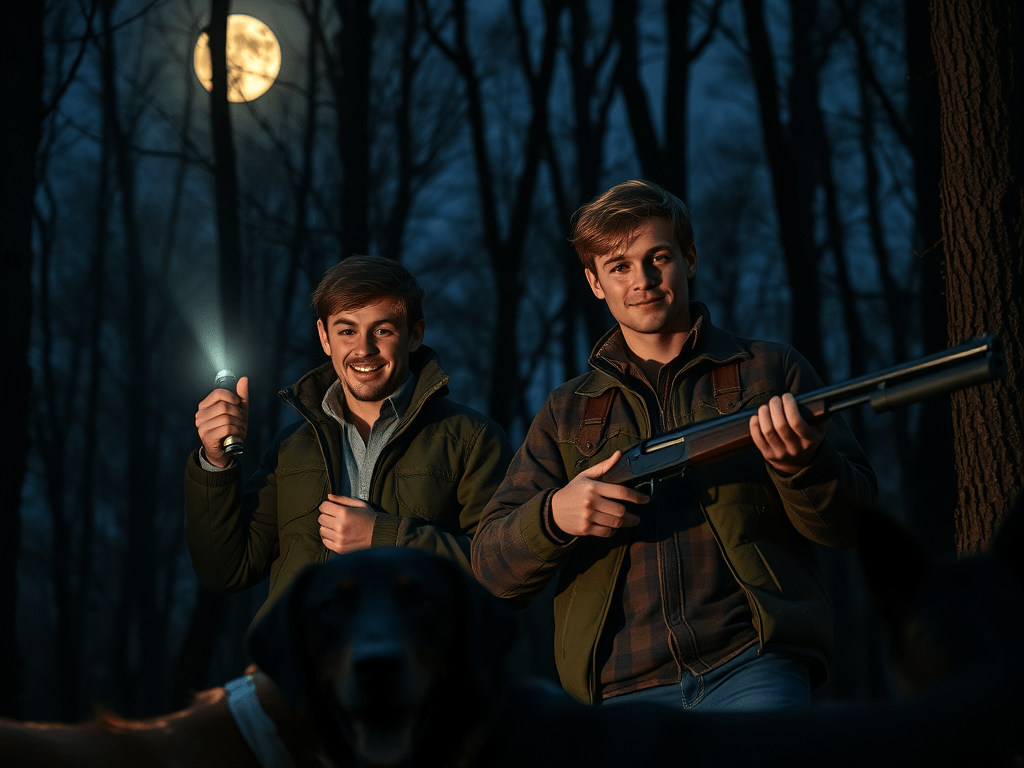
    The hounds bayed sharp and wild, their voices bouncing off the oak-studded hills of eastern Tennessee. Jace loped ahead, his lanky frame cutting through the underbrush, a coon’s trail hot under his boots. Behind him, Tuck trudged steady, stocky and sure, the old 12-gauge slung over his shoulder. The night was thick with cricket hum and the tang of pine, the kind of dark that swallowed you whole if you didn’t know these hollers.

    “Rusty’s got him treed,” Jace called, flashlight beam jerking toward a gnarled sycamore. The hound’s bark turned frantic, paws scrabbling at the trunk.

    Tuck caught up, wiping sweat from his brow with a sleeve. “Betsy’s circling. Reckon it’s a big’un.”

    They were barely twenty, raised on these ridges—Jace a dropout with dreams too big for school, Tuck a feed store grunt who’d rather wrestle sacks of grain than read a book. The dogs were their ticket out, or at least their excuse to roam. They’d hunted since they were kids, splitting pelts and patching each other’s mistakes, but it was the shack that sealed it—a tin-roofed lean-to tucked in a hollow, their claim on the wild.

    Jace grinned, teeth flashing in the dark. “Gonna skin this one clean. Maybe get enough for that carburetor you’ve been yapping about.”

    Tuck snorted, adjusting the shotgun. “You’re the one busting engines. I’m fine hauling feed.”

    They worked quick—Jace coaxing the coon down with a stick, Tuck ready with the gun. One sharp crack, and it was over, Rusty and Betsy nosing the prize. They’d drag it back to the shack come dawn, but for now, they sank onto a fallen log, catching their breath. The air cooled, stars peeking through the canopy.

    “Mom’s done with me,” Jace said, picking at a splinter in his thumb. “Caught me fiddling with that still again. Kicked me out ‘fore supper.”

    Tuck didn’t look up, just dug a can of dip from his pocket and tapped it against his knee. “She’ll cool off.”

    “Nah. Said I’m a lost cause this time.” Jace’s voice was light, but his hands stilled, the splinter forgotten.

    Tuck spat into the dirt, then stood. “C’mon. Shack’s open.”

    They trekked back, hounds trailing, the path worn by their own feet. The shack squatted at the holler’s edge—walls of scavenged pine, roof dented from a storm two summers back. Inside was a mess: pelts stacked in a corner, a kerosene lamp flickering on a crate, a cot Jace had claimed since Tuck liked the floor. Tuck kicked the door wide, tossing Jace a quilt from a milk crate.

    “Ain’t much,” he said, dropping his gear. “But it’s ours.”

    Jace caught the quilt, draping it over his shoulders like a cape. “Better’n a porch step.”

    Tuck grunted, fishing a dented thermos from his pack. He poured lukewarm coffee into a tin cup, splitting it with Jace. They sat on the porch—really just a slab of warped boards—dogs flopped at their feet, the coon’s carcass slung over a branch nearby. The night settled heavy, a whippoorwill calling somewhere deep in the ridge.

    “Got something,” Tuck said, pulling a pocket New Testament from his jeans. The cover was scuffed, pages curled from damp. He flipped it open by the lamp’s glow, squinting. “‘Two are better’n one,’” he read, slow and halting, “‘‘cause they got a good return for their work. If one falls, the other hauls him up.’” He stopped, scratching his jaw. “Ecclesiastes, I think. Preacher rambled ‘bout it once.”

    Jace smirked, sipping the coffee. “You’re turning holy on me?”

    “Shut it.” Tuck elbowed him, but his mouth quirked. “Just stuck, is all. Figure it’s us.”

    Jace leaned back, staring at the stars. “Yeah. Hauling each other up’s about right.”

    They sat quiet after that, the words hanging between them like the smoke from a fire they hadn’t lit. Tuck wasn’t one for books—Jace usually did the talking—but he’d kept that little Testament since his granny slipped it to him years back. Reading it now felt right, like staking a claim.

    “Gonna be alright?” Tuck asked, voice low.

    Jace nodded, slow. “Long as you’re here, I reckon.”

    Tuck capped the thermos, setting it aside. “Ain’t going nowhere.”

    The hounds snored, the night stretched on, and the shack held them—two boys too rough for the world, too tight to let it break them. It wasn’t much, this patch of dirt and tin, but it was theirs, built on pelts and promises and a verse Tuck could barely pronounce. They’d hunt again tomorrow, or the next day, and the holler would keep them. For now, that was enough.

  • The Lantern’s Keeper

    The Lantern’s Keeper

    The lighthouse leaned into the wind, its white paint flaking like old skin. Sam climbed the spiral stairs, a jug of oil sloshing in his grip, the echo of his boots sharp against the damp walls. Lucas trailed behind, a kerosene lamp swinging from his hand, its light dancing across the rust-streaked iron. The air smelled of salt and decay, a stubborn scent baked into this outpost on the edge of nowhere.

    “Running low,” Sam said, tipping the jug into the lantern’s reservoir at the top. Oil glugged out, dark and slow.

    Lucas set his lamp on the ledge, peering at the gauge. “Enough for tonight.”

    They’d been tending the place for months, ever since Sam’s dad died and left him the keys. Lucas had shown up the next morning, duffel slung over his shoulder, no explanation—just a nod and a decision to stay. Now, at twenty-six and twenty-seven, they were keepers of a light nobody else cared to claim.

    Sam struck a match, the hiss loud in the tight space. He lit the wick, and the lantern flared, throwing a beam into the fog beyond the glass. Lucas leaned against the railing, watching it carve through the dark. Words were spare up here. They didn’t need many.

    “Storm’s coming,” Lucas said, squinting at the horizon. “Feel it in the air.”

    “Always does,” Sam replied, wiping his hands on his jeans. He dropped onto the stool by the controls—his dad’s old perch—while Lucas stayed upright, arms crossed, a quiet shadow.

    They’d been friends since they were kids, fishing off the pier with Sam’s dad, splitting sandwiches from Lucas’s mom. Life had yanked them apart for a stretch—Sam to a warehouse, Lucas to odd jobs up the coast—but the lighthouse stitched them back together. Sam couldn’t face it alone, and Lucas wouldn’t let him try.

    “Ever think of bailing?” Sam asked, voice barely above the lantern’s hum.

    Lucas snorted. “To where?”

    “Somewhere that doesn’t smell like wet metal.” Sam rubbed his neck, staring at the flame. “This gig’s a grind.”

    “You’re here,” Lucas said, shrugging. “So I am.”

    Sam’s lips twitched—not a full smile, but close. He let it drop. Lucas didn’t waste breath on grand speeches, but he’d stuck around—hauled oil, patched leaks, weathered storms. That was enough.

    The fog thickened, swallowing the beam until it was a faint thread. Sam dug a thermos from his bag, pouring coffee into two chipped mugs. He slid one to Lucas, who took it with a grunt. They drank in silence, the warmth cutting through the chill, until Lucas reached into his jacket and pulled out a small, weathered book—dog-eared, spine cracked.

    “Got something,” he said, flipping it open.

    Sam raised an eyebrow. “Go on.”

    Lucas cleared his throat, voice rough but steady. “‘Two are better than one, because they have a good return for their labor. If either falls down, one can help the other up.’” He paused, glancing at Sam. “Ecclesiastes. Figured it fits.”

    Sam leaned back, mug cradled in his hands. “You’re getting soft.”

    “Says you.” Lucas smirked, but he kept reading, voice low against the wind. “‘Pity anyone who falls and has no one to help them up.’” He closed the book, tucking it away. “Dad used to read that one. Stuck with me.”

    Sam nodded, slow. “Mine said the light was a promise—keep it going, someone makes it home.”

    “Same deal, maybe,” Lucas said, sipping his coffee.

    “Maybe.” Sam stared at the lantern, its glow steady despite the gusts rattling the glass. “Feels like shouting into nothing some nights.”

    Lucas set his mug down, stepping to the lantern to tweak the wick. The flame surged, pushing back the dark a fraction more. “Someone’s out there. They’ll see it.”

    Sam watched him work—sure, unhurried. Lucas had been there since day one, no hesitation, like the lighthouse was his burden too. Sam hadn’t asked him to stay past that first night. He just did.

    The storm hit an hour later, wind howling through the cracks. The lantern flickered, and they moved in tandem—Sam wiping the lens with a rag, Lucas checking the fuel line. When it steadied, they sank back, Sam unrolling a sleeping bag by the wall, Lucas grabbing his from the corner.

    “Read me something else,” Sam said, settling in. “Keeps the noise out.”

    Lucas arched a brow but fished the book out again, flipping pages by the lantern’s light. “‘Carry each other’s burdens,’” he started, voice softening, “‘and in this way you will fulfill the law of Christ.’ Galatians. Short one.”

    Sam closed his eyes, the words settling over him like the warmth of the coffee. “Fits too.”

    “Thought so.” Lucas shut the book, stretching out on his own bag. “Wake me if it quits.”

    “Always do,” Sam murmured.

    The lantern hummed, a faint pulse in the dark. Sam drifted, the storm’s roar dulled by Lucas’s voice still echoing in his head. He thought of his dad, the light, the way Lucas had woven himself into both without a fuss. Not brothers by blood, but by something tougher—something that held.

    “Worth it?” Lucas asked, half-asleep across the room.

    “Yeah,” Sam said, not opening his eyes. “You?”

    “Yep.” Lucas shifted, the rustle of his bag fading. “Night.”

    “Night.”

    The wind screamed, but the light burned on. They slept, two keepers bound by a tower and a quiet pact, reading each other through the dark.

  • Garage Band

    Garage Band

    The garage smelled like motor oil and stale pizza, a haze of dust catching the light from a single dangling bulb. Tyler’s drumsticks clacked against the snare, a rhythm sharp enough to cut through the humid August air. Across from him, Gabe hunched over his beat-up Stratocaster, coaxing a riff out of strings that hadn’t been changed in months. They weren’t good—not by any stretch—but they were loud, and that was enough.

    “Turn it up,” Tyler called, grinning as he kicked the bass pedal. Gabe twisted a knob on the amp, and the sound swelled, rattling the toolbox on the workbench. The neighbors hated it. They loved that part most.

    They’d been at this since sophomore year, when Gabe found the guitar at a yard sale and Tyler begged his mom for a drum kit he’d never master. Three years later, they were still here—eighteen, sweaty, and tethered to this concrete box like it was the only place that made sense. No gigs, no dreams of stadiums. Just the two of them, filling the space with noise.

    “New riff?” Tyler asked, wiping his forehead with the back of his hand.

    “Old one, just louder,” Gabe said, strumming a chord that buzzed like a chainsaw. “You’re off beat again.”

    “Am not. You’re just deaf.” Tyler twirled a stick and missed, letting it clatter to the floor. Gabe snorted, and they fell into the easy silence that came after a jab. It was their rhythm—push, pull, steady.

    The garage door was half-open, letting in the hum of crickets and the occasional bark from the mutt next door. Tyler’s house was a squat ranch-style thing, paint peeling like it was tired of holding on. Gabe lived three blocks over, but he might as well have lived here. His sneakers were piled by the door, his initials scratched into the workbench from a bored afternoon with a pocketknife. They’d built this, piece by piece, without ever saying it aloud.

    “Dad’s pissed again,” Tyler said, tapping the hi-hat absently. “Says I’m wasting my life in here.”

    Gabe looked up, fingers pausing on the strings. “What’d you tell him?”

    “Nothing. Just took it.” Tyler shrugged, but his jaw tightened. “He’s not wrong, maybe.”

    “Bull.” Gabe set Lozano—the guitar had a name, because of course it did—against the amp and crossed his arms. “You’re not wasting anything. We’re here, aren’t we?”

    Tyler smirked, but it didn’t reach his eyes. “Yeah, real high achievers. You’re slinging burgers, I’m flunking trig. Rockstars, man.”

    Gabe kicked a stray soda can across the floor. “Doesn’t matter. We’ve got this.”

    “This” was the garage, the music, the way they could sit here until midnight and not need anyone else. Tyler nodded, slow, like he was convincing himself. Gabe picked up Lozano again, strumming something softer, a melody he’d been messing with for weeks. Tyler joined in, tentative at first, then harder, until the sound felt like a pulse between them.

    They played until the bulb flickered, a warning it was about to die. Tyler tossed his sticks onto the snare and stood, stretching. “Gotta crash. Early shift tomorrow.”

    “Same,” Gabe said, but he didn’t move. He watched Tyler shove the drum kit against the wall, the same way he always did—precise, like it mattered. “You good?”

    Tyler hesitated, hands in his pockets. “Yeah. Just… Dad’s on me about college again. Says I need a plan.”

    “You’ve got one,” Gabe said, voice firm. “Us.”

    Tyler laughed, short and sharp. “That’s not a plan, dude.”

    “It’s enough.” Gabe stood, slinging Lozano over his shoulder. “Come on, I’ll walk you in.”

    They stepped into the night, the air cooler now, crickets louder than the echo of their music. Tyler’s front door creaked as they slipped inside, dodging the living room where his dad’s snores rumbled from the couch. Upstairs, Tyler’s room was a mess—clothes on the floor, posters peeling off the walls. Gabe dropped onto the beanbag by the window, same spot he’d claimed since they were kids.

    “Stay over,” Tyler said, kicking off his shoes. “Floor’s yours.”

    Gabe nodded, like it was already decided. It usually was.

    The next week, everything cracked open. Tyler came home from his shift at the gas station to find his stuff—drumsticks, clothes, a half-dead phone—piled on the porch. His dad stood in the doorway, arms crossed, face red.

    “Out,” was all he said.

    Tyler didn’t argue. He grabbed what he could and walked, the weight of it sinking in with every step. He didn’t call Gabe. Didn’t need to. By the time he hit the third block, Gabe was there, leaning against a streetlight with Lozano strapped to his back.

    “Figured you’d show up,” Gabe said, falling into step beside him. “What happened?”

    “Dad’s done. Says I’m a leech.” Tyler’s voice was flat, but his hands shook as he clutched the bag.

    Gabe didn’t say anything for a minute, just kept walking. Then: “My mom’s at work. You’re crashing with me.”

    “Gabe—”

    “Shut up. You’re not sleeping on the street.” He adjusted Lozano’s strap, a nervous tic. “We’ll figure it out.”

    Tyler stopped, dropping the bag. “Why’re you doing this?”

    Gabe turned, eyes steady. “Because you’re my brother, dumbass. Not blood, but—y’know. We’re in this.”

    Tyler swallowed hard, nodding once. They kept moving, the silence heavier now, but not empty. Gabe’s place was small, a duplex with chipped paint and a leaky sink, but it was warm. He shoved a blanket at Tyler and pointed to the couch. “Yours.”

    Tyler didn’t sleep much that night, staring at the ceiling while Gabe’s snores drifted from the next room. He thought about the garage, the music, the way Gabe never asked questions—just showed up. It wasn’t a plan, not like his dad wanted. But it felt like something solid, something he could hold onto.

    Morning came gray and slow. Gabe shuffled out, hair a mess, and tossed a notebook onto the coffee table. “Wrote this last night,” he said, yawning. “For the band.”

    Tyler flipped it open. Scrawled in Gabe’s chicken-scratch was a line: Strength in two, me and you. Below it, a chord progression, rough but real.

    “Cheesy,” Tyler muttered, but he smiled.

    “Yeah, well, it’s true.” Gabe grabbed Lozano and started picking out the melody. “Play with me?”

    Tyler dug his sticks out of the bag, tapping the table like it was his snare. The sound was thin, nothing like the garage, but it was theirs. They played until the sun broke through the blinds, a promise neither had to speak. It wasn’t about fixing everything—not yet. It was about staying, about being enough.

    And for now, it was.

  • The Cut

    The Cut

    The barbershop glowed soft under a single bulb, clippers humming low against the Chicago dusk. Matt, 44, swept stray hairs off the worn floor, hands steady from years behind the chair. A fan ticked in the corner, stirring November air through streaked glass. The bell jingled—Dave, 42, stepped in, jacket slung over his shoulder, cap in hand, a desk job’s weight in his slouch.

    “Trim?” Matt asked, voice warm, nodding at the leather seat. Dave eased in, mirror catching a face etched by quiet years—divorce at 38, nights chasing peace in old habits. Matt’s wasn’t much different—party days traded for faith three years back, steady now with shears.

    Clippers buzzed, shearing Dave’s dark scrub. “Rough day?” Matt said, brushing a neck hair.

    “Office grind,” Dave replied, eyes half-closed. “Back’s griping—too much chair.”

    Matt chuckled, light. “Know it. Poured drinks ‘til 41—legs quit before the shots did.”

    Dave’s mouth twitched—a half-grin. “Barber now? What flipped it?”

    “Whiskey ran dry,” Matt said, easy. “Three years ago—church pal pulled me out. Clipping’s calmer—keeps me straight.”

    Dave’s fingers tapped the armrest—Matt caught it. “Wife left me,” Dave said, low. “Four years—thought she’d settle what stirred off. Never did.”

    Matt set the clippers down, grabbed a towel. “Yeah. Men got me—deep, not gals. Chased it in late bars—flicks, guys laughing, not loving. Hit harder’n anything.”

    Dave’s eyes met Matt’s in the glass, steady over the hum. “Same reel. Shows—two fellas, tight, not queer. Never named it ‘til it stuck.”

    The shop shrank—buzz, fan, street hum—just two voices weaving close. Matt knew that pull—loving men, not the world’s tune, soul not skin. Dave’s echo rang it softer—different ache, same thread.

    “Faith found me,” Matt said, wiping Dave’s neck. “Three years—still feel that hum. Not chasing beds—just a guy getting me. Christ took it, made it His.”

    Dave’s smile was faint. “Two years—prayer night, broke. Thought it’d damn me ‘til grace said no. Hums still—guy’s nod at work, old itch.”

    They’d crossed that month—hair snipped, talk spilled slow. Matt saw Dave’s pause at a customer’s laugh; Dave caught Matt’s quiet when a voice hit the door. No rush—just truth, gentle as dusk. They’d nodded once, chair left open—two men, worn but breathing (John 15:15—friends, not just hired hands).

    “Built for this,” Matt said, voice warm. “Men loving men, Christ’s way—not their line. Rare, but ours.”

    Dave rubbed his chin, steady. “Thought I’d drift solo—shamed out. This—covenant? Feels true.”

    The bulb flickered—shop dim, city soft beyond. Matt’s chest eased—Dave’s too. Not a spark of heat, not a blur—just alive, like shears cutting clean. Tomorrow waited—cuts for Matt, desks for Dave—but here, they sat, loving unique, God-lit.

    “This is it,” Matt said, firm but soft. “Live it—show ‘em there’s more. Build it, brother—heart and hands.”

    Dave tipped his head, meeting Matt’s eyes. “Yeah. Us—others too. No more lone.”

    Night hugged the glass, a quiet vow. Two men, past the script, carving covenant in the chair—simple, real, His.

  • Crimson Vow (Part 2)

    Crimson Vow (Part 2)

    Years stretched on, their paths sundered by war and fate. David became a fugitive king, leading outcasts through rugged cliffs, the crimson tunic fraying with each escape, the harp silent but ever-present. One frostbitten night, in a cave’s shadowed mouth, he wrapped the tunic tighter, bow in hand, and whispered to the stars, “Jonathan, your strength holds me still.” The wind howled, but Saul’s scouts prowled closer, their torches flickering like wolves’ eyes. Jonathan stayed with Saul, torn between love and duty, deflecting the king’s rages to buy David time. Yet their covenant held, a lifeline across the divide.

    Then came the news at Adullam: Saul and Jonathan had fallen at Mount Gilboa, slain by Philistine swords. The messenger, dust-caked and trembling, spoke of Jonathan’s final stand—how he’d fought to the last, his bow snapping as he shielded his father’s broken body, arrows spent, blood pooling on the ridge. David collapsed, clutching the bow, the harp slipping to the dust, and a cry tore from him, raw and shattering. “How the mighty have fallen!” he wailed. “Jonathan, my brother—your love was more precious than gold.”

    He took the harp, its strings trembling under his fingers, and poured out a lament, the notes rising over the camp like smoke. “Your bow lies still, your tunic ash, yet your vow endures,” he sang, tears streaking his face. He saw the stream again—their hands clasped, blood warm, starlight on the water—and his voice broke. The crimson tunic he burned that night, its threads curling slowly into the fire as he murmured, “Rest, my shield.” A shepherd’s farewell to a prince.

    He mourned through the ages, but he kept their oath. As king, he sought Mephibosheth, Jonathan’s lame son, and gave him a place at his table. The boy’s eyes, so like his father’s, met David’s as he said, “For your father’s sake, you’ll eat as my own.” He pressed a scarred hand to the boy’s shoulder, honoring the blood they’d shed by the stream. The bow hung in David’s chambers, the harp beside it, silent witnesses to their covenant—sealed in blood, forged in faith, and kept beyond the grave.

  • Crimson Vow (Part 1)

    Crimson Vow (Part 1)

    The sun dipped below the hills of Gibeah, painting the sky in hues of crimson and gold. David, the shepherd-turned-warrior, climbed the rocky path toward the king’s encampment, his sling swaying at his side, a leather pouch slung over his shoulder. He’d been summoned again to play his harp for King Saul, whose spirit grew ever more restless. The echoes of his victory over Goliath still rang through Israel, a triumph that brought both praise and peril.

    At the hill’s crest, Jonathan, son of Saul, waited. His bow rested in his hand, his quiver slung across his back, and his dark eyes tracked David’s approach. His crimson tunic fluttered faintly in the breeze, simple yet regal, its edges catching the dying light. A faint smile curved his lips as David drew near.

    “You’re late,” Jonathan said, his tone light.

    David wiped sweat from his brow, grinning. “The sheep don’t heed royal commands. I had to pen them first.”

    Jonathan laughed softly, stepping forward to clasp David’s arm. “My father’s mood darkens hourly. Your music’s the only balm he knows.”

    David’s smile faded. “I’ll play, but I feel his gaze—like a wolf sizing up its prey.”

    Jonathan’s eyes flickered to the horizon. “He hears the songs. ‘Saul has slain his thousands, and David his ten thousands.’ It festers in him.”

    They walked toward the camp, the bond between them unspoken but palpable. They’d met weeks before, when David felled Goliath with a single stone, and Jonathan had watched, awestruck, as the shepherd claimed victory for Israel. In that moment, something kindled in Jonathan—a pull beyond rivalry. David was no ordinary man, and Jonathan, though heir to the throne, felt their souls tethered by a force divine.

    That night, in the dim glow of oil lamps, David sat before Saul, his fingers coaxing a melody from his harp. The king lounged on a cushion, his face haggard, his eyes shadowed. The music wove through the tent, a thread of peace battling the unseen torment gripping Saul’s mind. Jonathan lingered near the entrance, arms crossed, the scent of olive oil and dust thick in the air, watching his father’s tension ease, if only briefly.

    When the last note faded, Saul grunted a curt thanks and dismissed David with a wave. The shepherd bowed and slipped into the night. Jonathan followed, catching him near a grove of olive trees, their gnarled branches whispering in the breeze.

    “You’ve a gift,” Jonathan said, his voice hushed. “Not just with strings, but with souls. Even my father feels it.”

    David glanced at him, moonlight glinting in his eyes. “I seek only God’s favor, not man’s. But I’m glad to serve.”

    Jonathan nodded toward a path winding away from the camp. “Come with me.”

    They walked in silence, the camp’s clamor fading. Stars blazed overhead, a vast tapestry of light, and they stopped by a shallow stream, its waters shimmering like molten silver, the air tinged with pine and damp earth. Jonathan turned to David, his expression grave yet warm.

    “I’ve been thinking,” he began, hesitating. “About you. About Goliath. It wasn’t just skill or chance. The Lord stood with you.”

    David nodded. “He’s guided me since I was a boy, guarding my father’s flocks. Lions, bears—I’ve faced them. But that day… it was His hand.”

    Jonathan stepped closer, his voice dropping. “I’ve fought Philistines too, David. I’ve trusted the Lord to guide my bow. But you—you’re chosen. I see it. The people see it. And my father… he fears it.”

    David shifted, kicking a stone into the stream. “I’m no threat to him, Jonathan. I’m a shepherd, not a king.”

    “Not yet,” Jonathan murmured, the words heavy with portent.

    David met his gaze, searching for envy or doubt, but found only trust. Jonathan drew a small dagger from his belt, its blade catching the starlight. “I want you to know something. Whatever comes—whatever my father does—I stand with you. My heart is yours, as a brother’s.”

    David’s breath hitched. He had known loyalty, but this ran deeper, unyielding. “And mine is yours,” he said, his voice firm despite the swell of emotion.

    Jonathan held out the dagger. “Then let’s seal it—not with words alone, but with blood. A covenant before God.”

    David’s eyes widened, but he nodded. Such oaths were rare, sacred—binding beyond death. Jonathan pressed the blade to his palm, wincing as it bit into his flesh. Blood welled, dark and glistening, and he handed the dagger to David. The shepherd took it, mirroring the act, his hand trembling only slightly as the steel parted his skin.

    They clasped hands, blood mingling warm and wet between their palms. The pain was sharp, but it faded beneath the weight of their vow. “The Lord be between us,” Jonathan whispered, his grip tightening.

    “And between our houses forever,” David finished, his voice steady.

    Jonathan shed his crimson tunic, draping it over David’s shoulders, its fabric soft yet heavy with meaning. “Wear this,” he said. “Let it mark our bond.” David accepted it, the warmth a shield against the night’s chill. They stood there, hands locked, the stream murmuring beside them, their covenant sealed—blood and bond, a promise etched in flesh and spirit.

    Months passed, and Saul’s jealousy festered into madness. David’s victories swelled his fame, and the king’s heart turned black with envy. One evening, as David played his harp, Saul’s hand darted to a spear leaning nearby. Jonathan saw the glint of intent too late. The weapon flew, pinning David’s tunic to the tent wall as he dodged.

    “Father!” Jonathan cried, stepping forward, but Saul’s face twisted with rage.

    “Out!” the king bellowed, and David fled into the darkness, the crimson tunic trailing behind him.

    Jonathan found him later, hidden beneath a rocky overhang miles from Gibeah. David’s face was streaked with dirt, his eyes wide with betrayal, the tunic frayed at the hem from his flight.

    “He tried to kill me,” David said, his voice hollow.

    Jonathan knelt beside him, gripping his shoulder. “I know. His spirit’s warped—by fear, by something evil.” From his belt, he unslung David’s harp, scratched but whole, recovered from the tent. “I brought this. Keep it close.”

    David took it, fingers brushing the strings, a faint note rising into the night. “You risk too much.”

    “Nor will I let him take you,” Jonathan swore. “We need a plan.”

    They devised a signal under the stars: Jonathan would test Saul’s intent and warn David with arrows. Three shot beyond a stone would mean danger; one short of it, safety. Their scarred hands clasped again, the faint sting a reminder of their oath.

    David slipped deeper into the hills that night, the tunic his cloak, the harp slung across his back. Near a jagged slope, he lit a small decoy fire, sending it tumbling down with a push of stones, then vanished into the shadows as Saul’s scouts chased the glow.

    At the new moon festival, David hid near the stone Ezel, watching as Jonathan entered Saul’s tent. The prince sat at the king’s table, his pulse racing as he spoke of David’s absence.

    “He went to Bethlehem, to his family,” Jonathan said, feigning calm, his cloak hiding the dust of a dawn ride past Abner’s patrol to reach David earlier.

    Saul’s eyes narrowed, his grip tightening on a goblet. “You cover for him! That son of Jesse—he’ll steal my throne!”

    Jonathan’s gut churned, but he pressed on. “He’s loyal, Father. He fights for you.”

    Saul hurled the goblet, wine splashing across Jonathan’s chest. “You’d give your birthright to that shepherd?”

    The words pierced, but Jonathan stood tall. “I’d give it to God’s chosen.”

    Saul’s fury exploded, and he grabbed his spear. Jonathan dodged and ran, snatching his bow and quiver as he fled into the night. He reached the field at dawn, a boy in tow as a ruse, and nocked an arrow. David watched from his hiding place as the first arrow soared past the stone. Then the second. Then the third.

    Danger.

    Jonathan shouted to the boy, “Fetch the arrows!” As the lad ran off, he darted to David. “He wants you dead,” he whispered. “Go—into the hills, the caves. I’ll shield you as long as I can.”

    David’s eyes shimmered. “You shouldn’t have come. Abner—”

    “Guesses nothing,” Jonathan cut in. “I told him I scouted game.” He unslung his bow, its wood worn smooth from battles, and pressed it into David’s hands. “Take this too. It’s been with me in every fight. Let it remind you of me.”

    David gripped it, the curve fitting his palm. “I’ll carry it always.”

    They wept, their scarred hands pressed together, blood long dried but the bond unbroken. “The Lord be between us,” Jonathan murmured.

    “And our houses forever,” David replied.

    They parted—Jonathan to the boy, David to the wilderness, the bow over one shoulder, the harp over the other, the crimson tunic a fading banner.

    (Continued in Part 2 tomorrow)

  • The Rooftop Pact

    The Rooftop Pact

    The city buzzed below, a tangle of headlights and horns that never quit. Up on the roof, it was quieter—just the hum of a vent and the occasional pigeon flapping off into the dark. Ethan leaned against the ledge, his hoodie pulled tight against the wind. Beside him, Jay sprawled on an old lawn chair they’d dragged up months ago, its plastic creaking under his weight. The building was a crumbling six-story walk-up, but this spot was theirs.

    “Think it’ll rain?” Ethan asked, squinting at the gray smear of clouds.

    “Hope so,” Jay said, tipping his head back. “Wash some of this noise away.”

    Ethan smirked, kicking a pebble across the tarred surface. It skittered into a puddle from last night’s drizzle. They’d been coming up here since they moved in—Ethan after dropping out of college, Jay after his barista gig became his only plan. Two years of sharing a shoebox apartment, splitting rent and ramen, had turned into something neither bothered to name.

    Jay pulled a beat-up journal from his jacket, flipping it open. “Wrote something dumb last night.”

    “Read it,” Ethan said, not looking over. He didn’t need to. Jay’s voice was enough.

    Jay cleared his throat, dramatic-like. “‘Sky’s a mess, head’s worse. But we’re here, so screw it.’” He paused, grinning. “Poetry, right?”

    “Deep,” Ethan deadpanned, but his lips twitched. “You’re a regular Shakespeare.”

    “Shut up.” Jay chucked the journal at him. Ethan caught it one-handed, flipping through pages scrawled with half-thoughts and doodles—their lives in smudged ink. He stopped at a line from weeks back: We’re enough for each other, man. Jesus said so. Jay had scratched it out, then rewritten it darker.

    “You believe that?” Ethan asked, voice low.

    Jay shrugged, staring at the skyline. “Some days.”

    Ethan nodded, handing the journal back. Some days was enough.

    They’d met at a bus stop three years ago, both soaked from a storm, arguing over whose headphones were louder. Ethan was nineteen then, all sharp edges and no direction. Jay was twenty, cocky but steady, the kind of guy who’d share his last dollar without asking why you needed it. Now, at twenty-two and twenty-three, they were still a mess—just a mess together.

    “Boss cut my hours again,” Ethan said, picking at a loose thread on his sleeve. “Says I’m ‘unmotivated.’”

    “You are,” Jay said, grinning when Ethan glared. “Kidding. You’ll bounce back.”

    Ethan didn’t answer, just stared at the lights flickering below. He’d dropped out after one semester, burned out on lectures and loans. Now he stocked shelves at a corner store, each shift a reminder he was going nowhere. Jay, at least, had the coffee shop—low pay, but he liked the rhythm. Ethan envied that, though he’d never say it.

    “Got an interview tomorrow,” Jay said, breaking the silence. “That new place by the park. Better tips, maybe.”

    “Good for you,” Ethan muttered, then winced at how bitter it sounded. “I mean it.”

    “I know.” Jay sat up, the chair groaning. “If I get it, I’ll cover rent ‘til you’re solid.”

    Ethan shook his head. “Don’t need charity.”

    “Not charity, dumbass. It’s us.” Jay’s tone was firm, like he’d already decided. Ethan didn’t argue. He never won those fights.

    The wind picked up, tugging at their clothes. Ethan pulled his knees to his chest, resting his chin on them. “Ever feel like you’re just… stuck?”

    Jay didn’t answer right away. He stood, stretching, then walked to the ledge beside Ethan. “Yeah. But then I come up here. You’re here. It’s not so bad.”

    Ethan looked up, meeting Jay’s eyes—steady, like always. He wanted to say something smart, brush it off, but the words stuck. Instead, he nodded, and Jay clapped a hand on his shoulder, leaving it there a beat too long.

    That night, Ethan crashed on the couch, too wired to sleep. Jay’s snores drifted from the bedroom, a sound Ethan could set a clock to. He thought about the roof, the way Jay never pushed, just stayed. It wasn’t a fix for the mess in his head, but it was something.

    Two days later, it all unraveled. Ethan came home from a shift—late, because the bus broke down—to find a note taped to their door. Rent’s due. Pay up or get out. They’d been late before, but this time the landlord meant it. Ethan’s stomach sank. His hours were cut, Jay’s interview hadn’t panned out yet, and their savings were a jar of quarters on the counter.

    He didn’t tell Jay when he got home. Just grabbed a soda and headed for the roof. Jay followed, no questions, journal tucked under his arm. They settled into their spots—Ethan on the ledge, Jay in the chair—like nothing was wrong.

    “Rough day?” Jay asked, flipping pages.

    Ethan popped the can, the hiss loud in the quiet. “You could say that.”

    “Spill.”

    “Landlord’s done. We’re out if we don’t pay by Friday.” Ethan kept his eyes on the city, waiting for Jay to freak.

    Jay didn’t. He scribbled something in the journal, then tore the page out and handed it over. Ethan took it, frowning. We’ll figure it out. Always do.

    “You’re nuts,” Ethan said, but he folded the paper into his pocket.

    “Probably.” Jay leaned back, hands behind his head. “Got a shift tomorrow. I’ll hustle. You?”

    “Same.” Ethan paused, then added, “Thanks.”

    Jay waved it off, but his grin said he got it.

    They stayed up there ‘til the stars peeked through, talking about nothing—old movies, dumb customers, the pigeon that kept stealing Jay’s fries. When the cold drove them inside, Ethan felt lighter, like the weight wasn’t all his anymore.

    Friday came fast. Jay picked up an extra shift; Ethan pawned a watch he didn’t need. They scraped the rent together, barely, and slid it under the landlord’s door with thirty minutes to spare. Back on the roof that night, exhausted, they didn’t say much. Jay scribbled in his journal, Ethan traced cracks in the ledge with his finger.

    “We’re good,” Jay said finally, closing the book.

    “Yeah,” Ethan agreed, and he meant it.

    The city kept buzzing below, but up here, it was just them—two guys against the grind, holding on. Not a plan, not a fix, just a pact. And for now, it held.

  • Testing Boundaries (Excerpt)

    Testing Boundaries (Excerpt)

    Silence settled, broken only by the rain’s patter. Ted didn’t rush to fill it, which irked Ethan for no good reason. He shifted, fingers drumming the armrest, then blurted, “So you just… denied that part of yourself?”

    Ted’s expression didn’t change. Ethan had been holding that question since the porch—maybe longer. With no distractions—no phone, no noise—it slipped out.

    Ted set his glass down with a quiet thunk, letting the words hang. “I surrendered it,” he said finally. “And I never looked back.”

    Ethan scoffed lightly. “That easy, huh?”

    Ted’s lips curved, not quite a smile. “Didn’t say it was easy.”

    Ethan leaned forward, arms on his knees. “So what—you just decided one day those feelings weren’t real?”

    Ted shook his head. “Never said that either.”

    Ethan frowned.

    Ted exhaled, settling back. “What I’m sayin’ is, I had to choose. The world told me one thing. God told me somethin’ else. I trusted Him more’n I trusted myself.”

    Ethan crossed his arms. “And that worked for you?”

    Ted nodded, but something heavier flickered in his eyes. He stared into the lantern’s glow. “I almost didn’t,” he admitted.

    Ethan raised an eyebrow.

    Ted rubbed his jaw, exhaling through his nose. “For a while, I figured I’d got it wrong. Maybe I was holdin’ onto somethin’ outta fear. So I walked away—gave the world’s way a shot, thought I’d find what I was lookin’ for.”

    Ethan’s stomach tightened. He hadn’t expected this.

    Ted shook his head, gaze settling on him. “Didn’t. Lost more’n I care to admit.” He leaned forward. “You wanna know why I trust God more’n myself? I’ve seen what happens when I don’t.”

    Ted sipped his water, calm again. “Spent years thinkin’ I had to choose between bein’ loved and bein’ faithful. But I was askin’ the wrong question. It wasn’t about that—it was about choosin’ Him.”

    Ethan swallowed, throat tight. He forced a smirk. “Not many people sound as sure as you.”

    “Took a long time to get here,” Ted said, a quiet laugh in his voice.

    Ethan watched him, the lantern light carving deeper lines in his face. He should’ve argued, laughed it off. But he didn’t want to. That scared him more than anything.

    Ted stood, grabbing a blanket from a closet and draping it over the couch. “In case it gets cold tonight.”

    (Excerpt from Narrow Road Together in the Ethan & Ted series. Contact me if you’d like to read the full story)
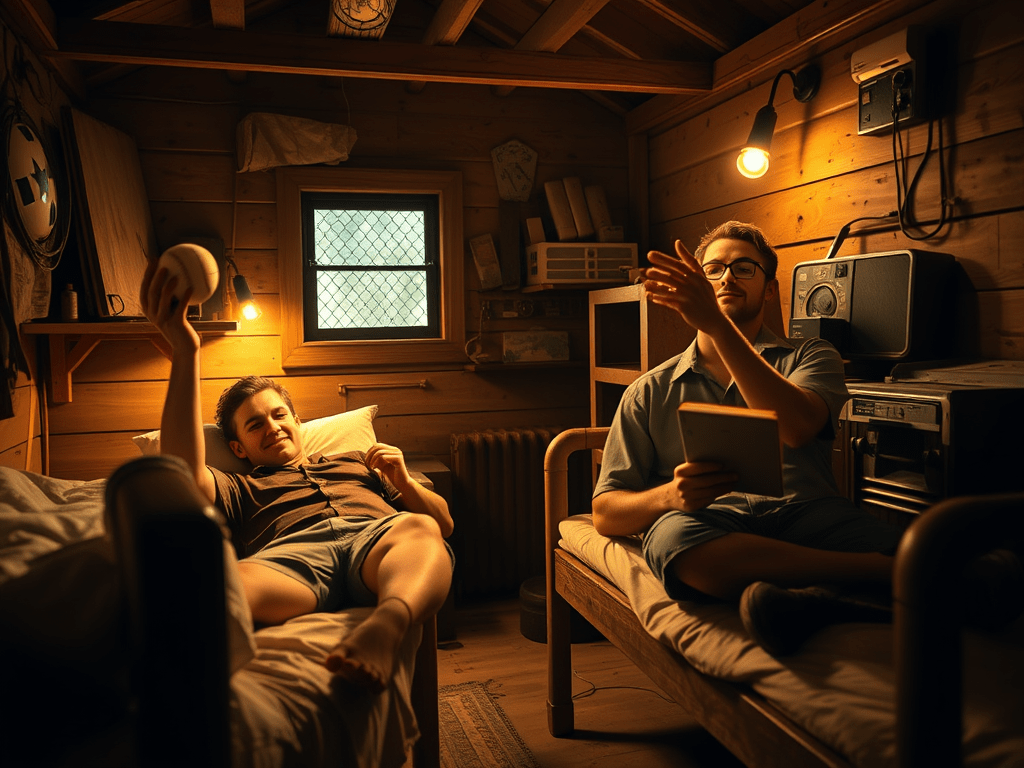
  • The Forge

    The Forge

    The fire spat embers into the night, a ragged glow against the Indiana pines. Caleb crouched by it, 52 years carved into his hands—calluses from swinging hammers, scars from swinging at life. Across the flames sat Eli, 48, eyes hollowed by years of hiding. Two men, strangers ‘til that retreat, now tethered by something neither could name ‘til it hit.

    Caleb tossed a stick into the blaze, sparks snapping like old guilt. “Grew up thinking God’d smite me for looking too long at a guy in church,” he said, voice gravel. “Dad preached hell—I believed it. Ran from it ‘til I couldn’t.”

    Eli nodded, boots scuffing dirt. “Same, different flavor. Mom said love was women or nothing. Tried it—married at 30, crashed by 35. Never told her the guys on the rig stirred me more’n she did.”

    The wind carried smoke between them, sharp and honest. Caleb’s gut knew that ache—loving men, not like the world said, but bone-deep, beyond flesh. He’d chased it in shadows—porn flickering on a screen, two guys bonding, not touching, but close. Never fit the gay label, never fit straight. Eli’s story echoed—different road, same ditch.

    “Found Christ at 47,” Caleb said, poking the fire. “Broke me open—grace, not wrath. Been five years, still wrestle the pull. Not sex—just that hum when a guy gets me.”

    Eli’s laugh was dry. “Yeah. Forty-five for me—Jesus hauled me out of a bottle. Two years in, same fight. Thought I was alone ‘til this.” He waved at the fire, the space between.

    Caleb leaned forward, elbows on knees. “Ain’t alone. World don’t get it—men loving men, pure, no mud. But Scripture does. Jonathan and David—souls knit, no bed. That’s us, brother.”

    Eli’s eyes caught the glow, steadying. “Thought I’d die single, shamed. This… covenant? Feels like air.”

    They’d met that week—retreat mud, shared coffee, stories spilling over late nights. Caleb saw Eli’s flinch at a guy’s grin; Eli caught Caleb’s quiet when loneliness bit. No preaching—just truth, raw as split wood. They’d prayed it out, hands clasped, fire a witness—two men, battered but standing (Ecclesiastes 4:12—cord of three strands).

    “Role’s this,” Caleb said, voice firm. “Live it—men who love men, Christ’s way. World’s blind; we ain’t. Build it, brother—hammer and soul.”

    Eli tossed dirt on the flames, embers hissing. “Yeah. Forge it—us, others. No more hiding.”

    Dawn crept up, gray and sure. They stood, shoulders brushing—not erotic, but alive. Caleb’s hammer waited; Eli’s rig called. Two men, loving unique, God-lit, stepping into a world that’d never name it. But they did—covenant, forged in fire, strong as hell.


  • Understanding the Deep Ache for Brotherhood

    Understanding the Deep Ache for Brotherhood

    Let’s talk about the ache.

    It’s not loud. It doesn’t usually show up in small groups or sermons. But it’s there—sitting behind the ribcage like something unfinished. The longing for a brother—not just a buddy, but someone who sees you. Someone who knows your wiring, your story, and doesn’t flinch. A man you could walk with in honesty and depth, and never feel like too much.

    I know that ache well. Seems like the more “connected” we become via the Internet, social media, Zoom calls, etc., the less truly connected, in the day to day sense, we can be.

    I’ve got brothers I can talk to—guys I can reach out to when it gets hard. Some of them know the deepest parts of my story. But none of them live close by. None I can really do life with day in and day out. That kind of shoulder-to-shoulder bond—the one you can lean on without explaining it every time—it’s not here right now. And I feel that absence.

    So this post? It’s not just for you. It’s for me too.

    Because this ache, this deep desire for covenant brotherhood, isn’t some fringe longing. It’s not about being needy or codependent. It’s part of God’s design. We were made for this kind of connection. Jesus had it. David and Jonathan had it. It’s the kind of friendship that’s forged, not found. It’s rooted in Christ, sharpened by time, and held together by grace.

    But what if you don’t have it?

    That’s where a lot of us live. In the in-between. Wanting it so deeply it hurts, but not knowing how to find it—or what to do with ourselves while we wait.

    And in that waiting, a lot can stir.

    Old habits. Old fantasies. I’ve found myself drawn toward imagined scenarios—emotional, sometimes even erotic. Longings that twist just enough to offer the illusion of being seen, known, held.

    But it never lasts.

    It flares up, then fades. And afterward, the ache is sharper. The loneliness deeper. The illusion of closeness can never hold the weight of what I really need.

    Still, I understand why the pull is there. Because at its core, this longing isn’t wrong. It’s holy ground that’s been stepped on by the world, by the enemy, by the wounds of our past. The desire to be known, loved, and not alone—it mirrors the very heart of God.

    So what do we do with the ache when the brother hasn’t come?

    We bring it to Jesus.

    Not the polished version. The real one. The messy ache. The unmet need. The quiet grief of another day without that kind of companionship. We lay it down—again and again—at the only altar that can hold the weight of our longings.

    Jesus isn’t afraid of it. He’s not rolling His eyes. He knows this ache. He felt it too—misunderstood, unseen, carrying love that had nowhere to land.

    And He’s not telling us to pretend it’s fine. He’s inviting us to trust that He’s not wasting the waiting.

    See, this isn’t about giving up on brotherhood. It’s about surrendering the form we think it has to take. It’s letting Jesus be enough in the meantime. Because He’s doing something in us while we wait. Something sacred. Something strong.

    And I have to believe that the ache, when surrendered, becomes the very soil where brotherhood can take root.

    So I’m still praying. Still hoping. Still staying open. Saying yes to the small invitations—firepit gatherings, book studies, texts that open doors. Some of those don’t lead anywhere obvious. But some might. Even if they don’t, they keep my heart soft. And that matters.

    And in the waiting, I hold onto this: I’m not forgotten. You’re not forgotten. We’re not broken for wanting something Jesus Himself modeled.

    I don’t have all the answers. But I know this much: chasing fantasy won’t fill it. Neither will stuffing it down. The way forward is surrender. Not because the ache will vanish—but because in Christ, it doesn’t own you anymore.

    And if you’re feeling that ache today too—man, I’m with you.

    Let’s keep showing up. Keep trusting. Keep bringing our need to the only One who truly sees.

    He’s not going anywhere.

    And I don’t think He’ll leave us in this ache forever.

  • The Weight and the Wonder (chapter)

    The Weight and the Wonder (chapter)

    The morning light slanted through the cabin windows soft and slow, catching motes of dust in its beams. A faint breeze stirred the curtains. The fire had long since gone out, leaving only a few glowing coals beneath the ash.

    Clyde sat at the table, mug in hand, elbows resting heavy on the wood. His flannel shirt hung unbuttoned over a clean tee, sleeves rolled up. He wasn’t moving much—just watching steam curl from his coffee like it had something to say he didn’t know how to hear.

    Behind him, the floor creaked. Tyler emerged from the back room, barefoot, hair still mussed from sleep, hoodie half-zipped over his bare chest. He didn’t say anything at first. Just padded into the kitchen and poured himself a cup.

    He didn’t ask how Clyde slept.

    Clyde didn’t ask him to sit.

    But Tyler did, folding into the chair across from him like it was the most natural thing in the world.

    The silence wasn’t awkward. It was warm. Full.

    Like they’d both remembered something in the night they’d never known before.

    Clyde finally cleared his throat. “I, uh… put a fresh pot on. Thought you’d want some.”

    Tyler nodded, taking a sip. “Thanks.”

    They sat like that for a long stretch, mugs in hand, the weight of what had passed between them settling like morning dew.

    “I figured I’d go clear the brush behind the toolshed today,” Clyde said eventually, not looking up. “Been meanin’ to get to it.”

    Tyler smiled softly. “Want a hand?”

    Clyde nodded once. “If you’re offerin’.”

    “I am.”

    It wasn’t avoidance. It was agreement—unspoken but understood. They’d talk. But not yet. Not with words.

    By midday, they were back in the rhythm of work. The sun was warm, filtering down through the pines as they cleared branches and hauled broken limbs to the burn pile. Sweat ran down their backs, shirts stuck to skin. They didn’t say much, but every so often their eyes met—and held, just for a second.

    Not afraid.

    Not ashamed.

    Just… searching. Remembering.

    When they took a break, Clyde handed Tyler a bottle of water and sat down hard on a split log, wiping his brow. Tyler sat beside him, close but not touching.

    Clyde let out a breath, rough around the edges. “I don’t know what to say about last night.”

    Tyler took a drink, then leaned forward, arms resting on his knees. “Me neither. But I don’t think we have to explain it all today.”

    Clyde nodded, jaw tightening. “It felt… real. I ain’t gonna pretend it didn’t.”

    Tyler turned to look at him. “Same.”

    They were quiet again, the breeze rustling through the trees like it was listening in.

    “I spent most my life thinkin’ if I ever crossed that line, it’d ruin me,” Clyde said slowly. “But I don’t feel ruined.”

    Tyler’s voice was low. “You’re not. Neither of us are.”

    Clyde looked down at his hands.“It wasn’t right—not in the way the world measures it. But there was a kind of… reverence in it. I can’t tell you if it was holy or not. But it didn’t feel dirty. It felt… honest.”

    Tyler nodded, watching him. “It wasn’t just a thing that happened. It was a moment. And yeah, we’ll have to walk through it. But I think God’s not afraid of what’s real. I think He meets us there.”

    Clyde looked up then, eyes steady. “You believe that?”

    “I do.”

    Another long pause. Then Clyde let out a breath that seemed to shake something loose in his chest. “I ain’t sure what comes next.”

    Tyler reached over, laid a hand gently on Clyde’s arm. “Then we walk it out. One step at a time. No shame. No hiding.”

    Clyde looked at the hand, then up at Tyler. “I’m still scared.”

    “Me too,” Tyler said. “But I’d rather be scared and honest than safe and alone.”

    The words settled between them like an anchor.

    And for the rest of the afternoon, they worked side by side again—brush and sweat, sun and stillness—less like men who’d messed up and more like men learning what grace really meant.

    Something had shifted.

    Not broken.

    Not lost.

    Just changed.

    And neither of them ran from it.

    (Chapter from Still With You in the Tyler and Clyde series. Contact me if you’d like to read the full story!)

  • When the Fire Settled (edited chapter)

    When the Fire Settled (edited chapter)

    The fire had burned low inside the cabin, just a slow curl of flame flickering over the last logs in the stone hearth. The room smelled faintly of smoke and cedar, the warmth of the blaze soft against the walls. They hadn’t talked much since supper. A few comments about the food, a short laugh over Clyde nearly dropping the pan off the grill, and then… just stillness.

    Tyler sat on the braided rug, one knee pulled up to his chest, hoodie sleeves half-pushed to his forearms. Clyde was beside him on the old leather couch, one boot off, socked foot planted on the floor. They were facing the fire, but neither of them was really looking at it anymore.

    The wind outside whispered against the cabin walls. The pines creaked in reply, like they were saying something neither man had the words for.

    Clyde shifted, elbows resting on his knees, hands folded. “You ever think,” he said quietly, “that silence feels more honest than half the stuff we say?”

    Tyler glanced at him. “Sometimes. Yeah.”

    Clyde nodded once, like that was all he’d meant to say, and maybe it was. But something hung in the air—weightier than the firelight, heavier than the day’s work. Tyler felt it between them, humming under the quiet like a thread pulled too tight.

    He looked at Clyde again. The firelight danced on his profile—weathered, tired, solid. There was something open in his face now, not guarded like usual. Not strong, exactly. Just… real.

    Tyler reached over and placed a hand on Clyde’s shoulder.

    Just that.

    Clyde’s shoulder was solid under Tyler’s hand—warm through the flannel, steady in a way that made Tyler’s chest tighten. He didn’t say anything. Just stayed there a moment, palm resting firm, thumb brushing once against the seam of Clyde’s shirt.

    Then Clyde turned slightly, and their foreheads met—an accident at first, then not. They stayed there, eyes closed, breathing the same breath. Something fragile and holy hovered in that space between them.

    Clyde spoke first, voice barely above a whisper. “I ain’t never let someone close like this.”

    Tyler swallowed. “Me neither. Not like this.”

    ….

    When it was done, they stayed close, breathing in sync, sweat cooling in the quiet. The fire had burned low, throwing long shadows up the log walls. Clyde lay on his back, eyes open, fixed on the ceiling like he was trying to anchor himself.

    Tyler lay on his side beside him, hand still resting near Clyde’s chest, not quite touching now.

    Neither spoke. There was too much to say.

    And not enough language to say it.

    …to be continued in “The Weight and the Wonder” later today

    (Edited chapter from Still With You from the Tyler and Clyde series, contact me if you’d like to read the full story!)

  • Something Solid (chapter)

    Something Solid (chapter)

    The creek behind Ted’s property ran quiet that afternoon, low from a dry spell but steady all the same. Tyler crouched at the bank, skipping rocks like he used to as a kid, boots half-dusty, half-muddied. The air smelled of pine and old leaves, warm with a hint of coming fall.

    Clyde sat nearby on a flat boulder, arms resting on his knees, watching the ripples Tyler’s throws left behind.

    Neither had said much for a while.

    Ted had invited them both out—“just a fire and some quiet,” he’d said—but he’d ducked inside to check on supper and left the two of them alone not long after. Maybe on purpose.

    Tyler stood, brushing his hands off on his jeans. “Don’t know why, but this place always slows my brain down.”

    Clyde gave a small grunt of agreement. “Somethin’ about water and woods. Strips the noise off.”

    Tyler looked over at him. “You ever think maybe God designed it that way? Like… made these places to help us remember what matters?”

    Clyde shifted, his gaze on the water. “Reckon He did. World’s loud. We make it louder.” A pause. “Truth don’t shout much.”

    Tyler chuckled, quiet. “Nah. It doesn’t.”

    He walked over and sat down next to Clyde on the rock. Their shoulders didn’t touch, but they didn’t need to. The closeness wasn’t forced—it just was.

    “I’ve been thinkin’,” Tyler said after a minute, “about what you said last week. About prayin’ honest.”

    Clyde didn’t look over, but his brow lifted slightly.

    Tyler kept going. “I started tryin’. Not just talkin’ to God, but tellin’ Him stuff I’d never even admitted to myself.” He let out a breath. “Thought He might be mad. But it’s weird… it’s like He already knew. Like He was waitin’ on me to say it just so I could hear it too.”

    Clyde nodded slow. “He’s good like that.”

    Tyler glanced down at the water. “That book you gave me… it didn’t fix me.” He paused. “But it started somethin’.”

    Clyde nodded, voice quiet. “That’s all I hoped for.”

    They sat quiet again, a hawk crying faint somewhere overhead.

    “I don’t really know what this is,” Tyler said, glancing at Clyde. “Us. This… whatever we’re buildin’. But I know it ain’t shallow.”

    Clyde’s jaw worked a bit, like he was chewing on the words. Then he said, “Don’t gotta name it to know it’s real.”

    Tyler nodded. “I don’t feel like I gotta prove anything around you. That’s new.”

    Clyde’s voice was low, steady. “I don’t feel like I gotta hide.”

    The words landed like a stone sinking slow into deep water.

    Tyler looked away, blinked a few times. “I used to think I needed somebody to complete me. Like there was this hole that only another guy could fill. And I chased that. Thought it was love. But now…” He trailed off, shook his head. “Reckon I just needed a brother who’d stay.”

    Clyde glanced at him then—just a flicker—and the corner of his mouth tugged up slightly.

    “Sounds about right.”

    They sat there, side by side, while the sun shifted through the trees and the creek rolled on.

    Ted’s screen door creaked open behind them. “Food’s up,” he called.

    Clyde stood, offered Tyler a hand. Tyler took it without hesitation, letting Clyde pull him up. Their grip lingered a beat—firm, steady.

    “Come on,” Clyde said. “Let’s eat.”They walked toward the cabin—not side by side, but close enough.
    More than nothing.
    Solid enough to hold.

    (Chapter from Solid Enough To Hold in the Tyler and Clyde series. Contact me if you’d like to read the full story.)