Tag: christian brotherhood

  • Understanding the Deep Ache for Brotherhood

    Understanding the Deep Ache for Brotherhood

    Let’s talk about the ache.

    It’s not loud. It doesn’t usually show up in small groups or sermons. But it’s there—sitting behind the ribcage like something unfinished. The longing for a brother—not just a buddy, but someone who sees you. Someone who knows your wiring, your story, and doesn’t flinch. A man you could walk with in honesty and depth, and never feel like too much.

    I know that ache well. Seems like the more “connected” we become via the Internet, social media, Zoom calls, etc., the less truly connected, in the day to day sense, we can be.

    I’ve got brothers I can talk to—guys I can reach out to when it gets hard. Some of them know the deepest parts of my story. But none of them live close by. None I can really do life with day in and day out. That kind of shoulder-to-shoulder bond—the one you can lean on without explaining it every time—it’s not here right now. And I feel that absence.

    So this post? It’s not just for you. It’s for me too.

    Because this ache, this deep desire for covenant brotherhood, isn’t some fringe longing. It’s not about being needy or codependent. It’s part of God’s design. We were made for this kind of connection. Jesus had it. David and Jonathan had it. It’s the kind of friendship that’s forged, not found. It’s rooted in Christ, sharpened by time, and held together by grace.

    But what if you don’t have it?

    That’s where a lot of us live. In the in-between. Wanting it so deeply it hurts, but not knowing how to find it—or what to do with ourselves while we wait.

    And in that waiting, a lot can stir.

    Old habits. Old fantasies. I’ve found myself drawn toward imagined scenarios—emotional, sometimes even erotic. Longings that twist just enough to offer the illusion of being seen, known, held.

    But it never lasts.

    It flares up, then fades. And afterward, the ache is sharper. The loneliness deeper. The illusion of closeness can never hold the weight of what I really need.

    Still, I understand why the pull is there. Because at its core, this longing isn’t wrong. It’s holy ground that’s been stepped on by the world, by the enemy, by the wounds of our past. The desire to be known, loved, and not alone—it mirrors the very heart of God.

    So what do we do with the ache when the brother hasn’t come?

    We bring it to Jesus.

    Not the polished version. The real one. The messy ache. The unmet need. The quiet grief of another day without that kind of companionship. We lay it down—again and again—at the only altar that can hold the weight of our longings.

    Jesus isn’t afraid of it. He’s not rolling His eyes. He knows this ache. He felt it too—misunderstood, unseen, carrying love that had nowhere to land.

    And He’s not telling us to pretend it’s fine. He’s inviting us to trust that He’s not wasting the waiting.

    See, this isn’t about giving up on brotherhood. It’s about surrendering the form we think it has to take. It’s letting Jesus be enough in the meantime. Because He’s doing something in us while we wait. Something sacred. Something strong.

    And I have to believe that the ache, when surrendered, becomes the very soil where brotherhood can take root.

    So I’m still praying. Still hoping. Still staying open. Saying yes to the small invitations—firepit gatherings, book studies, texts that open doors. Some of those don’t lead anywhere obvious. But some might. Even if they don’t, they keep my heart soft. And that matters.

    And in the waiting, I hold onto this: I’m not forgotten. You’re not forgotten. We’re not broken for wanting something Jesus Himself modeled.

    I don’t have all the answers. But I know this much: chasing fantasy won’t fill it. Neither will stuffing it down. The way forward is surrender. Not because the ache will vanish—but because in Christ, it doesn’t own you anymore.

    And if you’re feeling that ache today too—man, I’m with you.

    Let’s keep showing up. Keep trusting. Keep bringing our need to the only One who truly sees.

    He’s not going anywhere.

    And I don’t think He’ll leave us in this ache forever.
  • The Altar of Surrender

    Ethan had been fighting the same war since he was nine. It started with a memory—his older cousin, shirtless and laughing, tossing a baseball with a grace Ethan could never mimic. He’d wanted to be him, to wear that strength like a second skin. But the want turned dark, curling into a heat he didn’t understand, a pull that followed him into adolescence. By sixteen, it had a name—lust, envy, a tangled mess he hid behind a church-boy smile. He’d pray it away, fists clenched, begging God to rip it out. Make me normal. Make me good. But it clung like damp rot.

    Now, at twenty-eight, Ethan stood in his apartment, the late March light slanting through the blinds. He’d just hung up from a call with his pastor, who’d invited him to a men’s retreat. “Come as you are,” Pastor Dan had said. Ethan snorted. As he was? A man whose longing for brotherhood had fused with something erotic, something he couldn’t untangle? He’d tried everything—fasting, cold showers, dating women he didn’t want. Nothing worked. The desires still ambushed him, sparked by a coworker’s handshake or a stranger’s stride.

    He sank to his knees by the couch, the carpet rough against his shins. Jesus, I don’t know how to do this. He’d heard the phrase a thousand times—lay it at the cross—but it felt like jargon, a platitude with no map. He pictured a literal cross, splintered and bloody, and himself standing before it, hands empty. What did that even mean? Dump his shame there and walk away? He’d tried. It always came back.

    The retreat was a week away. Ethan spent the days wrestling. He opened his Bible to Galatians 2:20—“I have been crucified with Christ. It is no longer I who live, but Christ who lives in me.” The words stung. Crucified. Dead. Was that it? Not just handing over the mess, but letting it die with Him? He closed his eyes, picturing it—his envy, his hunger, nailed up there, bleeding out. Take it, Jesus. Kill it. His voice shook. I don’t want it anymore.

    It wasn’t a feeling, not at first. No rush of peace, no choir of angels. Just a choice, raw and deliberate. He kept at it, night after night, kneeling until his knees ached. This longing—the way it twists me—it’s yours. I’m done owning it. He imagined driving the nails himself, each prayer a hammer strike. The fantasies still came—unbidden, vivid—but he’d stop, breathe, and say it again. Yours, not mine. It was clumsy, unglamorous, a surrender he had to remake daily.

    The retreat was a cabin in the woods, ten guys around a firepit. Ethan arrived late, nerves buzzing. Pastor Dan greeted him with a nod, and the others—gruff, bearded types mixed with quieter ones—offered handshakes. He braced for the old pull, the way his eyes might linger, but he whispered under his breath, Yours, Jesus. It didn’t erase the flicker, but it shifted the weight.

    The first night, they shared stories. Dan went first—his own pride, a marriage he’d nearly wrecked. Another guy, Paul, talked about porn, voice cracking. Ethan’s pulse raced. He could stay silent, safe. But the cross loomed in his mind, a place of death and release. He cleared his throat. “I’ve… wanted to be one of the guys my whole life. But it got messed up. Envy turned into… stuff I’m ashamed of. I’ve been giving it to Jesus, but it’s hard.”

    The fire snapped. He waited for the shift—disgust, distance. Instead, Dan leaned forward. “That’s real, man. Takes guts to say it.” Paul nodded. “Yeah. We’re all carrying something.”

    Ethan exhaled, shaky. They didn’t pry, didn’t flinch. They just sat with it, with him. The next day, they hiked, fished, laughed over burnt hot dogs. Paul clapped him on the back after he snagged a trout—awkwardly, but still a win. “Nice one, brother.” The word landed soft, true.

    That night, Ethan knelt by his bunk, the cabin quiet. Jesus, thank you. For taking it. For them. He pictured the cross again, his desires pinned there, not gone but powerless. The surrender wasn’t a one-time fix—it was a rhythm, a daily dying. But it worked. Not because he felt clean, but because he trusted the one who’d already carried it.

    Months later, the group stuck. They met for coffee, prayed over texts. Ethan still stumbled—the old pull flared at a gym locker room or a friend’s grin—but he’d name it, nail it down. Yours. And the brothers stayed, not as saviors, but as echoes of the cross—living proof he wasn’t alone. Christ was the root; they were the branches. Ethan wasn’t healed, not fully. But he was held.

  • Something Solid (chapter)

    Something Solid (chapter)

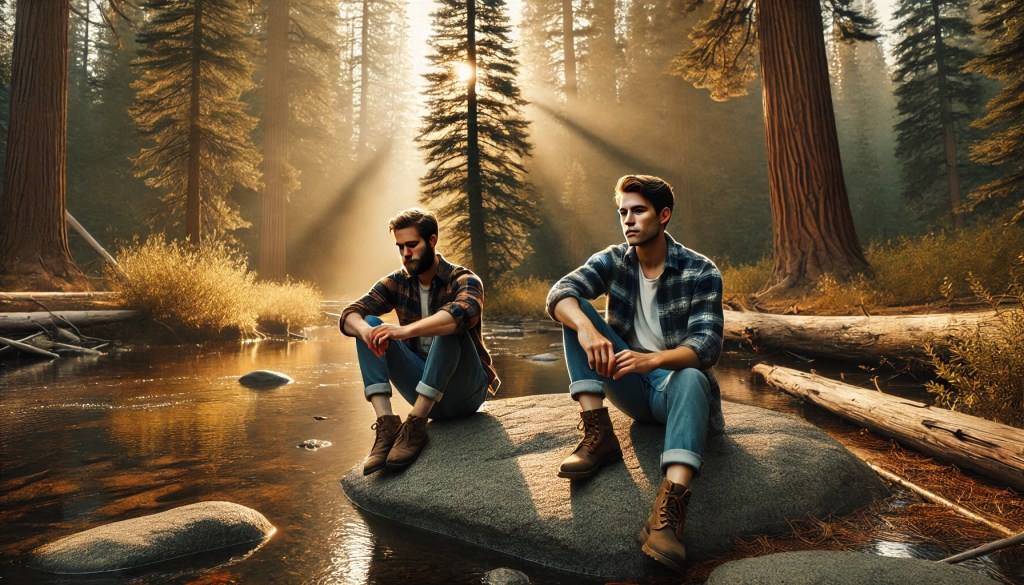
    The creek behind Ted’s property ran quiet that afternoon, low from a dry spell but steady all the same. Tyler crouched at the bank, skipping rocks like he used to as a kid, boots half-dusty, half-muddied. The air smelled of pine and old leaves, warm with a hint of coming fall.

    Clyde sat nearby on a flat boulder, arms resting on his knees, watching the ripples Tyler’s throws left behind.

    Neither had said much for a while.

    Ted had invited them both out—“just a fire and some quiet,” he’d said—but he’d ducked inside to check on supper and left the two of them alone not long after. Maybe on purpose.

    Tyler stood, brushing his hands off on his jeans. “Don’t know why, but this place always slows my brain down.”

    Clyde gave a small grunt of agreement. “Somethin’ about water and woods. Strips the noise off.”

    Tyler looked over at him. “You ever think maybe God designed it that way? Like… made these places to help us remember what matters?”

    Clyde shifted, his gaze on the water. “Reckon He did. World’s loud. We make it louder.” A pause. “Truth don’t shout much.”

    Tyler chuckled, quiet. “Nah. It doesn’t.”

    He walked over and sat down next to Clyde on the rock. Their shoulders didn’t touch, but they didn’t need to. The closeness wasn’t forced—it just was.

    “I’ve been thinkin’,” Tyler said after a minute, “about what you said last week. About prayin’ honest.”

    Clyde didn’t look over, but his brow lifted slightly.

    Tyler kept going. “I started tryin’. Not just talkin’ to God, but tellin’ Him stuff I’d never even admitted to myself.” He let out a breath. “Thought He might be mad. But it’s weird… it’s like He already knew. Like He was waitin’ on me to say it just so I could hear it too.”

    Clyde nodded slow. “He’s good like that.”

    Tyler glanced down at the water. “That book you gave me… it didn’t fix me.” He paused. “But it started somethin’.”

    Clyde nodded, voice quiet. “That’s all I hoped for.”

    They sat quiet again, a hawk crying faint somewhere overhead.

    “I don’t really know what this is,” Tyler said, glancing at Clyde. “Us. This… whatever we’re buildin’. But I know it ain’t shallow.”

    Clyde’s jaw worked a bit, like he was chewing on the words. Then he said, “Don’t gotta name it to know it’s real.”

    Tyler nodded. “I don’t feel like I gotta prove anything around you. That’s new.”

    Clyde’s voice was low, steady. “I don’t feel like I gotta hide.”

    The words landed like a stone sinking slow into deep water.

    Tyler looked away, blinked a few times. “I used to think I needed somebody to complete me. Like there was this hole that only another guy could fill. And I chased that. Thought it was love. But now…” He trailed off, shook his head. “Reckon I just needed a brother who’d stay.”

    Clyde glanced at him then—just a flicker—and the corner of his mouth tugged up slightly.

    “Sounds about right.”

    They sat there, side by side, while the sun shifted through the trees and the creek rolled on.

    Ted’s screen door creaked open behind them. “Food’s up,” he called.

    Clyde stood, offered Tyler a hand. Tyler took it without hesitation, letting Clyde pull him up. Their grip lingered a beat—firm, steady.

    “Come on,” Clyde said. “Let’s eat.”They walked toward the cabin—not side by side, but close enough.
    More than nothing.
    Solid enough to hold.

    (Chapter from Solid Enough To Hold in the Tyler and Clyde series. Contact me if you’d like to read the full story.)

  • Amos and Jonah (Part 5)

    Amos and Jonah (Part 5)

    The seasons spun on, each one layering their story deeper into the land. The oak by the porch grew gnarled, its branches heavy with years, much like the men who sat beneath it. They’d carved out a life that defied the whispers of the world—a brotherhood so fierce it stood as a testament, a living sermon etched in calloused hands and shared silences.

    The physical pull never left, not entirely. It’d flare in quiet moments—when Jonah’s arm slung around Amos’s shoulders as they watched a storm roll in, or when Amos’s fingers grazed Jonah’s wrist passing him a mug of coffee. But they’d mastered it, turned it into a current that ran beneath their covenant, powering it rather than pulling it apart.

    One summer, a traveling preacher came through, a wiry man with a voice like thunder. He stayed a night at the farm, breaking bread with them in the flickering light of the kitchen. He watched them close, his keen eyes catching the way Amos filled Jonah’s plate without asking, the way Jonah’s hand rested easy on Amos’s arm as they laughed over some old story. After supper, the preacher sat back, pipe in hand, and said, “Y’all got somethin’ special here. Like David and Jonathan, souls knit together. Ain’t seen many live it out so true.”

    Amos and Jonah exchanged a look, a flicker of pride and something softer passing between them. “Just tryin’ to honor Him,” Amos said, and Jonah nodded.

    “Ain’t always easy, but it’s good,” Jonah added.

    The preacher left the next day, but his words stuck, a quiet blessing on what they’d built. And build they did—year after year, until the farm wasn’t just a patch of dirt but a legacy of faith and fidelity. The chapel became a gathering place for the scattered folk of the hills, drawn by the warmth of two men who lived what they preached. They’d sit on those oak benches, listening as Jonah read Scripture or Amos prayed in that low, steady voice, and they’d leave feeling the weight of something holy.

    Fall came again, decades piling up like the leaves drifting against the barn. Amos was slower now, his back stooped from years of bending to the plow, and Jonah’s hands shook when he whittled, but they still worked the land, still knelt in the chapel, still laughed like the young men they’d once been. One evening, as the sun dipped low and the sky burned crimson, they walked the fence line, checking posts like they’d done a thousand times. Amos stopped, leaning heavy on a post, breath fogging in the chill.

    Jonah paused beside him, concern creasing his brow. “You alright?” he asked, stepping close, his hand finding Amos’s shoulder.

    Amos nodded, catching his breath. “Just takin’ it in. This place. You. All of it.”

    Amos turned, his hazel eyes locking with Jonah’s, weathered and deep with years of shared struggle and triumph. The wind kicked up, rustling the crimson leaves around their boots, and for a moment, they just stood there, the weight of their bond heavier than the post Amos leaned on. Jonah’s hand stayed firm on Amos’s shoulder, a tether as real as the Kentucky clay beneath them.

    “Reckon we’ve walked this road right,” Amos said, his voice a low rumble, softened by the years. “Ain’t been easy, fightin’ what we felt, but we made it somethin’ better. Somethin’ He can look down on and call good.”

    Jonah nodded, his gray eyes steady, a faint smile tugging at his lips. “Aye. Brothers, true and deep. That’s what He gave us strength for. Ain’t no shame in lovin’ you like this—pure, like David and Jonathan. We kept it holy.”

    Amos straightened, clapping Jonah on the back, the gesture rough but warm, a seal on their unspoken vow. “Let’s head in. Coffee’s callin’, and I ain’t freezin’ out here for pride.”

    They turned toward the farmhouse, shoulders brushing as they walked, the chapel’s silhouette a quiet sentinel against the fading light. Inside, they shed their coats, the fire already crackling from earlier. Jonah grabbed the pot, pouring two mugs, while Amos sank into his chair, the creak of the wood as familiar as a hymn. They sat across from each other, steam curling up between them, and raised their mugs in a silent toast—not to romance, not to what could’ve been, but to the brotherhood they’d forged, a covenant stronger than steel, rooted in their faith.


    Years later, when the townsfolk found them—Amos gone in his sleep, Jonah a day after, unwilling to linger alone—the chapel still stood, their initials carved in the bench. The land bore their mark, a testament to two men who’d wrestled the hum into something glorious, a friendship that glorified God’s design. They buried them side by side under the sycamore, the tree’s roots curling deep, just like the bond they’d lived out to the end.

  • Amos and Jonah (Part 4)

    Amos and Jonah (Part 4)

    Years rolled on, and the farm flourished under their care, a testament to their labor and their faith. The townsfolk would talk—two bachelors living out there, thick as thieves, closer than brothers, working the land and praising the Lord with a fire few could match. They’d see Amos and Jonah at the market, bartering for seed or a new plow blade, their easy banter and shared glances a quiet marvel. Some whispered, wondering at the depth of it, but most just saw two men who’d found a rare thing—a bond forged in sweat and Scripture, unbreakable as the Kentucky hills.

    The years etched lines into their faces, turned Amos’s hair to silver and Jonah’s to a dusty gray, but the rhythm of their days held steady. They’d rise before dawn, coffee brewing on the old stove, and head out to tend the herd or mend a fence. The physical affection stayed—a constant thread woven into their lives, natural as breathing. A hand on the back after a hard day, a rough hug when the weight of the world pressed too heavy, a playful shove that’d spark a wrestle in the yard, their laughter ringing out across the fields.

    The hum lingered too, a quiet ember they’d long learned to tend without letting it flare. It was there in the way Jonah’s eyes would trace Amos’s broad frame as he split wood, or how Amos’s breath would catch when Jonah sang hymns in that low, steady tenor. But they’d made their choice, and it was a choice they renewed every day—with every prayer, every shared meal, every step they took side by side.

    One crisp autumn evening, as the maples blazed red and gold, they sat on the porch, rocking chairs creaking under their weight. The harvest was in, the barn stuffed with hay, and the air smelled of apples ripening on the tree out back. Jonah whittled now, a habit he’d picked up from Amos, shaping a small cross from a chunk of walnut. Amos leaned back, hands folded over his belly, watching the sun sink behind the ridge.

    “Reckon we’ve done alright, Jonah,” Amos said, his voice a deep rumble softened by time. “This life, this place. Him up there’s gotta be smilin’ down on it.”

    Jonah paused, the knife still in his hand, and looked over at Amos. The fire in his eyes hadn’t dimmed, not even after all these years. “More’n alright,” he said. “We took what He gave us—this pull, this whatever-it-is—and made it somethin’ good. Somethin’ holy, even.”

    Amos grunted, a sound that might’ve been agreement or just the comfort of hearing Jonah’s voice. “Ain’t been easy,” he said after a beat. “Times I wanted to give in, let it turn to somethin’ else. But you kept me straight. Iron sharpens iron, like you’re always quotin’.”

    Jonah grinned, setting the cross on the arm of his chair. “You did the same for me. Nights I’d lie awake, wonderin’ if we was fools to fight it. But then I’d hear you snorin’ through the wall, and I’d think, ‘Naw, that’s my brother. That’s my rock.’ And I’d pray for us both.”

    Amos turned his head, meeting Jonah’s gaze. There was a weight there, a tenderness that didn’t need words, but he spoke anyway. “I’d do it all again, you know. Every wrestle, every hard day, every time I had to pull back from you. ’Cause what we got—it’s rarer than gold. Ain’t many men get a friend like this, a brother like this.”

    Jonah nodded, his throat working as he swallowed down the swell of emotion. “Same, Amos. Same.”

    They fell quiet then, the crickets picking up their song as dusk settled over the farm. The chapel still stood at the edge of the field, weathered now but sturdy, a silent witness to their covenant. Inside, they’d carved their initials into the back of one bench—A.K. and J.T., side by side, a small mark of the life they’d built. The townsfolk called it the Brotherhood Chapel, a name that stuck after old man Carver saw them praying there one Sunday and said it felt like walking into a piece of heaven.


    One winter, when the snow piled high and the wind howled through the eaves, Jonah took sick. A cough that wouldn’t quit turned into a fever that kept him abed, his lean frame shivering under a pile of quilts. Amos tended him like a mother hen, broth simmering on the stove, prayers muttered under his breath as he pressed a cool cloth to Jonah’s brow. The farm could wait—the cattle would survive a day untended—but Jonah couldn’t. Not to Amos.

    “Stop fussin’,” Jonah rasped one night, his voice weak but his eyes sharp. “I ain’t dyin’ yet. Got too much left to do with you.”

    Amos huffed, dipping the cloth back into a basin of cold water and wringing it out with hands that trembled just a touch. “Better not be dyin’. I ain’t haulin’ this farm alone, you hear? And I sure ain’t prayin’ in that chapel by myself.”

    Jonah managed a faint chuckle that turned into a cough, and Amos was quick to prop him up, a broad hand splayed across Jonah’s back, steadying him until the fit passed. Their eyes met in the dim lantern light, and for a moment, that old ember flared sharp and bright, a pang of longing they’d spent years taming. Amos’s hand lingered, warm against Jonah’s fevered skin, and Jonah’s breath hitched, not just from the sickness.

    “Lord, keep us,” Jonah whispered, a prayer as much as a plea, and Amos echoed it with a gruff “Amen.” He eased Jonah back onto the pillows, pulling the quilts up tight.

    “Rest now. We got this,” Amos said, his voice a rock in the storm.

    And they did. The fever broke by morning, leaving Jonah weak but alive, and Amos sank to his knees by the bed, head bowed in gratitude, tears cutting tracks through the grime on his weathered face.

    Spring came late that year, the frost clinging stubborn to the ground, but when it finally thawed, the land burst forth like a promise kept. Jonah was back on his feet, thinner now, his cheeks hollowed, but his spirit unbowed. They stood together in the chapel one Sunday, the air thick with the scent of damp earth and new growth seeping through the cracks. Jonah’s voice rose in a hymn—“Blessed be the tie that binds”—and Amos joined in, his rumble blending with Jonah’s tenor, rough harmony lifting to the rafters. Their shoulders brushed as they sang, and when the last note faded, they stayed there, side by side, breathing in the stillness.

    (Concluded in Part 5)

  • Amos and Jonah (Part 3)

    Amos and Jonah (Part 3)

    Days turned into weeks, and the rhythm of the farm carried them forward. They plowed the back forty together, the mules’ harnesses jangling as they trudged through the clay. Amos would clap Jonah on the back when they finished a row, his hand lingering a beat longer than necessary, and Jonah would grin, shoving him playfully in return. At night, they’d sit on the porch, the crickets serenading the stars, and talk about everything—Scripture, the herd, the way the river swelled after a rain.

    Sometimes they’d wrestle out in the yard, a rough tumble over a stray comment or just to burn off the restless energy that sparked between them. Amos would pin Jonah to the grass, both of them laughing, breathless, their faces inches apart until one of them would pull away, red-faced and muttering about needing water. The attraction simmered, undeniable, but they channeled it into something fierce and good—a bond that didn’t bend under the weight of temptation.

    One spring evening, after a long day mending fences, they sat by the creek that cut through the property. The water ran clear over smooth stones, and the willows dipped low, brushing the surface. Jonah stripped off his shirt, splashing water on his face, the droplets catching the golden light. Amos watched, his chest tightening, then looked away, picking up a flat stone to skip across the creek.

    “You’re a sight, Jonah,” he said, half-teasing, half-serious. “Oughta be careful, or I’ll forget myself.”

    Jonah laughed, shaking the water from his hair like a dog. “Ain’t my fault you’re weak, old man.” But his eyes softened, and he sat beside Amos on the bank, their shoulders brushing. “We’re doin’ right, ain’t we?” he asked quieter. “Keepin’ this in line?”

    Amos skipped another stone, watching it hop four times before sinking. “Reckon so. Ain’t easy, but it’s worth it. The Lord’s got us.”

    Jonah nodded, resting his forearms on his knees. “I’d rather have you as my brother, true and steady, than lose you to somethin’ fleeting. That’s what He wants, I figure. Men who stand together, lift each other up.”

    That summer, they built a small chapel on the edge of their land—nothing fancy, just a lean-to with a cross nailed above the door and a couple of benches hewn from oak they’d felled themselves. It became their sanctuary, a place where they could kneel together and lay their struggles bare before God. The chapel smelled of sawdust and resin, and the sunlight filtered through the gaps in the walls, painting stripes of gold across the dirt floor. They’d sit there after a day’s work, sweat-soaked and weary, and pray for the strength to keep their covenant, to honor the bond they’d forged not just with each other, but with the One who’d brought them together.


    The physical pull didn’t vanish—how could it? It was stitched into the fabric of who they were, two men carved from the same rugged earth, their lives entwined like the roots of the old sycamore that shaded the farmhouse. But they learned to dance with it, to let it fuel their brotherhood rather than fracture it. When Amos felled a tree, Jonah was there to haul the logs, their hands brushing as they hefted the weight together, a spark flickering but quickly smothered by a shared grunt of effort. When Jonah stumbled under the strain of a sick calf, Amos was there, his arm slung around Jonah’s waist to steady him, the warmth of his grip a quiet comfort they didn’t linger on too long. They’d laugh it off, clap each other on the back, and move on, their resolve a shield against the undertow of desire.

    Harvest season rolled in, the fields heavy with corn and the air thick with the drone of cicadas. They worked from dawn to dusk, scythes swinging in tandem, their rhythm so synced it was like one man mirrored in two bodies. One afternoon, the heat was unbearable, a wet blanket pressing down on the land. They stripped to their waists and waded into the creek to cool off, splashing water at each other like boys. Jonah tackled Amos into the shallows, and they wrestled, slick with mud and laughter, until Amos pinned Jonah beneath him, the current tugging at their legs.

    Their eyes locked, breaths heaving, and for a heartbeat, the world shrank to just them—the pulse of Jonah’s wrist under Amos’s hand, the bead of water sliding down Jonah’s temple. Amos’s grip tightened, then released. He rolled off, splashing back into the water with a groan.

    “Lord, give me strength,” Amos muttered, half to himself, half to the sky.

    Jonah sat up, grinning despite the flush in his cheeks. “He’s givin’ it, brother. We’re still standin’, ain’t we?”

    And they were. That was the miracle of it. The attraction was a fire, but they stoked it into something else—something that warmed rather than burned, something that lit the path they walked together. They’d sit by the fire at night, Amos whittling while Jonah read from the Psalms, his voice weaving through the crackle of the logs.

    “As iron sharpens iron, so one man sharpens another,” Jonah read one evening, glancing up with a knowing look.

    Amos nodded, the corner of his mouth twitching into a rare smile. “Reckon that’s us,” he said, shaving a curl of wood from the block in his hands. “Sharp enough to cut through anything the devil throws our way.”

    Winter came, blanketing the farm in snow, the fields glittering under a pale sun. They’d tromp through the drifts to check the cattle, their breaths puffing white in the air. One morning, Jonah slipped on a patch of ice, and Amos caught him, pulling him close to steady him. For a moment, they stood there, chest to chest, the cold biting their skin but the heat of each other cutting through it. Jonah’s hand rested on Amos’s arm, and Amos didn’t pull away—not right off. They looked at each other, the silence thick with all they wouldn’t say, and then Jonah stepped back, clapping Amos on the shoulder.

    “Thanks, big man,” he said, voice rough but light. “Ain’t goin’ down that easy.”

    Amos chuckled, shaking his head. “Better not. Who’d keep me in line?”

    Spring returned, and with it, a calf born under the first full moon. They named her Hope, a scrappy little thing with a coat like midnight. They knelt in the straw of the barn, marveling at her, their shoulders pressed together as they watched her wobble to her feet. Jonah’s hand found Amos’s, a brief squeeze, and Amos returned it—two men bound by something bigger than themselves, something eternal.

    (Continued in Part 4)

  • Amos and Jonah (Part 2)

    Amos and Jonah (Part 2)

    Amos’s words hung heavy in the air, raw and unguarded. “Reckon I’d die for you, Jonah.” The confession slipped out like a stone dropping into a deep well, rippling through the silence of the farmhouse. Outside, the wind rustled the bare branches of the oak tree by the porch, a soft moan that mirrored the ache in both their chests.

    Jonah rose from his chair, the Bible still resting on the table, its leather cover worn smooth from years of touch. He crossed the room slow, his boots scuffing the pine floor, and stopped a pace behind Amos. “Don’t say that less you mean it,” Jonah said, his voice low but steady, like the hum of a hymn. “’Cause I feel the same, and it scares me somethin’ fierce.”

    Amos turned, his hazel eyes catching the firelight, glinting with a mix of resolve and torment. “I mean it. Ain’t no lie in me when it comes to you. But feelin’ it don’t make it right, does it? We’re men of the Word. We know what’s laid out for us.”

    Jonah nodded, his throat tight. He stepped closer, close enough that Amos could smell the sweat and earth clinging to him from the day’s labor, a scent as familiar as the fields they worked. “It’s a fight, ain’t it?” Jonah said, his voice trembling just a hair. “Lovin’ you like this and knowin’ we gotta turn it into somethin’ else. Somethin’ God can smile on.”

    Amos clenched his fists at his sides, the muscles in his forearms flexing under the rolled-up sleeves of his flannel shirt. “Ain’t never felt a pull this strong,” he admitted. “Not even when I was young and full of fool notions about the world. You’re in my bones, Jonah. But I ain’t here to defy Him. I’m here to serve Him.”

    Jonah reached out, hesitant, then rested a hand on Amos’s shoulder, firm and warm through the worn fabric. “Same,” he said. “We’re brothers in Christ first. That’s the covenant that matters. Whatever this is, we shape it to fit His will.”

    They stood there, locked in that touch, the fire popping behind them like a chorus urging them onward. The weight of their faith pressed down, but so did the strength of it, lifting them above the churn of their hearts. Amos finally stepped back, breaking the contact, and ran a hand over his stubbled jaw.

    “Let’s pray on it,” he said gruffly. “Ain’t no better way to sort this out.”

    They knelt together on the braided rug by the hearth, knees sinking into the faded colors woven by Amos’s mother years back. Jonah led, his voice steadying as he spoke. “Lord, You see us. You know every corner of our hearts, every stumble and every hope. We’re Yours, first and always. Take this bond we got, this love, and make it holy. Shape it to Your design, not ours. Give us strength to walk upright, to glorify You in all we do.”

    Amos murmured an “amen,” his head bowed, the firelight dancing across the planes of his face. When they rose, there was a quiet resolve between them, a pact forged in the heat of that moment. They wouldn’t run from what they felt, but they wouldn’t let it rule them either. It’d be a brotherhood, deep and true, tempered by faith.

  • Flesh and Bone: The Bond that Holds

    Flesh and Bone: The Bond that Holds

    The wind howled across the cliffs of Dunmoor, dragging salt and spray inland, where a village called Hearthglen clung to the land like a memory. Long before the world grew sharp and distant, the men of Hearthglen lived close—close to the earth, close to each other. They worked the fields and fished the sea, and when the day was done, they sat shoulder to shoulder by the fire, letting touch speak what words didn’t need to.

    Back then, no one questioned it. A hand on the back said, “I’m with you.” A grip on the arm meant, “We’re still standing.” Touch was strength shared, not stolen. The old elder Eamon called it God’s design: “He made us flesh and bone, lads—not just to toil, but to hold.”

    Torin and Calum weren’t brothers by blood, but they might as well have been. One loud, one quiet. One broad and brawny, the other lean and sharp-eyed. They moved through life like two halves of a single soul—until the world changed.

    Traders came with polished steel and slippery words. They sold more than goods; they sold a new idea of manhood: self-made, self-reliant, untouched. And slowly, the village followed. Arms that once held now hung at men’s sides. Brothers became rivals. Words replaced presence. The fire grew cold.

    Then the storm came.

    It tore through Hearthglen, ripping roofs, shattering boats, and leaving silence in its wake. Torin and Calum stood yards apart, working through the wreckage, silent, stiff, the space between them colder than the wind. And it was Eamon, bent and half-frozen, who limped into the heart of it all and shouted what everyone knew but had forgotten: “God gave us hands to hold—not just to hoard.”

    And when a boy named Finn—thin, trembling, alone—stepped into the square asking for help, no one moved… until Eamon did. He wrapped that boy in his frail arms and broke something open.

    Torin stepped toward Calum.

    “Brother,” he said—rough, unsure—and placed a hand on his shoulder.

    Calum flinched… then reached up and gripped Torin’s arm.

    And that was the spark.

    One by one, men followed. An embrace here, a clasp of arms there. Walls crumbled. Eyes softened. Voices rose. It wasn’t polished—it was raw, clumsy, honest. It was holy.

    They rebuilt the village, yes. But more than that, they rebuilt the bond. Shoulder to shoulder. Hand to back. Forehead to forehead in prayer. Touch, reclaimed. Pure. God-honoring.

    The traders came again, puzzled at what they found: not lonely men chasing coin, but a tribe forged in shared strength. They left, muttering. Hearthglen didn’t blink.

    Years passed. Eamon died, buried beneath the cliffs. They carved his words into stone:

    “Flesh and bone—meant to hold fast.”

    And they did.

    Men lingered after the work was done—not to compete, but to stay close. They taught the boys how to fish, how to plant, how to press a hand to a brother’s back when the weight got heavy. They didn’t call it covenant. They didn’t need to. It was carved in the way they leaned into each other. It was how God made them.

    Not just to stand tall.

    But to stand tall together.

  • More Than Words

    The fire burned low, throwing flickering shadows against the trees. The night air was crisp, the scent of pine mingling with cooling embers and the faint smell of fresh-cut lumber stacked neatly by the porch, waiting for morning repairs. No tension hung between them now—just the quiet weight of men who had walked hard roads.

    Clyde sat back in his chair, arms crossed, his expression unreadable but lacking its usual edge. Tyler sat to his left, staring into the flames, silent but not restless. Ethan leaned forward, turning a stick over in his hands, the firelight catching the side of his face. Ted, as always, was steady, his presence grounding them all.

    For a long time, none of them spoke.

    Then Clyde cleared his throat, voice gruff but not biting. “So. This… covenant thing.”

    Ethan glanced up.

    Clyde’s gaze stayed on the fire. “It ain’t just some sentimental nonsense, is it?”

    Ethan’s lips quirked. “No.”

    Clyde nodded once, like that answer was good enough for now. He rubbed a hand over his jaw, exhaling slowly. “So explain it to me.”

    Tyler looked over, curiosity flickering in his eyes.

    Ethan turned the stick in his fingers, thoughtful. Then he spoke, steady and sure. “Covenant’s not just about loyalty. It’s about belonging. It’s saying, ‘I see you. I walk with you. I fight for you.’ It’s not built on obligation—it’s built on choice.”

    Clyde was quiet, absorbing that.

    Ethan looked into the fire, voice steady. “The world tells men like us that closeness always has to mean something else. That brotherhood can’t be deep without crossing lines. That we’re always missing something.” He shook his head. “But that’s a lie. The enemy wants us to believe it, because it keeps us from stepping into the love God actually designed for us.”

    The fire crackled, sending sparks spiraling into the dark.

    Clyde exhaled slowly. “You really believe that?”

    Ethan met his gaze directly. “Yeah. I do.”

    Clyde studied him, searching for something—maybe weakness, maybe hesitation. But there was none. Clyde’s jaw worked subtly, his eyes narrowing not in judgment but something closer to respect, a quiet acknowledgment of truth landing deeper than he’d expected.

    Tyler shifted slightly. “And that’s enough?” His voice was low, uncertain, as though afraid the answer might actually matter.

    Ethan’s brow furrowed slightly. “More than enough.” He hesitated, then added softly, “It’s better.”

    Tyler looked away, his fingers flexing restlessly against his knee.

    Clyde let out another slow breath, eyes drifting back to the fire, rubbing the back of his neck. He didn’t argue. Didn’t scoff. Just sat quietly, wrestling silently with something he’d spent years pushing away.

    Ted, who’d been listening quietly, finally spoke up. “Funny thing about truth.” He leaned forward, resting his arms on his knees. “You don’t have to rush it. Just gotta let it do its work.”

    The fire burned lower, glowing embers pulsing beneath the ash. One by one, the others started shifting—Ted stretched with a quiet grunt before heading toward the cabin, pausing to glance at the stack of lumber, making a silent note of tomorrow’s tasks. Ethan finished off his coffee before following, nodding toward Clyde and Tyler as he passed.

    Clyde stayed put, kicking at a loose log with the toe of his boot.

    Tyler grabbed a stick, prodding at the fire, sending sparks up into the night. Neither spoke for a long while.

    Finally, Clyde grunted. “You gonna sit there, or you gonna help me put this thing out?”

    Tyler huffed softly but stood, grabbing a bucket of water from beside the porch. He sloshed some over the coals, steam hissing up between them. Clyde nodded in quiet approval, kicking dirt over the rest.

    They stood there in the fading glow, watching the last embers die.

    Then Tyler muttered, “We’re not friends.”

    Clyde let out a low chuckle, shaking his head. “Didn’t say we were.”

    Silence stretched again. The wind stirred through the trees.

    Clyde exhaled, voice quieter than before. “But maybe you’re not as lost as I thought.”

    Tyler glanced over, studying him briefly, then smirked faintly. “Maybe you’re not as certain as you thought.”

    Clyde snorted, but a faint smile tugged at the corner of his mouth. He didn’t argue.

    They didn’t shake hands. Didn’t nod in silent truce.

    But when they turned toward the cabin, they walked back at the same pace.

    (Chapter from Beyond Ourselves in the Ethan and Ted series, contact me if you’d like to read the full story)

  • The Sacred Call to Brotherhood Among Men

    The Sacred Call to Brotherhood Among Men

    We talk a lot about the need for brotherhood. And it’s true—we weren’t meant to walk alone. God wired us for connection, for iron sharpening iron, for a kind of love between men that strengthens, refines, and restores. But what if brotherhood isn’t just something we need?

    What if it’s something we’re called to?

    In a world that tells men to be independent, self-sufficient, and emotionally detached, brotherhood often gets reduced to a preference—a nice addition if you can find it, but not essential. Even in Christian circles, friendship is encouraged, but rarely do we hear it spoken of as a sacred duty.

    But throughout Scripture, we see a different picture.

    We see Jonathan, a warrior prince, binding his soul to David—not just out of affection, but because he saw God’s hand on his life (1 Sam. 18:1-4). We see Moses needing Aaron and Hur to hold up his arms when he grew weak (Ex. 17:12). We see Jesus Himself, the Son of God, walking not alone but with brothers—men He called friends (John 15:15).

    Brotherhood isn’t just an emotional longing—it’s part of God’s design for how men are meant to live and fight.

    And when we step into it, it’s not just for ourselves.

    Because here’s the truth: The world is starving for strong, righteous, Christ-centered men to rise up—not just as lone warriors, but as brothers. Men who will stand for each other, fight for each other, and commit to something bigger than themselves.

    The enemy knows the power of brotherhood. That’s why he isolates. That’s why he twists male connection into something impure or unnecessary. That’s why he wants men passive, detached, and drifting through life without anchors. Because he knows what happens when men walk together in strength.

    When men choose covenant over convenience.

    When they stop waiting for brotherhood to find them and start stepping into the calling to build it.

    It’s not just about us. It never was. It’s about restoring what’s been lost. It’s about saying yes to something that will outlive us.

    And that? That’s worth everything.