Category: Fiction

  • Garage Band

    Garage Band

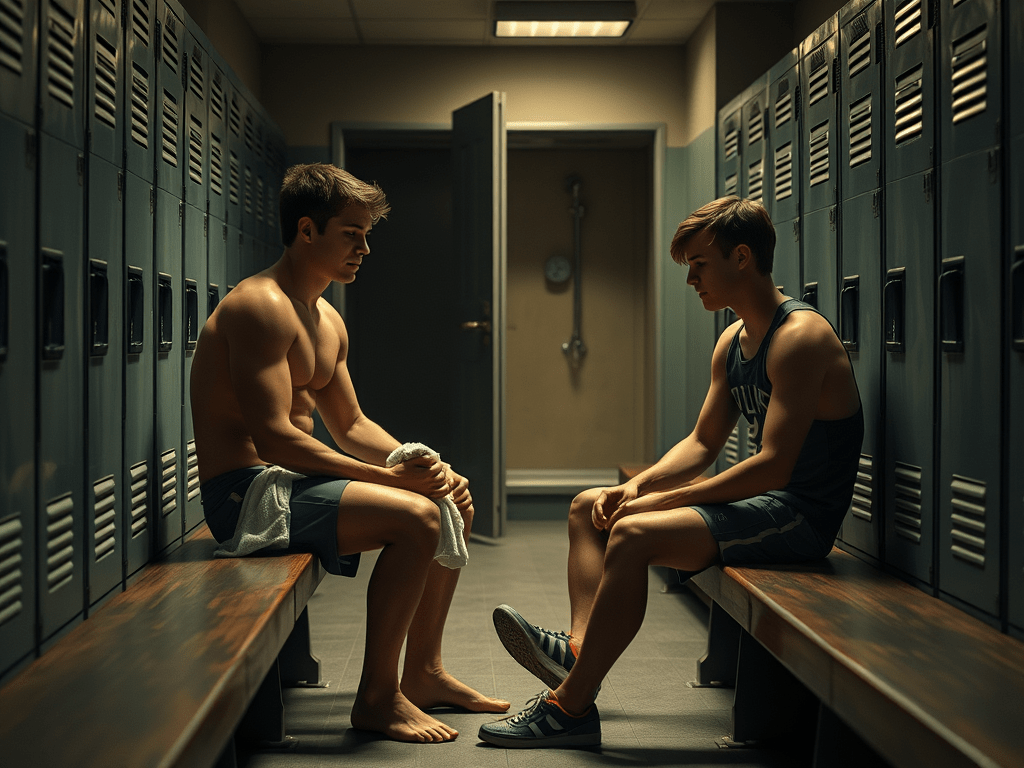
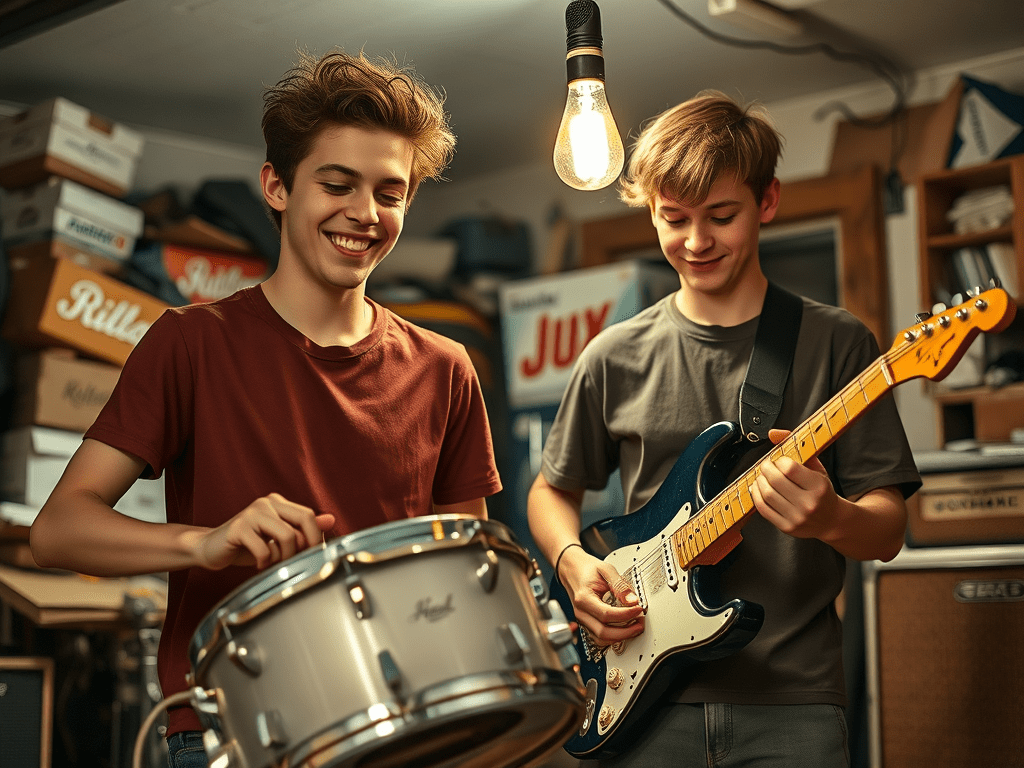
    The garage smelled like motor oil and stale pizza, a haze of dust catching the light from a single dangling bulb. Tyler’s drumsticks clacked against the snare, a rhythm sharp enough to cut through the humid August air. Across from him, Gabe hunched over his beat-up Stratocaster, coaxing a riff out of strings that hadn’t been changed in months. They weren’t good—not by any stretch—but they were loud, and that was enough.

    “Turn it up,” Tyler called, grinning as he kicked the bass pedal. Gabe twisted a knob on the amp, and the sound swelled, rattling the toolbox on the workbench. The neighbors hated it. They loved that part most.

    They’d been at this since sophomore year, when Gabe found the guitar at a yard sale and Tyler begged his mom for a drum kit he’d never master. Three years later, they were still here—eighteen, sweaty, and tethered to this concrete box like it was the only place that made sense. No gigs, no dreams of stadiums. Just the two of them, filling the space with noise.

    “New riff?” Tyler asked, wiping his forehead with the back of his hand.

    “Old one, just louder,” Gabe said, strumming a chord that buzzed like a chainsaw. “You’re off beat again.”

    “Am not. You’re just deaf.” Tyler twirled a stick and missed, letting it clatter to the floor. Gabe snorted, and they fell into the easy silence that came after a jab. It was their rhythm—push, pull, steady.

    The garage door was half-open, letting in the hum of crickets and the occasional bark from the mutt next door. Tyler’s house was a squat ranch-style thing, paint peeling like it was tired of holding on. Gabe lived three blocks over, but he might as well have lived here. His sneakers were piled by the door, his initials scratched into the workbench from a bored afternoon with a pocketknife. They’d built this, piece by piece, without ever saying it aloud.

    “Dad’s pissed again,” Tyler said, tapping the hi-hat absently. “Says I’m wasting my life in here.”

    Gabe looked up, fingers pausing on the strings. “What’d you tell him?”

    “Nothing. Just took it.” Tyler shrugged, but his jaw tightened. “He’s not wrong, maybe.”

    “Bull.” Gabe set Lozano—the guitar had a name, because of course it did—against the amp and crossed his arms. “You’re not wasting anything. We’re here, aren’t we?”

    Tyler smirked, but it didn’t reach his eyes. “Yeah, real high achievers. You’re slinging burgers, I’m flunking trig. Rockstars, man.”

    Gabe kicked a stray soda can across the floor. “Doesn’t matter. We’ve got this.”

    “This” was the garage, the music, the way they could sit here until midnight and not need anyone else. Tyler nodded, slow, like he was convincing himself. Gabe picked up Lozano again, strumming something softer, a melody he’d been messing with for weeks. Tyler joined in, tentative at first, then harder, until the sound felt like a pulse between them.

    They played until the bulb flickered, a warning it was about to die. Tyler tossed his sticks onto the snare and stood, stretching. “Gotta crash. Early shift tomorrow.”

    “Same,” Gabe said, but he didn’t move. He watched Tyler shove the drum kit against the wall, the same way he always did—precise, like it mattered. “You good?”

    Tyler hesitated, hands in his pockets. “Yeah. Just… Dad’s on me about college again. Says I need a plan.”

    “You’ve got one,” Gabe said, voice firm. “Us.”

    Tyler laughed, short and sharp. “That’s not a plan, dude.”

    “It’s enough.” Gabe stood, slinging Lozano over his shoulder. “Come on, I’ll walk you in.”

    They stepped into the night, the air cooler now, crickets louder than the echo of their music. Tyler’s front door creaked as they slipped inside, dodging the living room where his dad’s snores rumbled from the couch. Upstairs, Tyler’s room was a mess—clothes on the floor, posters peeling off the walls. Gabe dropped onto the beanbag by the window, same spot he’d claimed since they were kids.

    “Stay over,” Tyler said, kicking off his shoes. “Floor’s yours.”

    Gabe nodded, like it was already decided. It usually was.

    The next week, everything cracked open. Tyler came home from his shift at the gas station to find his stuff—drumsticks, clothes, a half-dead phone—piled on the porch. His dad stood in the doorway, arms crossed, face red.

    “Out,” was all he said.

    Tyler didn’t argue. He grabbed what he could and walked, the weight of it sinking in with every step. He didn’t call Gabe. Didn’t need to. By the time he hit the third block, Gabe was there, leaning against a streetlight with Lozano strapped to his back.

    “Figured you’d show up,” Gabe said, falling into step beside him. “What happened?”

    “Dad’s done. Says I’m a leech.” Tyler’s voice was flat, but his hands shook as he clutched the bag.

    Gabe didn’t say anything for a minute, just kept walking. Then: “My mom’s at work. You’re crashing with me.”

    “Gabe—”

    “Shut up. You’re not sleeping on the street.” He adjusted Lozano’s strap, a nervous tic. “We’ll figure it out.”

    Tyler stopped, dropping the bag. “Why’re you doing this?”

    Gabe turned, eyes steady. “Because you’re my brother, dumbass. Not blood, but—y’know. We’re in this.”

    Tyler swallowed hard, nodding once. They kept moving, the silence heavier now, but not empty. Gabe’s place was small, a duplex with chipped paint and a leaky sink, but it was warm. He shoved a blanket at Tyler and pointed to the couch. “Yours.”

    Tyler didn’t sleep much that night, staring at the ceiling while Gabe’s snores drifted from the next room. He thought about the garage, the music, the way Gabe never asked questions—just showed up. It wasn’t a plan, not like his dad wanted. But it felt like something solid, something he could hold onto.

    Morning came gray and slow. Gabe shuffled out, hair a mess, and tossed a notebook onto the coffee table. “Wrote this last night,” he said, yawning. “For the band.”

    Tyler flipped it open. Scrawled in Gabe’s chicken-scratch was a line: Strength in two, me and you. Below it, a chord progression, rough but real.

    “Cheesy,” Tyler muttered, but he smiled.

    “Yeah, well, it’s true.” Gabe grabbed Lozano and started picking out the melody. “Play with me?”

    Tyler dug his sticks out of the bag, tapping the table like it was his snare. The sound was thin, nothing like the garage, but it was theirs. They played until the sun broke through the blinds, a promise neither had to speak. It wasn’t about fixing everything—not yet. It was about staying, about being enough.

    And for now, it was.
  • The Cut

    The Cut

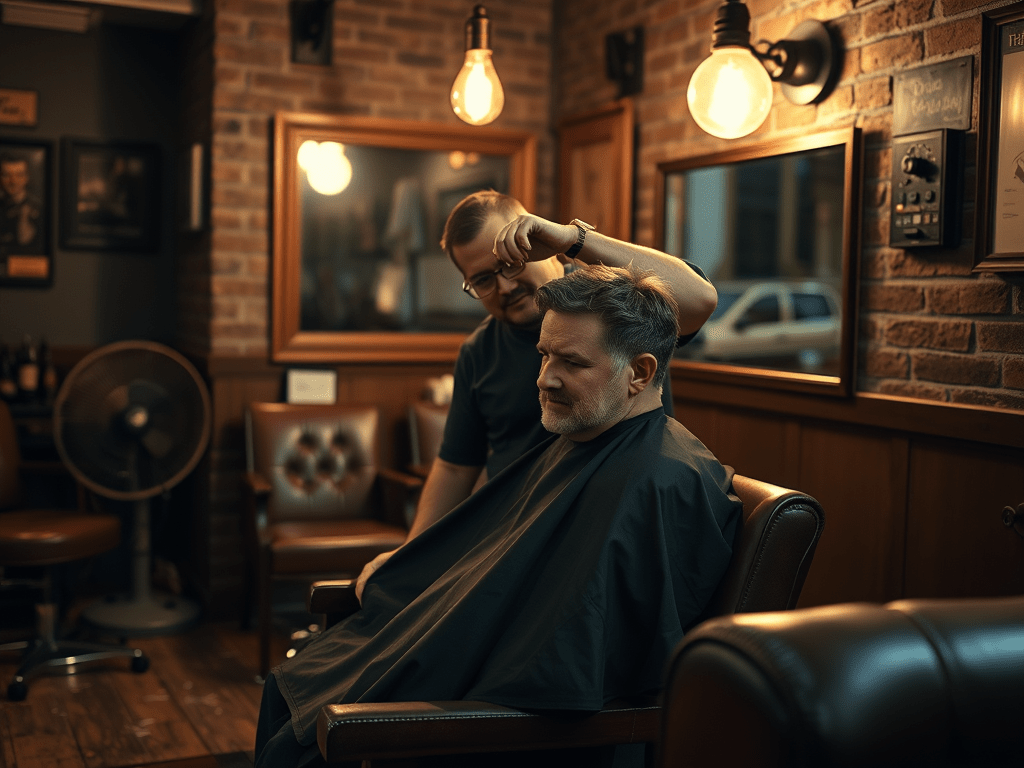
    The barbershop glowed soft under a single bulb, clippers humming low against the Chicago dusk. Matt, 44, swept stray hairs off the worn floor, hands steady from years behind the chair. A fan ticked in the corner, stirring November air through streaked glass. The bell jingled—Dave, 42, stepped in, jacket slung over his shoulder, cap in hand, a desk job’s weight in his slouch.

    “Trim?” Matt asked, voice warm, nodding at the leather seat. Dave eased in, mirror catching a face etched by quiet years—divorce at 38, nights chasing peace in old habits. Matt’s wasn’t much different—party days traded for faith three years back, steady now with shears.

    Clippers buzzed, shearing Dave’s dark scrub. “Rough day?” Matt said, brushing a neck hair.

    “Office grind,” Dave replied, eyes half-closed. “Back’s griping—too much chair.”

    Matt chuckled, light. “Know it. Poured drinks ‘til 41—legs quit before the shots did.”

    Dave’s mouth twitched—a half-grin. “Barber now? What flipped it?”

    “Whiskey ran dry,” Matt said, easy. “Three years ago—church pal pulled me out. Clipping’s calmer—keeps me straight.”

    Dave’s fingers tapped the armrest—Matt caught it. “Wife left me,” Dave said, low. “Four years—thought she’d settle what stirred off. Never did.”

    Matt set the clippers down, grabbed a towel. “Yeah. Men got me—deep, not gals. Chased it in late bars—flicks, guys laughing, not loving. Hit harder’n anything.”

    Dave’s eyes met Matt’s in the glass, steady over the hum. “Same reel. Shows—two fellas, tight, not queer. Never named it ‘til it stuck.”

    The shop shrank—buzz, fan, street hum—just two voices weaving close. Matt knew that pull—loving men, not the world’s tune, soul not skin. Dave’s echo rang it softer—different ache, same thread.

    “Faith found me,” Matt said, wiping Dave’s neck. “Three years—still feel that hum. Not chasing beds—just a guy getting me. Christ took it, made it His.”

    Dave’s smile was faint. “Two years—prayer night, broke. Thought it’d damn me ‘til grace said no. Hums still—guy’s nod at work, old itch.”

    They’d crossed that month—hair snipped, talk spilled slow. Matt saw Dave’s pause at a customer’s laugh; Dave caught Matt’s quiet when a voice hit the door. No rush—just truth, gentle as dusk. They’d nodded once, chair left open—two men, worn but breathing (John 15:15—friends, not just hired hands).

    “Built for this,” Matt said, voice warm. “Men loving men, Christ’s way—not their line. Rare, but ours.”

    Dave rubbed his chin, steady. “Thought I’d drift solo—shamed out. This—covenant? Feels true.”

    The bulb flickered—shop dim, city soft beyond. Matt’s chest eased—Dave’s too. Not a spark of heat, not a blur—just alive, like shears cutting clean. Tomorrow waited—cuts for Matt, desks for Dave—but here, they sat, loving unique, God-lit.

    “This is it,” Matt said, firm but soft. “Live it—show ‘em there’s more. Build it, brother—heart and hands.”

    Dave tipped his head, meeting Matt’s eyes. “Yeah. Us—others too. No more lone.”

    Night hugged the glass, a quiet vow. Two men, past the script, carving covenant in the chair—simple, real, His.

  • Crimson Vow (Part 2)

    Crimson Vow (Part 2)

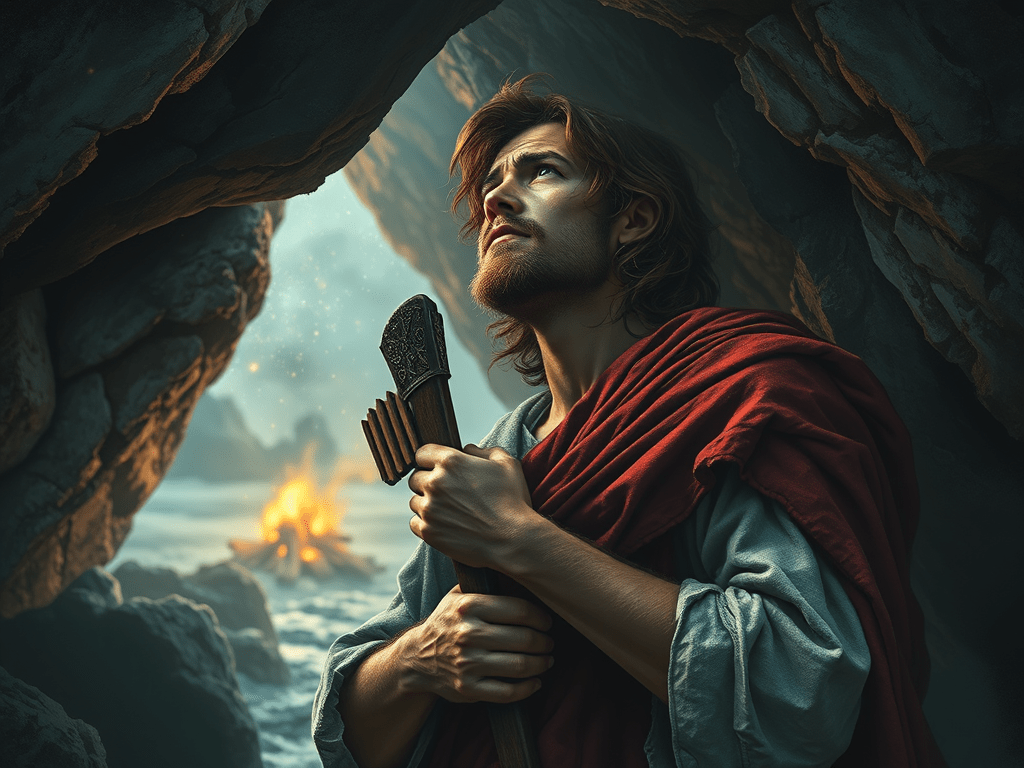
    Years stretched on, their paths sundered by war and fate. David became a fugitive king, leading outcasts through rugged cliffs, the crimson tunic fraying with each escape, the harp silent but ever-present. One frostbitten night, in a cave’s shadowed mouth, he wrapped the tunic tighter, bow in hand, and whispered to the stars, “Jonathan, your strength holds me still.” The wind howled, but Saul’s scouts prowled closer, their torches flickering like wolves’ eyes. Jonathan stayed with Saul, torn between love and duty, deflecting the king’s rages to buy David time. Yet their covenant held, a lifeline across the divide.

    Then came the news at Adullam: Saul and Jonathan had fallen at Mount Gilboa, slain by Philistine swords. The messenger, dust-caked and trembling, spoke of Jonathan’s final stand—how he’d fought to the last, his bow snapping as he shielded his father’s broken body, arrows spent, blood pooling on the ridge. David collapsed, clutching the bow, the harp slipping to the dust, and a cry tore from him, raw and shattering. “How the mighty have fallen!” he wailed. “Jonathan, my brother—your love was more precious than gold.”

    He took the harp, its strings trembling under his fingers, and poured out a lament, the notes rising over the camp like smoke. “Your bow lies still, your tunic ash, yet your vow endures,” he sang, tears streaking his face. He saw the stream again—their hands clasped, blood warm, starlight on the water—and his voice broke. The crimson tunic he burned that night, its threads curling slowly into the fire as he murmured, “Rest, my shield.” A shepherd’s farewell to a prince.

    He mourned through the ages, but he kept their oath. As king, he sought Mephibosheth, Jonathan’s lame son, and gave him a place at his table. The boy’s eyes, so like his father’s, met David’s as he said, “For your father’s sake, you’ll eat as my own.” He pressed a scarred hand to the boy’s shoulder, honoring the blood they’d shed by the stream. The bow hung in David’s chambers, the harp beside it, silent witnesses to their covenant—sealed in blood, forged in faith, and kept beyond the grave.

  • Crimson Vow (Part 1)

    Crimson Vow (Part 1)

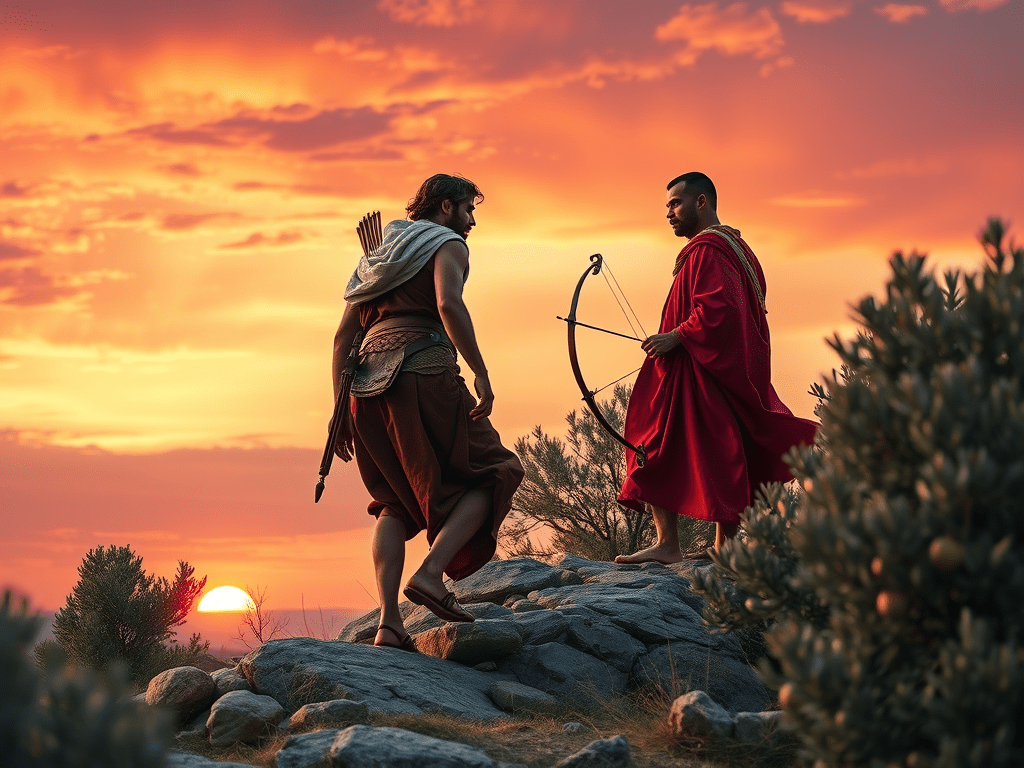
    The sun dipped below the hills of Gibeah, painting the sky in hues of crimson and gold. David, the shepherd-turned-warrior, climbed the rocky path toward the king’s encampment, his sling swaying at his side, a leather pouch slung over his shoulder. He’d been summoned again to play his harp for King Saul, whose spirit grew ever more restless. The echoes of his victory over Goliath still rang through Israel, a triumph that brought both praise and peril.

    At the hill’s crest, Jonathan, son of Saul, waited. His bow rested in his hand, his quiver slung across his back, and his dark eyes tracked David’s approach. His crimson tunic fluttered faintly in the breeze, simple yet regal, its edges catching the dying light. A faint smile curved his lips as David drew near.

    “You’re late,” Jonathan said, his tone light.

    David wiped sweat from his brow, grinning. “The sheep don’t heed royal commands. I had to pen them first.”

    Jonathan laughed softly, stepping forward to clasp David’s arm. “My father’s mood darkens hourly. Your music’s the only balm he knows.”

    David’s smile faded. “I’ll play, but I feel his gaze—like a wolf sizing up its prey.”

    Jonathan’s eyes flickered to the horizon. “He hears the songs. ‘Saul has slain his thousands, and David his ten thousands.’ It festers in him.”

    They walked toward the camp, the bond between them unspoken but palpable. They’d met weeks before, when David felled Goliath with a single stone, and Jonathan had watched, awestruck, as the shepherd claimed victory for Israel. In that moment, something kindled in Jonathan—a pull beyond rivalry. David was no ordinary man, and Jonathan, though heir to the throne, felt their souls tethered by a force divine.

    That night, in the dim glow of oil lamps, David sat before Saul, his fingers coaxing a melody from his harp. The king lounged on a cushion, his face haggard, his eyes shadowed. The music wove through the tent, a thread of peace battling the unseen torment gripping Saul’s mind. Jonathan lingered near the entrance, arms crossed, the scent of olive oil and dust thick in the air, watching his father’s tension ease, if only briefly.

    When the last note faded, Saul grunted a curt thanks and dismissed David with a wave. The shepherd bowed and slipped into the night. Jonathan followed, catching him near a grove of olive trees, their gnarled branches whispering in the breeze.

    “You’ve a gift,” Jonathan said, his voice hushed. “Not just with strings, but with souls. Even my father feels it.”

    David glanced at him, moonlight glinting in his eyes. “I seek only God’s favor, not man’s. But I’m glad to serve.”

    Jonathan nodded toward a path winding away from the camp. “Come with me.”

    They walked in silence, the camp’s clamor fading. Stars blazed overhead, a vast tapestry of light, and they stopped by a shallow stream, its waters shimmering like molten silver, the air tinged with pine and damp earth. Jonathan turned to David, his expression grave yet warm.

    “I’ve been thinking,” he began, hesitating. “About you. About Goliath. It wasn’t just skill or chance. The Lord stood with you.”

    David nodded. “He’s guided me since I was a boy, guarding my father’s flocks. Lions, bears—I’ve faced them. But that day… it was His hand.”

    Jonathan stepped closer, his voice dropping. “I’ve fought Philistines too, David. I’ve trusted the Lord to guide my bow. But you—you’re chosen. I see it. The people see it. And my father… he fears it.”

    David shifted, kicking a stone into the stream. “I’m no threat to him, Jonathan. I’m a shepherd, not a king.”

    “Not yet,” Jonathan murmured, the words heavy with portent.

    David met his gaze, searching for envy or doubt, but found only trust. Jonathan drew a small dagger from his belt, its blade catching the starlight. “I want you to know something. Whatever comes—whatever my father does—I stand with you. My heart is yours, as a brother’s.”

    David’s breath hitched. He had known loyalty, but this ran deeper, unyielding. “And mine is yours,” he said, his voice firm despite the swell of emotion.

    Jonathan held out the dagger. “Then let’s seal it—not with words alone, but with blood. A covenant before God.”

    David’s eyes widened, but he nodded. Such oaths were rare, sacred—binding beyond death. Jonathan pressed the blade to his palm, wincing as it bit into his flesh. Blood welled, dark and glistening, and he handed the dagger to David. The shepherd took it, mirroring the act, his hand trembling only slightly as the steel parted his skin.

    They clasped hands, blood mingling warm and wet between their palms. The pain was sharp, but it faded beneath the weight of their vow. “The Lord be between us,” Jonathan whispered, his grip tightening.

    “And between our houses forever,” David finished, his voice steady.

    Jonathan shed his crimson tunic, draping it over David’s shoulders, its fabric soft yet heavy with meaning. “Wear this,” he said. “Let it mark our bond.” David accepted it, the warmth a shield against the night’s chill. They stood there, hands locked, the stream murmuring beside them, their covenant sealed—blood and bond, a promise etched in flesh and spirit.

    Months passed, and Saul’s jealousy festered into madness. David’s victories swelled his fame, and the king’s heart turned black with envy. One evening, as David played his harp, Saul’s hand darted to a spear leaning nearby. Jonathan saw the glint of intent too late. The weapon flew, pinning David’s tunic to the tent wall as he dodged.

    “Father!” Jonathan cried, stepping forward, but Saul’s face twisted with rage.

    “Out!” the king bellowed, and David fled into the darkness, the crimson tunic trailing behind him.

    Jonathan found him later, hidden beneath a rocky overhang miles from Gibeah. David’s face was streaked with dirt, his eyes wide with betrayal, the tunic frayed at the hem from his flight.

    “He tried to kill me,” David said, his voice hollow.

    Jonathan knelt beside him, gripping his shoulder. “I know. His spirit’s warped—by fear, by something evil.” From his belt, he unslung David’s harp, scratched but whole, recovered from the tent. “I brought this. Keep it close.”

    David took it, fingers brushing the strings, a faint note rising into the night. “You risk too much.”

    “Nor will I let him take you,” Jonathan swore. “We need a plan.”

    They devised a signal under the stars: Jonathan would test Saul’s intent and warn David with arrows. Three shot beyond a stone would mean danger; one short of it, safety. Their scarred hands clasped again, the faint sting a reminder of their oath.

    David slipped deeper into the hills that night, the tunic his cloak, the harp slung across his back. Near a jagged slope, he lit a small decoy fire, sending it tumbling down with a push of stones, then vanished into the shadows as Saul’s scouts chased the glow.

    At the new moon festival, David hid near the stone Ezel, watching as Jonathan entered Saul’s tent. The prince sat at the king’s table, his pulse racing as he spoke of David’s absence.

    “He went to Bethlehem, to his family,” Jonathan said, feigning calm, his cloak hiding the dust of a dawn ride past Abner’s patrol to reach David earlier.

    Saul’s eyes narrowed, his grip tightening on a goblet. “You cover for him! That son of Jesse—he’ll steal my throne!”

    Jonathan’s gut churned, but he pressed on. “He’s loyal, Father. He fights for you.”

    Saul hurled the goblet, wine splashing across Jonathan’s chest. “You’d give your birthright to that shepherd?”

    The words pierced, but Jonathan stood tall. “I’d give it to God’s chosen.”

    Saul’s fury exploded, and he grabbed his spear. Jonathan dodged and ran, snatching his bow and quiver as he fled into the night. He reached the field at dawn, a boy in tow as a ruse, and nocked an arrow. David watched from his hiding place as the first arrow soared past the stone. Then the second. Then the third.

    Danger.

    Jonathan shouted to the boy, “Fetch the arrows!” As the lad ran off, he darted to David. “He wants you dead,” he whispered. “Go—into the hills, the caves. I’ll shield you as long as I can.”

    David’s eyes shimmered. “You shouldn’t have come. Abner—”

    “Guesses nothing,” Jonathan cut in. “I told him I scouted game.” He unslung his bow, its wood worn smooth from battles, and pressed it into David’s hands. “Take this too. It’s been with me in every fight. Let it remind you of me.”

    David gripped it, the curve fitting his palm. “I’ll carry it always.”

    They wept, their scarred hands pressed together, blood long dried but the bond unbroken. “The Lord be between us,” Jonathan murmured.

    “And our houses forever,” David replied.

    They parted—Jonathan to the boy, David to the wilderness, the bow over one shoulder, the harp over the other, the crimson tunic a fading banner.

    (Continued in Part 2 tomorrow)

  • The Rooftop Pact

    The Rooftop Pact

    The city buzzed below, a tangle of headlights and horns that never quit. Up on the roof, it was quieter—just the hum of a vent and the occasional pigeon flapping off into the dark. Ethan leaned against the ledge, his hoodie pulled tight against the wind. Beside him, Jay sprawled on an old lawn chair they’d dragged up months ago, its plastic creaking under his weight. The building was a crumbling six-story walk-up, but this spot was theirs.

    “Think it’ll rain?” Ethan asked, squinting at the gray smear of clouds.

    “Hope so,” Jay said, tipping his head back. “Wash some of this noise away.”

    Ethan smirked, kicking a pebble across the tarred surface. It skittered into a puddle from last night’s drizzle. They’d been coming up here since they moved in—Ethan after dropping out of college, Jay after his barista gig became his only plan. Two years of sharing a shoebox apartment, splitting rent and ramen, had turned into something neither bothered to name.

    Jay pulled a beat-up journal from his jacket, flipping it open. “Wrote something dumb last night.”

    “Read it,” Ethan said, not looking over. He didn’t need to. Jay’s voice was enough.

    Jay cleared his throat, dramatic-like. “‘Sky’s a mess, head’s worse. But we’re here, so screw it.’” He paused, grinning. “Poetry, right?”

    “Deep,” Ethan deadpanned, but his lips twitched. “You’re a regular Shakespeare.”

    “Shut up.” Jay chucked the journal at him. Ethan caught it one-handed, flipping through pages scrawled with half-thoughts and doodles—their lives in smudged ink. He stopped at a line from weeks back: We’re enough for each other, man. Jesus said so. Jay had scratched it out, then rewritten it darker.

    “You believe that?” Ethan asked, voice low.

    Jay shrugged, staring at the skyline. “Some days.”

    Ethan nodded, handing the journal back. Some days was enough.

    They’d met at a bus stop three years ago, both soaked from a storm, arguing over whose headphones were louder. Ethan was nineteen then, all sharp edges and no direction. Jay was twenty, cocky but steady, the kind of guy who’d share his last dollar without asking why you needed it. Now, at twenty-two and twenty-three, they were still a mess—just a mess together.

    “Boss cut my hours again,” Ethan said, picking at a loose thread on his sleeve. “Says I’m ‘unmotivated.’”

    “You are,” Jay said, grinning when Ethan glared. “Kidding. You’ll bounce back.”

    Ethan didn’t answer, just stared at the lights flickering below. He’d dropped out after one semester, burned out on lectures and loans. Now he stocked shelves at a corner store, each shift a reminder he was going nowhere. Jay, at least, had the coffee shop—low pay, but he liked the rhythm. Ethan envied that, though he’d never say it.

    “Got an interview tomorrow,” Jay said, breaking the silence. “That new place by the park. Better tips, maybe.”

    “Good for you,” Ethan muttered, then winced at how bitter it sounded. “I mean it.”

    “I know.” Jay sat up, the chair groaning. “If I get it, I’ll cover rent ‘til you’re solid.”

    Ethan shook his head. “Don’t need charity.”

    “Not charity, dumbass. It’s us.” Jay’s tone was firm, like he’d already decided. Ethan didn’t argue. He never won those fights.

    The wind picked up, tugging at their clothes. Ethan pulled his knees to his chest, resting his chin on them. “Ever feel like you’re just… stuck?”

    Jay didn’t answer right away. He stood, stretching, then walked to the ledge beside Ethan. “Yeah. But then I come up here. You’re here. It’s not so bad.”

    Ethan looked up, meeting Jay’s eyes—steady, like always. He wanted to say something smart, brush it off, but the words stuck. Instead, he nodded, and Jay clapped a hand on his shoulder, leaving it there a beat too long.

    That night, Ethan crashed on the couch, too wired to sleep. Jay’s snores drifted from the bedroom, a sound Ethan could set a clock to. He thought about the roof, the way Jay never pushed, just stayed. It wasn’t a fix for the mess in his head, but it was something.

    Two days later, it all unraveled. Ethan came home from a shift—late, because the bus broke down—to find a note taped to their door. Rent’s due. Pay up or get out. They’d been late before, but this time the landlord meant it. Ethan’s stomach sank. His hours were cut, Jay’s interview hadn’t panned out yet, and their savings were a jar of quarters on the counter.

    He didn’t tell Jay when he got home. Just grabbed a soda and headed for the roof. Jay followed, no questions, journal tucked under his arm. They settled into their spots—Ethan on the ledge, Jay in the chair—like nothing was wrong.

    “Rough day?” Jay asked, flipping pages.

    Ethan popped the can, the hiss loud in the quiet. “You could say that.”

    “Spill.”

    “Landlord’s done. We’re out if we don’t pay by Friday.” Ethan kept his eyes on the city, waiting for Jay to freak.

    Jay didn’t. He scribbled something in the journal, then tore the page out and handed it over. Ethan took it, frowning. We’ll figure it out. Always do.

    “You’re nuts,” Ethan said, but he folded the paper into his pocket.

    “Probably.” Jay leaned back, hands behind his head. “Got a shift tomorrow. I’ll hustle. You?”

    “Same.” Ethan paused, then added, “Thanks.”

    Jay waved it off, but his grin said he got it.

    They stayed up there ‘til the stars peeked through, talking about nothing—old movies, dumb customers, the pigeon that kept stealing Jay’s fries. When the cold drove them inside, Ethan felt lighter, like the weight wasn’t all his anymore.

    Friday came fast. Jay picked up an extra shift; Ethan pawned a watch he didn’t need. They scraped the rent together, barely, and slid it under the landlord’s door with thirty minutes to spare. Back on the roof that night, exhausted, they didn’t say much. Jay scribbled in his journal, Ethan traced cracks in the ledge with his finger.

    “We’re good,” Jay said finally, closing the book.

    “Yeah,” Ethan agreed, and he meant it.

    The city kept buzzing below, but up here, it was just them—two guys against the grind, holding on. Not a plan, not a fix, just a pact. And for now, it held.

  • Testing Boundaries (Excerpt)

    Testing Boundaries (Excerpt)

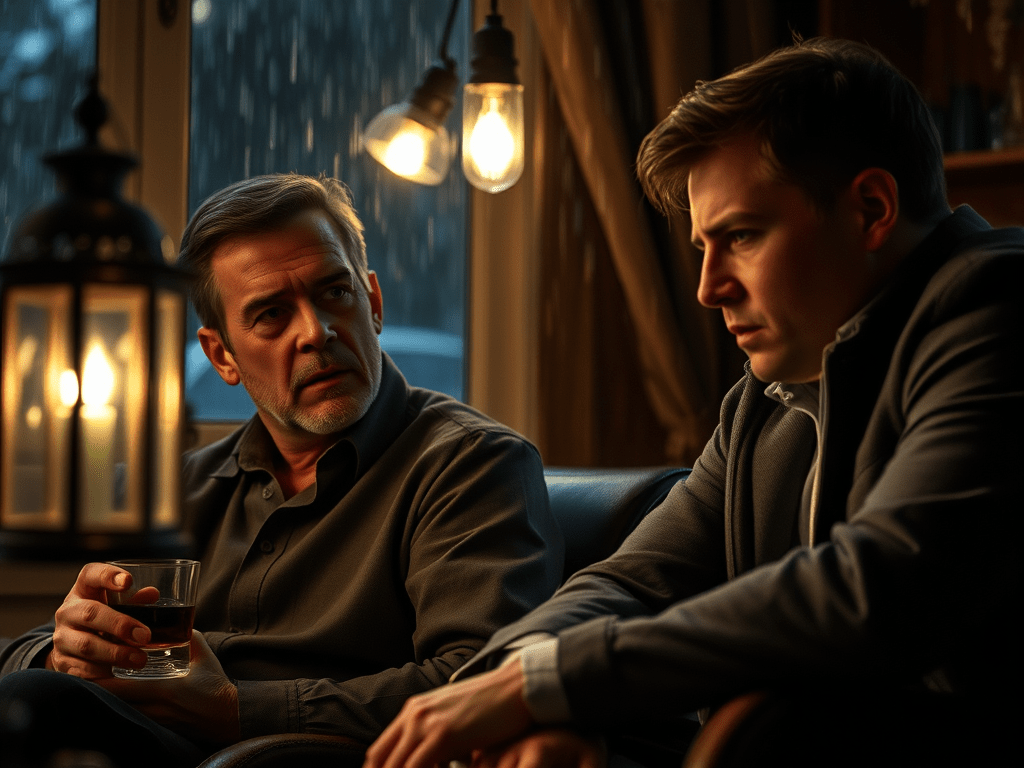
    Silence settled, broken only by the rain’s patter. Ted didn’t rush to fill it, which irked Ethan for no good reason. He shifted, fingers drumming the armrest, then blurted, “So you just… denied that part of yourself?”

    Ted’s expression didn’t change. Ethan had been holding that question since the porch—maybe longer. With no distractions—no phone, no noise—it slipped out.

    Ted set his glass down with a quiet thunk, letting the words hang. “I surrendered it,” he said finally. “And I never looked back.”

    Ethan scoffed lightly. “That easy, huh?”

    Ted’s lips curved, not quite a smile. “Didn’t say it was easy.”

    Ethan leaned forward, arms on his knees. “So what—you just decided one day those feelings weren’t real?”

    Ted shook his head. “Never said that either.”

    Ethan frowned.

    Ted exhaled, settling back. “What I’m sayin’ is, I had to choose. The world told me one thing. God told me somethin’ else. I trusted Him more’n I trusted myself.”

    Ethan crossed his arms. “And that worked for you?”

    Ted nodded, but something heavier flickered in his eyes. He stared into the lantern’s glow. “I almost didn’t,” he admitted.

    Ethan raised an eyebrow.

    Ted rubbed his jaw, exhaling through his nose. “For a while, I figured I’d got it wrong. Maybe I was holdin’ onto somethin’ outta fear. So I walked away—gave the world’s way a shot, thought I’d find what I was lookin’ for.”

    Ethan’s stomach tightened. He hadn’t expected this.

    Ted shook his head, gaze settling on him. “Didn’t. Lost more’n I care to admit.” He leaned forward. “You wanna know why I trust God more’n myself? I’ve seen what happens when I don’t.”

    Ted sipped his water, calm again. “Spent years thinkin’ I had to choose between bein’ loved and bein’ faithful. But I was askin’ the wrong question. It wasn’t about that—it was about choosin’ Him.”

    Ethan swallowed, throat tight. He forced a smirk. “Not many people sound as sure as you.”

    “Took a long time to get here,” Ted said, a quiet laugh in his voice.

    Ethan watched him, the lantern light carving deeper lines in his face. He should’ve argued, laughed it off. But he didn’t want to. That scared him more than anything.

    Ted stood, grabbing a blanket from a closet and draping it over the couch. “In case it gets cold tonight.”

    (Excerpt from Narrow Road Together in the Ethan & Ted series. Contact me if you’d like to read the full story)

  • The Forge

    The Forge

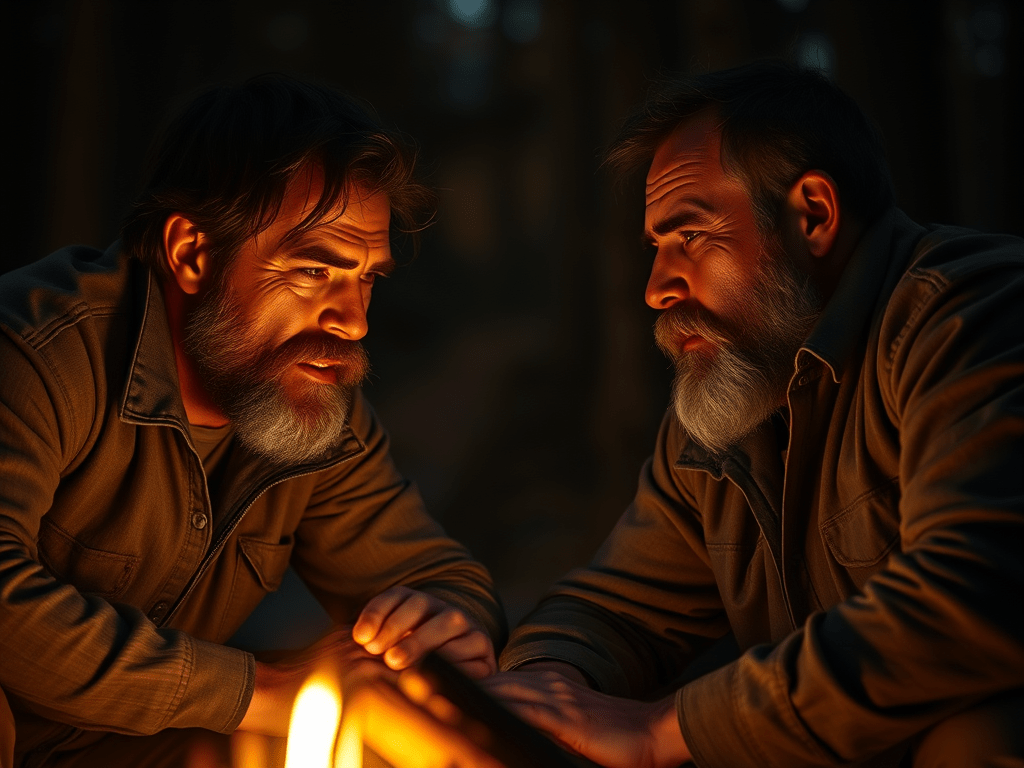
    The fire spat embers into the night, a ragged glow against the Indiana pines. Caleb crouched by it, 52 years carved into his hands—calluses from swinging hammers, scars from swinging at life. Across the flames sat Eli, 48, eyes hollowed by years of hiding. Two men, strangers ‘til that retreat, now tethered by something neither could name ‘til it hit.

    Caleb tossed a stick into the blaze, sparks snapping like old guilt. “Grew up thinking God’d smite me for looking too long at a guy in church,” he said, voice gravel. “Dad preached hell—I believed it. Ran from it ‘til I couldn’t.”

    Eli nodded, boots scuffing dirt. “Same, different flavor. Mom said love was women or nothing. Tried it—married at 30, crashed by 35. Never told her the guys on the rig stirred me more’n she did.”

    The wind carried smoke between them, sharp and honest. Caleb’s gut knew that ache—loving men, not like the world said, but bone-deep, beyond flesh. He’d chased it in shadows—porn flickering on a screen, two guys bonding, not touching, but close. Never fit the gay label, never fit straight. Eli’s story echoed—different road, same ditch.

    “Found Christ at 47,” Caleb said, poking the fire. “Broke me open—grace, not wrath. Been five years, still wrestle the pull. Not sex—just that hum when a guy gets me.”

    Eli’s laugh was dry. “Yeah. Forty-five for me—Jesus hauled me out of a bottle. Two years in, same fight. Thought I was alone ‘til this.” He waved at the fire, the space between.

    Caleb leaned forward, elbows on knees. “Ain’t alone. World don’t get it—men loving men, pure, no mud. But Scripture does. Jonathan and David—souls knit, no bed. That’s us, brother.”

    Eli’s eyes caught the glow, steadying. “Thought I’d die single, shamed. This… covenant? Feels like air.”

    They’d met that week—retreat mud, shared coffee, stories spilling over late nights. Caleb saw Eli’s flinch at a guy’s grin; Eli caught Caleb’s quiet when loneliness bit. No preaching—just truth, raw as split wood. They’d prayed it out, hands clasped, fire a witness—two men, battered but standing (Ecclesiastes 4:12—cord of three strands).

    “Role’s this,” Caleb said, voice firm. “Live it—men who love men, Christ’s way. World’s blind; we ain’t. Build it, brother—hammer and soul.”

    Eli tossed dirt on the flames, embers hissing. “Yeah. Forge it—us, others. No more hiding.”

    Dawn crept up, gray and sure. They stood, shoulders brushing—not erotic, but alive. Caleb’s hammer waited; Eli’s rig called. Two men, loving unique, God-lit, stepping into a world that’d never name it. But they did—covenant, forged in fire, strong as hell.


  • The Altar of Surrender

    Ethan had been fighting the same war since he was nine. It started with a memory—his older cousin, shirtless and laughing, tossing a baseball with a grace Ethan could never mimic. He’d wanted to be him, to wear that strength like a second skin. But the want turned dark, curling into a heat he didn’t understand, a pull that followed him into adolescence. By sixteen, it had a name—lust, envy, a tangled mess he hid behind a church-boy smile. He’d pray it away, fists clenched, begging God to rip it out. Make me normal. Make me good. But it clung like damp rot.

    Now, at twenty-eight, Ethan stood in his apartment, the late March light slanting through the blinds. He’d just hung up from a call with his pastor, who’d invited him to a men’s retreat. “Come as you are,” Pastor Dan had said. Ethan snorted. As he was? A man whose longing for brotherhood had fused with something erotic, something he couldn’t untangle? He’d tried everything—fasting, cold showers, dating women he didn’t want. Nothing worked. The desires still ambushed him, sparked by a coworker’s handshake or a stranger’s stride.

    He sank to his knees by the couch, the carpet rough against his shins. Jesus, I don’t know how to do this. He’d heard the phrase a thousand times—lay it at the cross—but it felt like jargon, a platitude with no map. He pictured a literal cross, splintered and bloody, and himself standing before it, hands empty. What did that even mean? Dump his shame there and walk away? He’d tried. It always came back.

    The retreat was a week away. Ethan spent the days wrestling. He opened his Bible to Galatians 2:20—“I have been crucified with Christ. It is no longer I who live, but Christ who lives in me.” The words stung. Crucified. Dead. Was that it? Not just handing over the mess, but letting it die with Him? He closed his eyes, picturing it—his envy, his hunger, nailed up there, bleeding out. Take it, Jesus. Kill it. His voice shook. I don’t want it anymore.

    It wasn’t a feeling, not at first. No rush of peace, no choir of angels. Just a choice, raw and deliberate. He kept at it, night after night, kneeling until his knees ached. This longing—the way it twists me—it’s yours. I’m done owning it. He imagined driving the nails himself, each prayer a hammer strike. The fantasies still came—unbidden, vivid—but he’d stop, breathe, and say it again. Yours, not mine. It was clumsy, unglamorous, a surrender he had to remake daily.

    The retreat was a cabin in the woods, ten guys around a firepit. Ethan arrived late, nerves buzzing. Pastor Dan greeted him with a nod, and the others—gruff, bearded types mixed with quieter ones—offered handshakes. He braced for the old pull, the way his eyes might linger, but he whispered under his breath, Yours, Jesus. It didn’t erase the flicker, but it shifted the weight.

    The first night, they shared stories. Dan went first—his own pride, a marriage he’d nearly wrecked. Another guy, Paul, talked about porn, voice cracking. Ethan’s pulse raced. He could stay silent, safe. But the cross loomed in his mind, a place of death and release. He cleared his throat. “I’ve… wanted to be one of the guys my whole life. But it got messed up. Envy turned into… stuff I’m ashamed of. I’ve been giving it to Jesus, but it’s hard.”

    The fire snapped. He waited for the shift—disgust, distance. Instead, Dan leaned forward. “That’s real, man. Takes guts to say it.” Paul nodded. “Yeah. We’re all carrying something.”

    Ethan exhaled, shaky. They didn’t pry, didn’t flinch. They just sat with it, with him. The next day, they hiked, fished, laughed over burnt hot dogs. Paul clapped him on the back after he snagged a trout—awkwardly, but still a win. “Nice one, brother.” The word landed soft, true.

    That night, Ethan knelt by his bunk, the cabin quiet. Jesus, thank you. For taking it. For them. He pictured the cross again, his desires pinned there, not gone but powerless. The surrender wasn’t a one-time fix—it was a rhythm, a daily dying. But it worked. Not because he felt clean, but because he trusted the one who’d already carried it.

    Months later, the group stuck. They met for coffee, prayed over texts. Ethan still stumbled—the old pull flared at a gym locker room or a friend’s grin—but he’d name it, nail it down. Yours. And the brothers stayed, not as saviors, but as echoes of the cross—living proof he wasn’t alone. Christ was the root; they were the branches. Ethan wasn’t healed, not fully. But he was held.

  • The Weight and the Wonder (chapter)

    The Weight and the Wonder (chapter)

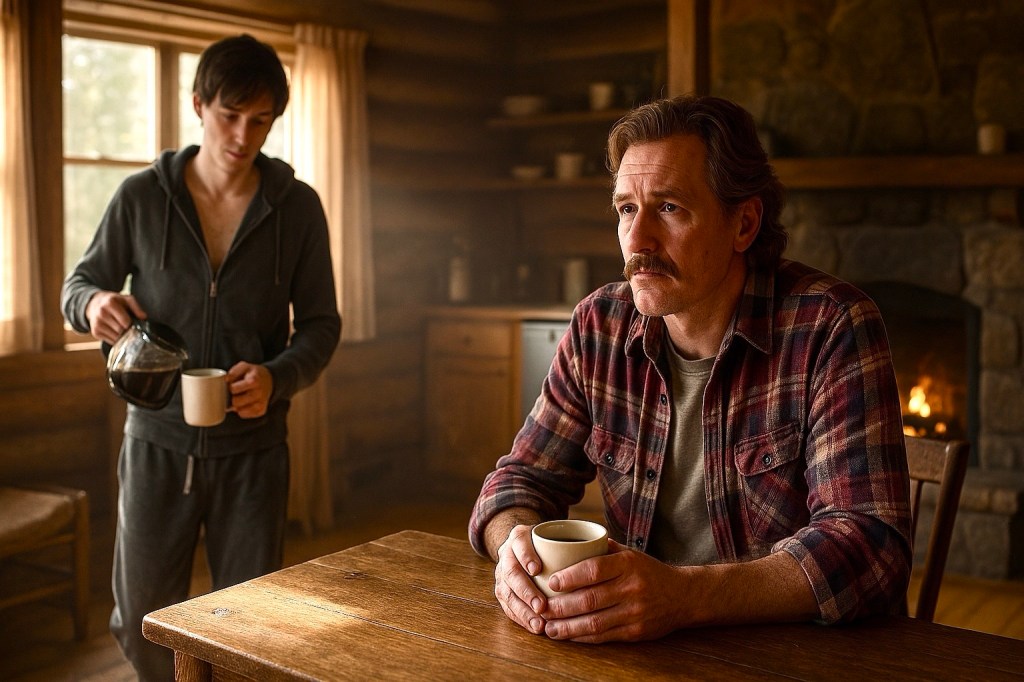
    The morning light slanted through the cabin windows soft and slow, catching motes of dust in its beams. A faint breeze stirred the curtains. The fire had long since gone out, leaving only a few glowing coals beneath the ash.

    Clyde sat at the table, mug in hand, elbows resting heavy on the wood. His flannel shirt hung unbuttoned over a clean tee, sleeves rolled up. He wasn’t moving much—just watching steam curl from his coffee like it had something to say he didn’t know how to hear.

    Behind him, the floor creaked. Tyler emerged from the back room, barefoot, hair still mussed from sleep, hoodie half-zipped over his bare chest. He didn’t say anything at first. Just padded into the kitchen and poured himself a cup.

    He didn’t ask how Clyde slept.

    Clyde didn’t ask him to sit.

    But Tyler did, folding into the chair across from him like it was the most natural thing in the world.

    The silence wasn’t awkward. It was warm. Full.

    Like they’d both remembered something in the night they’d never known before.

    Clyde finally cleared his throat. “I, uh… put a fresh pot on. Thought you’d want some.”

    Tyler nodded, taking a sip. “Thanks.”

    They sat like that for a long stretch, mugs in hand, the weight of what had passed between them settling like morning dew.

    “I figured I’d go clear the brush behind the toolshed today,” Clyde said eventually, not looking up. “Been meanin’ to get to it.”

    Tyler smiled softly. “Want a hand?”

    Clyde nodded once. “If you’re offerin’.”

    “I am.”

    It wasn’t avoidance. It was agreement—unspoken but understood. They’d talk. But not yet. Not with words.

    By midday, they were back in the rhythm of work. The sun was warm, filtering down through the pines as they cleared branches and hauled broken limbs to the burn pile. Sweat ran down their backs, shirts stuck to skin. They didn’t say much, but every so often their eyes met—and held, just for a second.

    Not afraid.

    Not ashamed.

    Just… searching. Remembering.

    When they took a break, Clyde handed Tyler a bottle of water and sat down hard on a split log, wiping his brow. Tyler sat beside him, close but not touching.

    Clyde let out a breath, rough around the edges. “I don’t know what to say about last night.”

    Tyler took a drink, then leaned forward, arms resting on his knees. “Me neither. But I don’t think we have to explain it all today.”

    Clyde nodded, jaw tightening. “It felt… real. I ain’t gonna pretend it didn’t.”

    Tyler turned to look at him. “Same.”

    They were quiet again, the breeze rustling through the trees like it was listening in.

    “I spent most my life thinkin’ if I ever crossed that line, it’d ruin me,” Clyde said slowly. “But I don’t feel ruined.”

    Tyler’s voice was low. “You’re not. Neither of us are.”

    Clyde looked down at his hands.“It wasn’t right—not in the way the world measures it. But there was a kind of… reverence in it. I can’t tell you if it was holy or not. But it didn’t feel dirty. It felt… honest.”

    Tyler nodded, watching him. “It wasn’t just a thing that happened. It was a moment. And yeah, we’ll have to walk through it. But I think God’s not afraid of what’s real. I think He meets us there.”

    Clyde looked up then, eyes steady. “You believe that?”

    “I do.”

    Another long pause. Then Clyde let out a breath that seemed to shake something loose in his chest. “I ain’t sure what comes next.”

    Tyler reached over, laid a hand gently on Clyde’s arm. “Then we walk it out. One step at a time. No shame. No hiding.”

    Clyde looked at the hand, then up at Tyler. “I’m still scared.”

    “Me too,” Tyler said. “But I’d rather be scared and honest than safe and alone.”

    The words settled between them like an anchor.

    And for the rest of the afternoon, they worked side by side again—brush and sweat, sun and stillness—less like men who’d messed up and more like men learning what grace really meant.

    Something had shifted.

    Not broken.

    Not lost.

    Just changed.

    And neither of them ran from it.

    (Chapter from Still With You in the Tyler and Clyde series. Contact me if you’d like to read the full story!)

  • When the Fire Settled (edited chapter)

    When the Fire Settled (edited chapter)

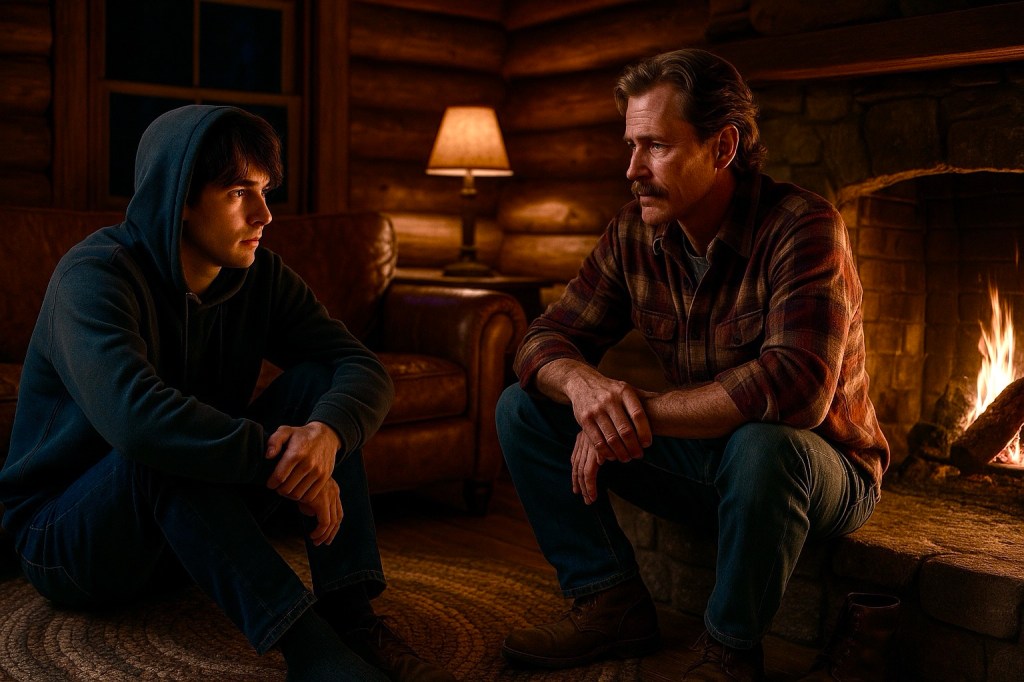
    The fire had burned low inside the cabin, just a slow curl of flame flickering over the last logs in the stone hearth. The room smelled faintly of smoke and cedar, the warmth of the blaze soft against the walls. They hadn’t talked much since supper. A few comments about the food, a short laugh over Clyde nearly dropping the pan off the grill, and then… just stillness.

    Tyler sat on the braided rug, one knee pulled up to his chest, hoodie sleeves half-pushed to his forearms. Clyde was beside him on the old leather couch, one boot off, socked foot planted on the floor. They were facing the fire, but neither of them was really looking at it anymore.

    The wind outside whispered against the cabin walls. The pines creaked in reply, like they were saying something neither man had the words for.

    Clyde shifted, elbows resting on his knees, hands folded. “You ever think,” he said quietly, “that silence feels more honest than half the stuff we say?”

    Tyler glanced at him. “Sometimes. Yeah.”

    Clyde nodded once, like that was all he’d meant to say, and maybe it was. But something hung in the air—weightier than the firelight, heavier than the day’s work. Tyler felt it between them, humming under the quiet like a thread pulled too tight.

    He looked at Clyde again. The firelight danced on his profile—weathered, tired, solid. There was something open in his face now, not guarded like usual. Not strong, exactly. Just… real.

    Tyler reached over and placed a hand on Clyde’s shoulder.

    Just that.

    Clyde’s shoulder was solid under Tyler’s hand—warm through the flannel, steady in a way that made Tyler’s chest tighten. He didn’t say anything. Just stayed there a moment, palm resting firm, thumb brushing once against the seam of Clyde’s shirt.

    Then Clyde turned slightly, and their foreheads met—an accident at first, then not. They stayed there, eyes closed, breathing the same breath. Something fragile and holy hovered in that space between them.

    Clyde spoke first, voice barely above a whisper. “I ain’t never let someone close like this.”

    Tyler swallowed. “Me neither. Not like this.”

    ….

    When it was done, they stayed close, breathing in sync, sweat cooling in the quiet. The fire had burned low, throwing long shadows up the log walls. Clyde lay on his back, eyes open, fixed on the ceiling like he was trying to anchor himself.

    Tyler lay on his side beside him, hand still resting near Clyde’s chest, not quite touching now.

    Neither spoke. There was too much to say.

    And not enough language to say it.

    …to be continued in “The Weight and the Wonder” later today

    (Edited chapter from Still With You from the Tyler and Clyde series, contact me if you’d like to read the full story!)

  • Something Solid (chapter)

    Something Solid (chapter)

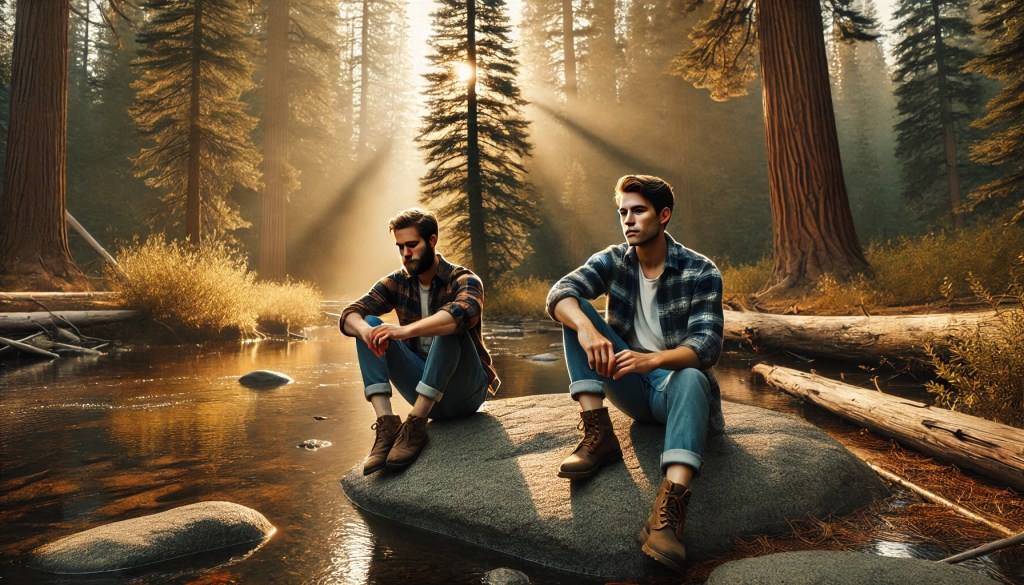
    The creek behind Ted’s property ran quiet that afternoon, low from a dry spell but steady all the same. Tyler crouched at the bank, skipping rocks like he used to as a kid, boots half-dusty, half-muddied. The air smelled of pine and old leaves, warm with a hint of coming fall.

    Clyde sat nearby on a flat boulder, arms resting on his knees, watching the ripples Tyler’s throws left behind.

    Neither had said much for a while.

    Ted had invited them both out—“just a fire and some quiet,” he’d said—but he’d ducked inside to check on supper and left the two of them alone not long after. Maybe on purpose.

    Tyler stood, brushing his hands off on his jeans. “Don’t know why, but this place always slows my brain down.”

    Clyde gave a small grunt of agreement. “Somethin’ about water and woods. Strips the noise off.”

    Tyler looked over at him. “You ever think maybe God designed it that way? Like… made these places to help us remember what matters?”

    Clyde shifted, his gaze on the water. “Reckon He did. World’s loud. We make it louder.” A pause. “Truth don’t shout much.”

    Tyler chuckled, quiet. “Nah. It doesn’t.”

    He walked over and sat down next to Clyde on the rock. Their shoulders didn’t touch, but they didn’t need to. The closeness wasn’t forced—it just was.

    “I’ve been thinkin’,” Tyler said after a minute, “about what you said last week. About prayin’ honest.”

    Clyde didn’t look over, but his brow lifted slightly.

    Tyler kept going. “I started tryin’. Not just talkin’ to God, but tellin’ Him stuff I’d never even admitted to myself.” He let out a breath. “Thought He might be mad. But it’s weird… it’s like He already knew. Like He was waitin’ on me to say it just so I could hear it too.”

    Clyde nodded slow. “He’s good like that.”

    Tyler glanced down at the water. “That book you gave me… it didn’t fix me.” He paused. “But it started somethin’.”

    Clyde nodded, voice quiet. “That’s all I hoped for.”

    They sat quiet again, a hawk crying faint somewhere overhead.

    “I don’t really know what this is,” Tyler said, glancing at Clyde. “Us. This… whatever we’re buildin’. But I know it ain’t shallow.”

    Clyde’s jaw worked a bit, like he was chewing on the words. Then he said, “Don’t gotta name it to know it’s real.”

    Tyler nodded. “I don’t feel like I gotta prove anything around you. That’s new.”

    Clyde’s voice was low, steady. “I don’t feel like I gotta hide.”

    The words landed like a stone sinking slow into deep water.

    Tyler looked away, blinked a few times. “I used to think I needed somebody to complete me. Like there was this hole that only another guy could fill. And I chased that. Thought it was love. But now…” He trailed off, shook his head. “Reckon I just needed a brother who’d stay.”

    Clyde glanced at him then—just a flicker—and the corner of his mouth tugged up slightly.

    “Sounds about right.”

    They sat there, side by side, while the sun shifted through the trees and the creek rolled on.

    Ted’s screen door creaked open behind them. “Food’s up,” he called.

    Clyde stood, offered Tyler a hand. Tyler took it without hesitation, letting Clyde pull him up. Their grip lingered a beat—firm, steady.

    “Come on,” Clyde said. “Let’s eat.”They walked toward the cabin—not side by side, but close enough.
    More than nothing.
    Solid enough to hold.

    (Chapter from Solid Enough To Hold in the Tyler and Clyde series. Contact me if you’d like to read the full story.)

  • Amos and Jonah (Part 5)

    Amos and Jonah (Part 5)

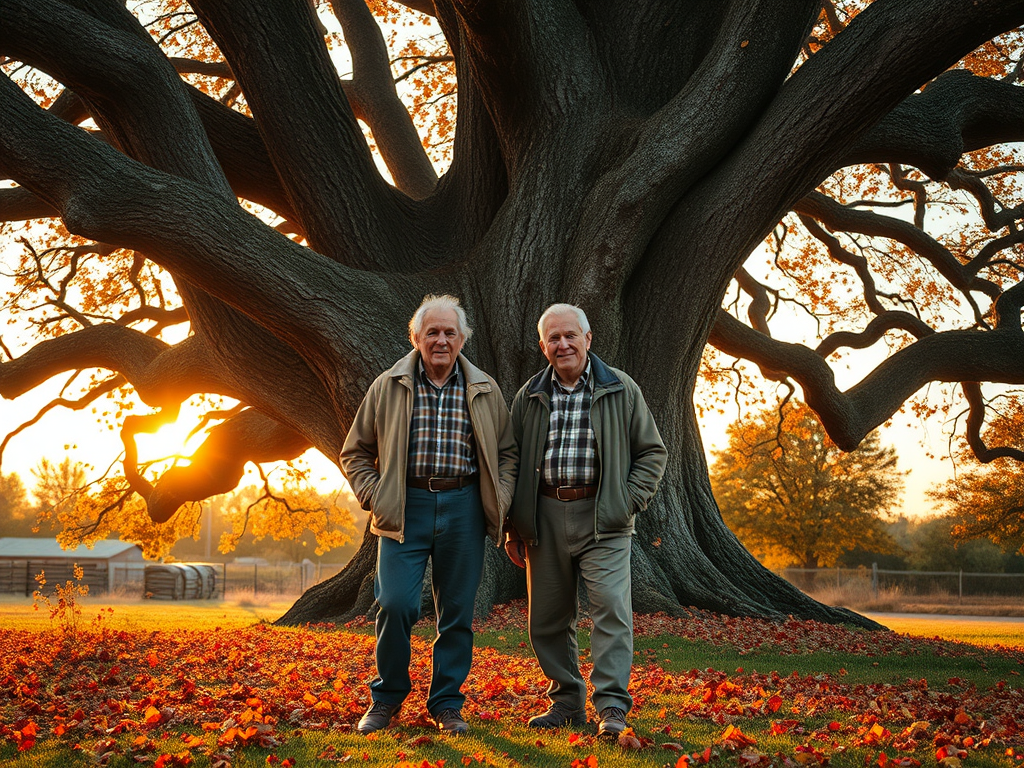
    The seasons spun on, each one layering their story deeper into the land. The oak by the porch grew gnarled, its branches heavy with years, much like the men who sat beneath it. They’d carved out a life that defied the whispers of the world—a brotherhood so fierce it stood as a testament, a living sermon etched in calloused hands and shared silences.

    The physical pull never left, not entirely. It’d flare in quiet moments—when Jonah’s arm slung around Amos’s shoulders as they watched a storm roll in, or when Amos’s fingers grazed Jonah’s wrist passing him a mug of coffee. But they’d mastered it, turned it into a current that ran beneath their covenant, powering it rather than pulling it apart.

    One summer, a traveling preacher came through, a wiry man with a voice like thunder. He stayed a night at the farm, breaking bread with them in the flickering light of the kitchen. He watched them close, his keen eyes catching the way Amos filled Jonah’s plate without asking, the way Jonah’s hand rested easy on Amos’s arm as they laughed over some old story. After supper, the preacher sat back, pipe in hand, and said, “Y’all got somethin’ special here. Like David and Jonathan, souls knit together. Ain’t seen many live it out so true.”

    Amos and Jonah exchanged a look, a flicker of pride and something softer passing between them. “Just tryin’ to honor Him,” Amos said, and Jonah nodded.

    “Ain’t always easy, but it’s good,” Jonah added.

    The preacher left the next day, but his words stuck, a quiet blessing on what they’d built. And build they did—year after year, until the farm wasn’t just a patch of dirt but a legacy of faith and fidelity. The chapel became a gathering place for the scattered folk of the hills, drawn by the warmth of two men who lived what they preached. They’d sit on those oak benches, listening as Jonah read Scripture or Amos prayed in that low, steady voice, and they’d leave feeling the weight of something holy.

    Fall came again, decades piling up like the leaves drifting against the barn. Amos was slower now, his back stooped from years of bending to the plow, and Jonah’s hands shook when he whittled, but they still worked the land, still knelt in the chapel, still laughed like the young men they’d once been. One evening, as the sun dipped low and the sky burned crimson, they walked the fence line, checking posts like they’d done a thousand times. Amos stopped, leaning heavy on a post, breath fogging in the chill.

    Jonah paused beside him, concern creasing his brow. “You alright?” he asked, stepping close, his hand finding Amos’s shoulder.

    Amos nodded, catching his breath. “Just takin’ it in. This place. You. All of it.”

    Amos turned, his hazel eyes locking with Jonah’s, weathered and deep with years of shared struggle and triumph. The wind kicked up, rustling the crimson leaves around their boots, and for a moment, they just stood there, the weight of their bond heavier than the post Amos leaned on. Jonah’s hand stayed firm on Amos’s shoulder, a tether as real as the Kentucky clay beneath them.

    “Reckon we’ve walked this road right,” Amos said, his voice a low rumble, softened by the years. “Ain’t been easy, fightin’ what we felt, but we made it somethin’ better. Somethin’ He can look down on and call good.”

    Jonah nodded, his gray eyes steady, a faint smile tugging at his lips. “Aye. Brothers, true and deep. That’s what He gave us strength for. Ain’t no shame in lovin’ you like this—pure, like David and Jonathan. We kept it holy.”

    Amos straightened, clapping Jonah on the back, the gesture rough but warm, a seal on their unspoken vow. “Let’s head in. Coffee’s callin’, and I ain’t freezin’ out here for pride.”

    They turned toward the farmhouse, shoulders brushing as they walked, the chapel’s silhouette a quiet sentinel against the fading light. Inside, they shed their coats, the fire already crackling from earlier. Jonah grabbed the pot, pouring two mugs, while Amos sank into his chair, the creak of the wood as familiar as a hymn. They sat across from each other, steam curling up between them, and raised their mugs in a silent toast—not to romance, not to what could’ve been, but to the brotherhood they’d forged, a covenant stronger than steel, rooted in their faith.


    Years later, when the townsfolk found them—Amos gone in his sleep, Jonah a day after, unwilling to linger alone—the chapel still stood, their initials carved in the bench. The land bore their mark, a testament to two men who’d wrestled the hum into something glorious, a friendship that glorified God’s design. They buried them side by side under the sycamore, the tree’s roots curling deep, just like the bond they’d lived out to the end.

  • Amos and Jonah (Part 4)

    Amos and Jonah (Part 4)

    Years rolled on, and the farm flourished under their care, a testament to their labor and their faith. The townsfolk would talk—two bachelors living out there, thick as thieves, closer than brothers, working the land and praising the Lord with a fire few could match. They’d see Amos and Jonah at the market, bartering for seed or a new plow blade, their easy banter and shared glances a quiet marvel. Some whispered, wondering at the depth of it, but most just saw two men who’d found a rare thing—a bond forged in sweat and Scripture, unbreakable as the Kentucky hills.

    The years etched lines into their faces, turned Amos’s hair to silver and Jonah’s to a dusty gray, but the rhythm of their days held steady. They’d rise before dawn, coffee brewing on the old stove, and head out to tend the herd or mend a fence. The physical affection stayed—a constant thread woven into their lives, natural as breathing. A hand on the back after a hard day, a rough hug when the weight of the world pressed too heavy, a playful shove that’d spark a wrestle in the yard, their laughter ringing out across the fields.

    The hum lingered too, a quiet ember they’d long learned to tend without letting it flare. It was there in the way Jonah’s eyes would trace Amos’s broad frame as he split wood, or how Amos’s breath would catch when Jonah sang hymns in that low, steady tenor. But they’d made their choice, and it was a choice they renewed every day—with every prayer, every shared meal, every step they took side by side.

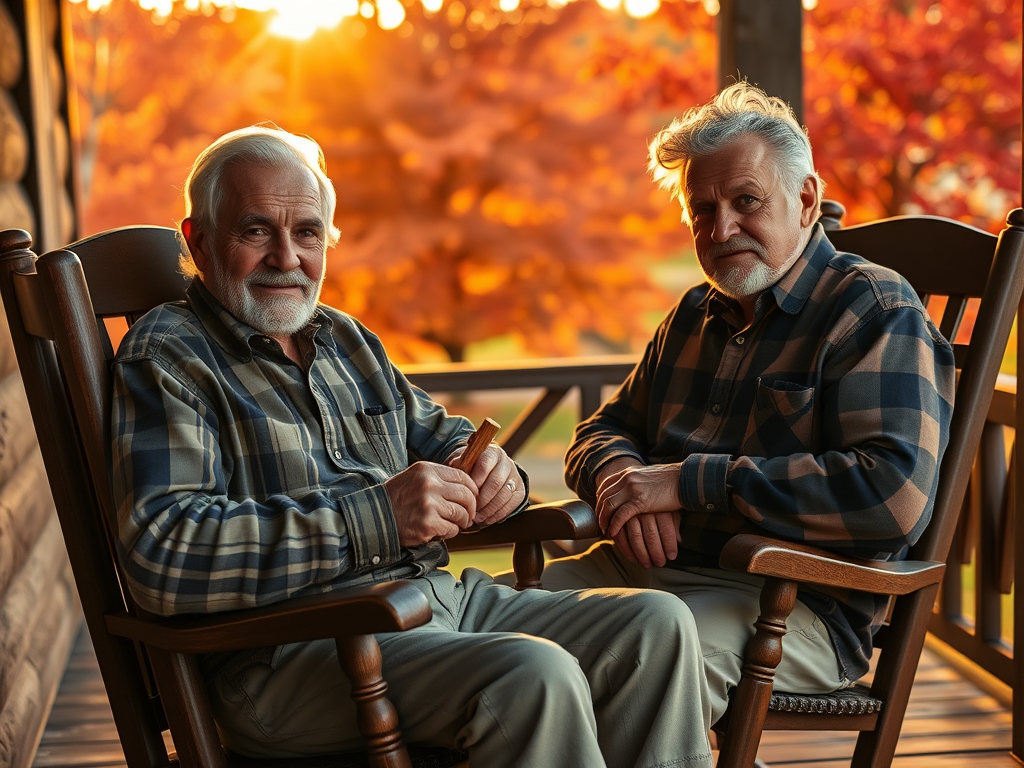
    One crisp autumn evening, as the maples blazed red and gold, they sat on the porch, rocking chairs creaking under their weight. The harvest was in, the barn stuffed with hay, and the air smelled of apples ripening on the tree out back. Jonah whittled now, a habit he’d picked up from Amos, shaping a small cross from a chunk of walnut. Amos leaned back, hands folded over his belly, watching the sun sink behind the ridge.

    “Reckon we’ve done alright, Jonah,” Amos said, his voice a deep rumble softened by time. “This life, this place. Him up there’s gotta be smilin’ down on it.”

    Jonah paused, the knife still in his hand, and looked over at Amos. The fire in his eyes hadn’t dimmed, not even after all these years. “More’n alright,” he said. “We took what He gave us—this pull, this whatever-it-is—and made it somethin’ good. Somethin’ holy, even.”

    Amos grunted, a sound that might’ve been agreement or just the comfort of hearing Jonah’s voice. “Ain’t been easy,” he said after a beat. “Times I wanted to give in, let it turn to somethin’ else. But you kept me straight. Iron sharpens iron, like you’re always quotin’.”

    Jonah grinned, setting the cross on the arm of his chair. “You did the same for me. Nights I’d lie awake, wonderin’ if we was fools to fight it. But then I’d hear you snorin’ through the wall, and I’d think, ‘Naw, that’s my brother. That’s my rock.’ And I’d pray for us both.”

    Amos turned his head, meeting Jonah’s gaze. There was a weight there, a tenderness that didn’t need words, but he spoke anyway. “I’d do it all again, you know. Every wrestle, every hard day, every time I had to pull back from you. ’Cause what we got—it’s rarer than gold. Ain’t many men get a friend like this, a brother like this.”

    Jonah nodded, his throat working as he swallowed down the swell of emotion. “Same, Amos. Same.”

    They fell quiet then, the crickets picking up their song as dusk settled over the farm. The chapel still stood at the edge of the field, weathered now but sturdy, a silent witness to their covenant. Inside, they’d carved their initials into the back of one bench—A.K. and J.T., side by side, a small mark of the life they’d built. The townsfolk called it the Brotherhood Chapel, a name that stuck after old man Carver saw them praying there one Sunday and said it felt like walking into a piece of heaven.


    One winter, when the snow piled high and the wind howled through the eaves, Jonah took sick. A cough that wouldn’t quit turned into a fever that kept him abed, his lean frame shivering under a pile of quilts. Amos tended him like a mother hen, broth simmering on the stove, prayers muttered under his breath as he pressed a cool cloth to Jonah’s brow. The farm could wait—the cattle would survive a day untended—but Jonah couldn’t. Not to Amos.

    “Stop fussin’,” Jonah rasped one night, his voice weak but his eyes sharp. “I ain’t dyin’ yet. Got too much left to do with you.”

    Amos huffed, dipping the cloth back into a basin of cold water and wringing it out with hands that trembled just a touch. “Better not be dyin’. I ain’t haulin’ this farm alone, you hear? And I sure ain’t prayin’ in that chapel by myself.”

    Jonah managed a faint chuckle that turned into a cough, and Amos was quick to prop him up, a broad hand splayed across Jonah’s back, steadying him until the fit passed. Their eyes met in the dim lantern light, and for a moment, that old ember flared sharp and bright, a pang of longing they’d spent years taming. Amos’s hand lingered, warm against Jonah’s fevered skin, and Jonah’s breath hitched, not just from the sickness.

    “Lord, keep us,” Jonah whispered, a prayer as much as a plea, and Amos echoed it with a gruff “Amen.” He eased Jonah back onto the pillows, pulling the quilts up tight.

    “Rest now. We got this,” Amos said, his voice a rock in the storm.

    And they did. The fever broke by morning, leaving Jonah weak but alive, and Amos sank to his knees by the bed, head bowed in gratitude, tears cutting tracks through the grime on his weathered face.

    Spring came late that year, the frost clinging stubborn to the ground, but when it finally thawed, the land burst forth like a promise kept. Jonah was back on his feet, thinner now, his cheeks hollowed, but his spirit unbowed. They stood together in the chapel one Sunday, the air thick with the scent of damp earth and new growth seeping through the cracks. Jonah’s voice rose in a hymn—“Blessed be the tie that binds”—and Amos joined in, his rumble blending with Jonah’s tenor, rough harmony lifting to the rafters. Their shoulders brushed as they sang, and when the last note faded, they stayed there, side by side, breathing in the stillness.

    (Concluded in Part 5)

  • Amos and Jonah (Part 3)

    Amos and Jonah (Part 3)

    Days turned into weeks, and the rhythm of the farm carried them forward. They plowed the back forty together, the mules’ harnesses jangling as they trudged through the clay. Amos would clap Jonah on the back when they finished a row, his hand lingering a beat longer than necessary, and Jonah would grin, shoving him playfully in return. At night, they’d sit on the porch, the crickets serenading the stars, and talk about everything—Scripture, the herd, the way the river swelled after a rain.

    Sometimes they’d wrestle out in the yard, a rough tumble over a stray comment or just to burn off the restless energy that sparked between them. Amos would pin Jonah to the grass, both of them laughing, breathless, their faces inches apart until one of them would pull away, red-faced and muttering about needing water. The attraction simmered, undeniable, but they channeled it into something fierce and good—a bond that didn’t bend under the weight of temptation.

    One spring evening, after a long day mending fences, they sat by the creek that cut through the property. The water ran clear over smooth stones, and the willows dipped low, brushing the surface. Jonah stripped off his shirt, splashing water on his face, the droplets catching the golden light. Amos watched, his chest tightening, then looked away, picking up a flat stone to skip across the creek.

    “You’re a sight, Jonah,” he said, half-teasing, half-serious. “Oughta be careful, or I’ll forget myself.”

    Jonah laughed, shaking the water from his hair like a dog. “Ain’t my fault you’re weak, old man.” But his eyes softened, and he sat beside Amos on the bank, their shoulders brushing. “We’re doin’ right, ain’t we?” he asked quieter. “Keepin’ this in line?”

    Amos skipped another stone, watching it hop four times before sinking. “Reckon so. Ain’t easy, but it’s worth it. The Lord’s got us.”

    Jonah nodded, resting his forearms on his knees. “I’d rather have you as my brother, true and steady, than lose you to somethin’ fleeting. That’s what He wants, I figure. Men who stand together, lift each other up.”

    That summer, they built a small chapel on the edge of their land—nothing fancy, just a lean-to with a cross nailed above the door and a couple of benches hewn from oak they’d felled themselves. It became their sanctuary, a place where they could kneel together and lay their struggles bare before God. The chapel smelled of sawdust and resin, and the sunlight filtered through the gaps in the walls, painting stripes of gold across the dirt floor. They’d sit there after a day’s work, sweat-soaked and weary, and pray for the strength to keep their covenant, to honor the bond they’d forged not just with each other, but with the One who’d brought them together.


    The physical pull didn’t vanish—how could it? It was stitched into the fabric of who they were, two men carved from the same rugged earth, their lives entwined like the roots of the old sycamore that shaded the farmhouse. But they learned to dance with it, to let it fuel their brotherhood rather than fracture it. When Amos felled a tree, Jonah was there to haul the logs, their hands brushing as they hefted the weight together, a spark flickering but quickly smothered by a shared grunt of effort. When Jonah stumbled under the strain of a sick calf, Amos was there, his arm slung around Jonah’s waist to steady him, the warmth of his grip a quiet comfort they didn’t linger on too long. They’d laugh it off, clap each other on the back, and move on, their resolve a shield against the undertow of desire.

    Harvest season rolled in, the fields heavy with corn and the air thick with the drone of cicadas. They worked from dawn to dusk, scythes swinging in tandem, their rhythm so synced it was like one man mirrored in two bodies. One afternoon, the heat was unbearable, a wet blanket pressing down on the land. They stripped to their waists and waded into the creek to cool off, splashing water at each other like boys. Jonah tackled Amos into the shallows, and they wrestled, slick with mud and laughter, until Amos pinned Jonah beneath him, the current tugging at their legs.

    Their eyes locked, breaths heaving, and for a heartbeat, the world shrank to just them—the pulse of Jonah’s wrist under Amos’s hand, the bead of water sliding down Jonah’s temple. Amos’s grip tightened, then released. He rolled off, splashing back into the water with a groan.

    “Lord, give me strength,” Amos muttered, half to himself, half to the sky.

    Jonah sat up, grinning despite the flush in his cheeks. “He’s givin’ it, brother. We’re still standin’, ain’t we?”

    And they were. That was the miracle of it. The attraction was a fire, but they stoked it into something else—something that warmed rather than burned, something that lit the path they walked together. They’d sit by the fire at night, Amos whittling while Jonah read from the Psalms, his voice weaving through the crackle of the logs.

    “As iron sharpens iron, so one man sharpens another,” Jonah read one evening, glancing up with a knowing look.

    Amos nodded, the corner of his mouth twitching into a rare smile. “Reckon that’s us,” he said, shaving a curl of wood from the block in his hands. “Sharp enough to cut through anything the devil throws our way.”

    Winter came, blanketing the farm in snow, the fields glittering under a pale sun. They’d tromp through the drifts to check the cattle, their breaths puffing white in the air. One morning, Jonah slipped on a patch of ice, and Amos caught him, pulling him close to steady him. For a moment, they stood there, chest to chest, the cold biting their skin but the heat of each other cutting through it. Jonah’s hand rested on Amos’s arm, and Amos didn’t pull away—not right off. They looked at each other, the silence thick with all they wouldn’t say, and then Jonah stepped back, clapping Amos on the shoulder.

    “Thanks, big man,” he said, voice rough but light. “Ain’t goin’ down that easy.”

    Amos chuckled, shaking his head. “Better not. Who’d keep me in line?”

    Spring returned, and with it, a calf born under the first full moon. They named her Hope, a scrappy little thing with a coat like midnight. They knelt in the straw of the barn, marveling at her, their shoulders pressed together as they watched her wobble to her feet. Jonah’s hand found Amos’s, a brief squeeze, and Amos returned it—two men bound by something bigger than themselves, something eternal.

    (Continued in Part 4)

  • Amos and Jonah (Part 2)

    Amos and Jonah (Part 2)

    Amos’s words hung heavy in the air, raw and unguarded. “Reckon I’d die for you, Jonah.” The confession slipped out like a stone dropping into a deep well, rippling through the silence of the farmhouse. Outside, the wind rustled the bare branches of the oak tree by the porch, a soft moan that mirrored the ache in both their chests.

    Jonah rose from his chair, the Bible still resting on the table, its leather cover worn smooth from years of touch. He crossed the room slow, his boots scuffing the pine floor, and stopped a pace behind Amos. “Don’t say that less you mean it,” Jonah said, his voice low but steady, like the hum of a hymn. “’Cause I feel the same, and it scares me somethin’ fierce.”

    Amos turned, his hazel eyes catching the firelight, glinting with a mix of resolve and torment. “I mean it. Ain’t no lie in me when it comes to you. But feelin’ it don’t make it right, does it? We’re men of the Word. We know what’s laid out for us.”

    Jonah nodded, his throat tight. He stepped closer, close enough that Amos could smell the sweat and earth clinging to him from the day’s labor, a scent as familiar as the fields they worked. “It’s a fight, ain’t it?” Jonah said, his voice trembling just a hair. “Lovin’ you like this and knowin’ we gotta turn it into somethin’ else. Somethin’ God can smile on.”

    Amos clenched his fists at his sides, the muscles in his forearms flexing under the rolled-up sleeves of his flannel shirt. “Ain’t never felt a pull this strong,” he admitted. “Not even when I was young and full of fool notions about the world. You’re in my bones, Jonah. But I ain’t here to defy Him. I’m here to serve Him.”

    Jonah reached out, hesitant, then rested a hand on Amos’s shoulder, firm and warm through the worn fabric. “Same,” he said. “We’re brothers in Christ first. That’s the covenant that matters. Whatever this is, we shape it to fit His will.”

    They stood there, locked in that touch, the fire popping behind them like a chorus urging them onward. The weight of their faith pressed down, but so did the strength of it, lifting them above the churn of their hearts. Amos finally stepped back, breaking the contact, and ran a hand over his stubbled jaw.

    “Let’s pray on it,” he said gruffly. “Ain’t no better way to sort this out.”

    They knelt together on the braided rug by the hearth, knees sinking into the faded colors woven by Amos’s mother years back. Jonah led, his voice steadying as he spoke. “Lord, You see us. You know every corner of our hearts, every stumble and every hope. We’re Yours, first and always. Take this bond we got, this love, and make it holy. Shape it to Your design, not ours. Give us strength to walk upright, to glorify You in all we do.”

    Amos murmured an “amen,” his head bowed, the firelight dancing across the planes of his face. When they rose, there was a quiet resolve between them, a pact forged in the heat of that moment. They wouldn’t run from what they felt, but they wouldn’t let it rule them either. It’d be a brotherhood, deep and true, tempered by faith.

  • Amos and Jonah (Part 1)

    Amos and Jonah (Part 1)

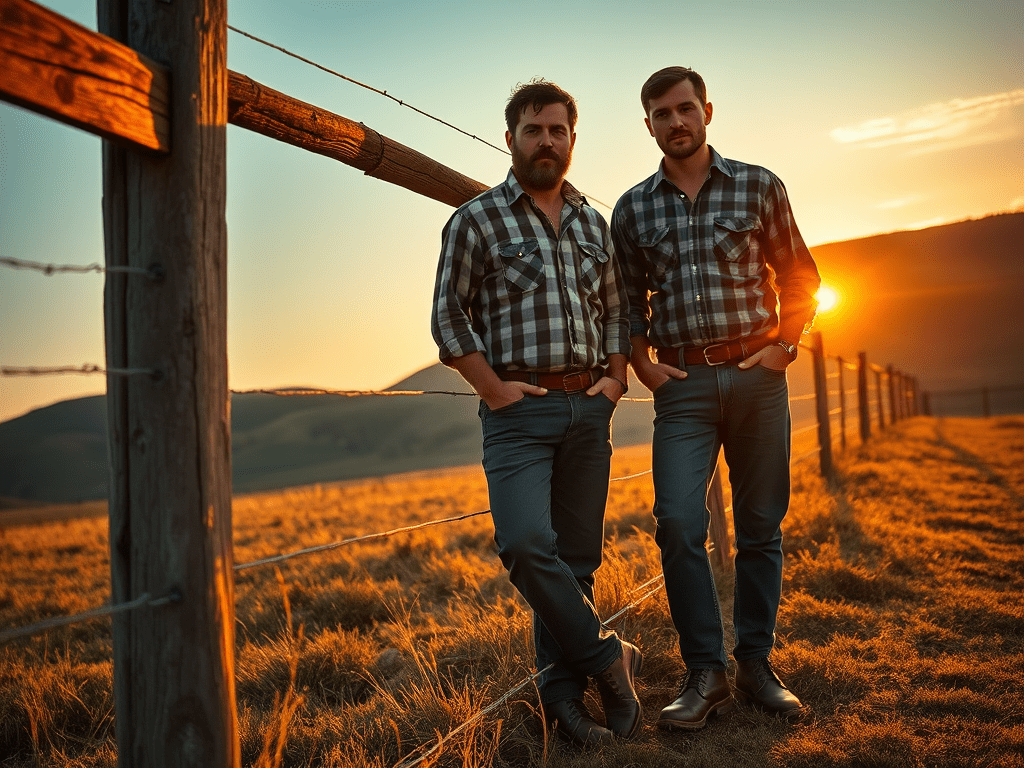
    The sun was dipping low over the rolling fields of eastern Kentucky, painting the sky with streaks of orange and violet. The air carried the earthy scent of freshly turned soil and the faint sweetness of clover. Two men stood at the edge of a weathered wooden fence, their boots caked with the red clay of the land they’d worked since dawn. Amos, broad-shouldered and sun-burned, leaned against a post, his calloused hands resting on the splintered wood. Beside him stood Jonah, leaner, with sharp cheekbones and eyes like the still waters of a pond at dusk. They were quiet for a moment, watching the last of the cattle amble toward the barn, their breaths visible in the cooling air.

    Amos broke the silence, his voice low and gravelly. “Good day’s work. Reckon the Lord’s pleased with hands that don’t idle.”

    Jonah nodded, pulling off his battered hat and running a hand through his sweat-damp hair. “Aye. Keeps the mind steady too. Idle hands, idle thoughts—ain’t no good comes from that.”

    They’d been working this land together for nigh on five years now, ever since Jonah had shown up at Amos’s doorstep, a drifter with a Bible tucked under his arm and a hunger for purpose. Amos had been alone then, his folks long gone, the farm too big for one man. Something about Jonah—his quiet strength, his unshakable faith—had made Amos offer him a place to stay. And stay he did. They’d built a life here, side by side, tilling the earth, raising livestock, and praying under the same roof each night.

    But there was something else too, something unspoken that lingered in the spaces between their words and glances. It had started small—a brush of hands when passing a tool, a lingering look across the supper table, the way Jonah’s laugh sent a warmth through Amos’s chest he couldn’t quite name. And for Jonah, it was Amos’s steady presence, the way he’d rest a hand on Jonah’s shoulder after a long day, firm and grounding, that stirred something deep within him. They both felt it, this pull, this ache. And they both knew it wasn’t simple.

    That night, after supper, they sat by the hearth in the small farmhouse. The fire crackled, casting shadows on the rough-hewn walls. Jonah had his Bible open on his lap, reading aloud from Proverbs, his voice steady and sure. Amos listened, whittling a piece of cedar with his pocketknife, the scent of the wood mixing with the smoke. When Jonah finished, he closed the book and set it aside, his eyes drifting to Amos.

    “You ever think about it?” Jonah asked, his tone careful, like he was stepping onto thin ice.

    Amos’s knife paused mid-stroke. He didn’t look up. “Think about what?”

    Jonah shifted in his chair, the floorboards creaking beneath him. “You know what I mean. Us. This… thing we don’t talk about.”

    The room went still, save for the pop of a log in the fire. Amos set the cedar and knife down on the table beside him, his hands resting on his knees. He met Jonah’s gaze, and there it was—the weight of it, the truth they’d both been circling like hawks over a field.

    “Yeah,” Amos said finally, his voice rough. “I think about it. More’n I should, maybe.”

    Jonah leaned forward, elbows on his knees, his fingers lacing together. “Me too. Ain’t easy, is it? Feelin’ somethin’ strong as this and knowin’ it don’t fit the way we’re meant to walk.”

    Amos nodded slow, his jaw tight. “Scripture’s clear. God’s design—it’s man and wife, family, fruitful land. Ain’t no room in that for… whatever this is.”

    “But it’s real,” Jonah said, his voice barely above a whisper. “I feel it when you’re near me, Amos. Like my soul’s tethered to yours. Ain’t lust, not all of it. It’s deeper. Like you’re kin, but more.”

    Amos stood abruptly, pacing to the window. He stared out at the dark fields, his broad frame silhouetted against the glass. “I know it,” he said, his back to Jonah. “I feel it too. Reckon I’d die for you, Jonah.”

    (Continued in Part 2)

  • Flesh and Bone: The Bond that Holds

    Flesh and Bone: The Bond that Holds

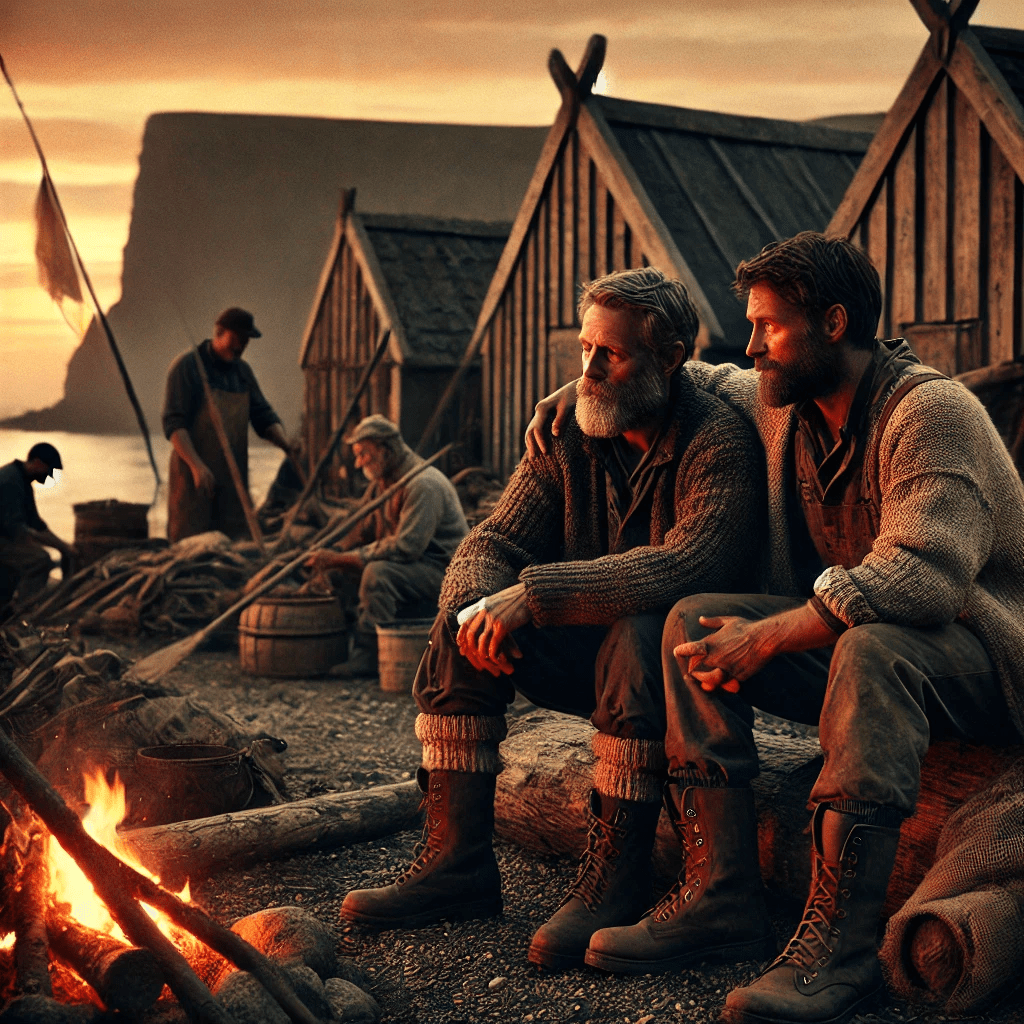
    The wind howled across the cliffs of Dunmoor, dragging salt and spray inland, where a village called Hearthglen clung to the land like a memory. Long before the world grew sharp and distant, the men of Hearthglen lived close—close to the earth, close to each other. They worked the fields and fished the sea, and when the day was done, they sat shoulder to shoulder by the fire, letting touch speak what words didn’t need to.

    Back then, no one questioned it. A hand on the back said, “I’m with you.” A grip on the arm meant, “We’re still standing.” Touch was strength shared, not stolen. The old elder Eamon called it God’s design: “He made us flesh and bone, lads—not just to toil, but to hold.”

    Torin and Calum weren’t brothers by blood, but they might as well have been. One loud, one quiet. One broad and brawny, the other lean and sharp-eyed. They moved through life like two halves of a single soul—until the world changed.

    Traders came with polished steel and slippery words. They sold more than goods; they sold a new idea of manhood: self-made, self-reliant, untouched. And slowly, the village followed. Arms that once held now hung at men’s sides. Brothers became rivals. Words replaced presence. The fire grew cold.

    Then the storm came.

    It tore through Hearthglen, ripping roofs, shattering boats, and leaving silence in its wake. Torin and Calum stood yards apart, working through the wreckage, silent, stiff, the space between them colder than the wind. And it was Eamon, bent and half-frozen, who limped into the heart of it all and shouted what everyone knew but had forgotten: “God gave us hands to hold—not just to hoard.”

    And when a boy named Finn—thin, trembling, alone—stepped into the square asking for help, no one moved… until Eamon did. He wrapped that boy in his frail arms and broke something open.

    Torin stepped toward Calum.

    “Brother,” he said—rough, unsure—and placed a hand on his shoulder.

    Calum flinched… then reached up and gripped Torin’s arm.

    And that was the spark.

    One by one, men followed. An embrace here, a clasp of arms there. Walls crumbled. Eyes softened. Voices rose. It wasn’t polished—it was raw, clumsy, honest. It was holy.

    They rebuilt the village, yes. But more than that, they rebuilt the bond. Shoulder to shoulder. Hand to back. Forehead to forehead in prayer. Touch, reclaimed. Pure. God-honoring.

    The traders came again, puzzled at what they found: not lonely men chasing coin, but a tribe forged in shared strength. They left, muttering. Hearthglen didn’t blink.

    Years passed. Eamon died, buried beneath the cliffs. They carved his words into stone:

    “Flesh and bone—meant to hold fast.”

    And they did.

    Men lingered after the work was done—not to compete, but to stay close. They taught the boys how to fish, how to plant, how to press a hand to a brother’s back when the weight got heavy. They didn’t call it covenant. They didn’t need to. It was carved in the way they leaned into each other. It was how God made them.

    Not just to stand tall.

    But to stand tall together.

  • The Risk of Brotherhood—Why It’s Worth It

    The Risk of Brotherhood—Why It’s Worth It

    Caleb could still feel it—the sharp jab of the pin as it pierced his fingertip. The bead of blood had welled up, bright red against the summer dust on his skin. Elias, all freckles and wild hair, pressed his own pricked finger against Caleb’s, their twelve-year-old hands trembling with the weight of it. The tall grass swayed around them, a green curtain behind Caleb’s peeling clapboard house, swallowing their giggles as they swore their oath. “Blood brothers,” Elias had declared, voice cracking with boyish gravity. “Forever, no matter what.” Caleb had nodded, believing every word, the sting in his finger a small price for something eternal.

    That was twenty years ago. Time had a cruel way of fraying promises, stretching them until they were gossamer-thin. Life piled up—college finals, cubicles, wedding vows—and the thread between them stretched too far. Elias slipped away first, his voice fading from late-night calls to clipped texts, then nothing. Caleb tried—phone calls unanswered, a birthday card returned unopened. Each silence cut deeper than that pin ever had, leaving a dull ache where trust used to be. He’d lost his brother, and the loss settled into his bones like damp cold.

    Now, whispers slithered through First Baptist’s pews, sharp as pine needles. Elias was back, hiding out in his uncle’s old cabin on the edge of town. “He’s different,” they said, voices low over coffee cups. “Angry. Broken.” Some swore he’d turned his back on God; others muttered about liquor bottles and shadows under his eyes. Caleb didn’t know what to believe—just that hearing it twisted the knife of losing Elias all over again, a fresh wound over an old scar.

    Then the letter landed in his mailbox. No envelope, just a scrap of notebook paper folded once, Elias’s jagged handwriting spilling across it: “Caleb—I need you. Come now. Cabin.” No sorry, no explanation—just a plea, raw and reckless. Caleb sat at his kitchen table, the note trembling in his hands, the clock ticking past midnight. He wanted to crumple it, let it rot with the junk mail. Why should he go? After years of silence, why risk the sting of Elias’s temper—or worse, indifference? The rumors gnawed at him: what if his friend was too far gone? But that echo—“No matter what”—rattled in his skull, a stubborn ghost of a boy’s voice. It wouldn’t let him sleep.

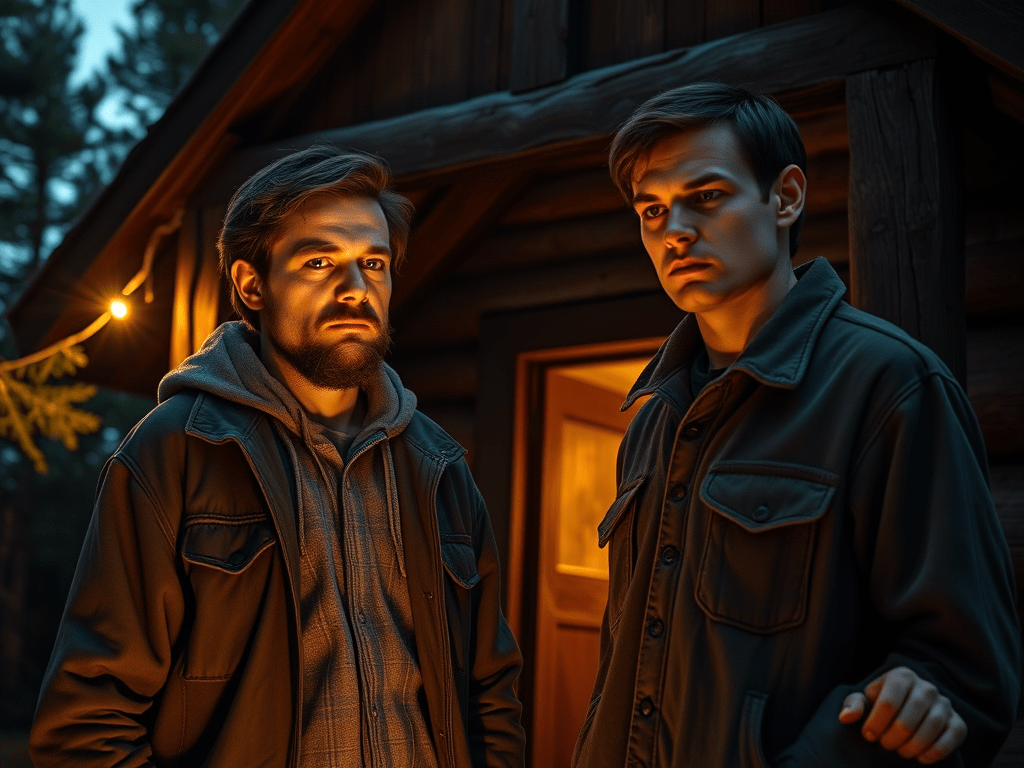
    So he drove. The road to the cabin snaked through a forest of pines, their branches clawing at the sky in the gray March dusk. Gravel crunched under his tires, each mile tightening the knot in his gut. What if Elias didn’t mean it? What if this was a fool’s errand? The cabin loomed ahead—sagging roof, windows dark like hollow eyes. Caleb killed the engine, his breath fogging in the chill. He knocked, the sound swallowed by the woods. The door groaned open, and there stood Elias—gaunt, a hint of gray threading his hair, his face a map of hard years. But those eyes—still green, still his—locked onto Caleb’s.

    “Caleb,” Elias croaked, voice like dry leaves. He stepped aside, a silent invitation. “Didn’t think you’d show.”

    “Didn’t think you’d care,” Caleb snapped, the words sharper than the air between them. Old hurt hung there, thick and heavy.

    Elias pointed to a couch—springs poking through faded plaid—and Caleb sank into it, arms crossed. Elias paced, boots scuffing the warped floorboards, then stopped, hands jammed in his pockets. “Writing that note scared the hell out of me,” he said. “Thought you’d hate me. I… I didn’t know how to face you after I disappeared.”

    Caleb’s jaw tightened. “You didn’t disappear, Elias. You left. I called. I wrote. You shut me out.”

    “I know.” Elias’s voice splintered, raw-edged. “Everything fell apart—lost my job, my wife walked out. I was a wreck, drowning in it. I pushed everyone away because I couldn’t stand them seeing me like that. Especially you. Thought you’d be better off without me dragging you down.”

    The confession landed like a stone in Caleb’s chest. All those years, he’d pictured Elias moving on, carefree, while he nursed the rejection. But this—shame, not apathy—had built the wall between them. “You should’ve told me,” Caleb said, quieter now, the anger softening into something tender. “We were brothers.”

    Are,” Elias said, eyes fierce despite the weariness. “If you’ll still have me.”

    The room went still, the weight of the choice pressing down. Caleb could leave—protect himself, let the rumors bury what was left. Or he could stay, wade into the wreckage, like Jonathan standing by David against a king’s wrath, like Christ carrying a cross for the unworthy. A friend loves at all times, and a brother is born for adversity. The verse burned in his mind, unbidden.

    “Three hours on that damn road,” Caleb said, a crooked smile breaking through. “I’m not turning back now.”

    Elias let out a shaky breath, the mask of his guarded face cracking into something real—relief, maybe hope. They talked until the windows turned silver with dawn. Elias spilled it all: the layoffs, the divorce, the nights he’d raged at God and the bottle alike. Caleb admitted his own failures—pride that kept him from banging down Elias’s door, resentment that had festered too long. It wasn’t pretty. Trust was a bridge half-collapsed, rebuilt with shaky hands and honest words. But they built it, step by messy step, because brotherhood—covenant carved in blood and grace—was worth the risk.

    Weeks later, at church, Caleb caught the whispers again. “Elias seems lighter now.” He didn’t reply, just traced the faint scar on his fingertip—barely there, but indelible. The pinprick had faded, but the bond it marked had endured, tempered by fire, held by a promise neither could outrun. They were different men now, scarred and steady, and that was enough.

  • Brotherhood as Mirror: The Unseen Strength

    Brotherhood as Mirror: The Unseen Strength

    The parking lot was mostly empty now, just a handful of cars under the streetlights. The meeting had wrapped up a while ago, but Ethan, Nate, Ben, and Will lingered by Ben’s truck, hands in pockets, shoulders hunched against the cool night air.

    Ethan kicked a loose pebble, watching it skitter across the pavement. “I just don’t think I have it in me,” he muttered. “Not like you guys.”

    Ben leaned back against the truck, arms crossed. “Like us how?”

    Ethan shrugged. “I don’t know. The way you all just… carry yourselves. Confident. Solid. I still feel like I’m waiting for someone to tell me I’m actually a man, you know?”

    Nate exhaled, shaking his head. “Man, you really don’t see it, do you?”

    Ethan frowned. “See what?”

    Will clapped a hand on his shoulder. “You remember two weeks ago in small group, when Alex opened up about his dad walking out?”

    Ethan nodded. “Yeah. What about it?”

    Ben tilted his head. “Who do you think he was looking at when he told that story?”

    Ethan blinked. “I don’t know… all of us?”

    Nate shook his head. “No, man. He was looking at you. You didn’t say much, but you sat there, locked in, not looking away, not filling the silence just to make it easier. You made space for him to be real, and that’s why he kept talking.”

    Ethan opened his mouth, but no words came out.

    Ben smirked. “And what about last month when James came in pissed off, ready to tear someone’s head off over work drama? You didn’t try to fix it, didn’t tell him to calm down—you just let him be mad for a minute. Then you asked one question—‘What do you think God’s saying in this?’ And boom, the whole room shifted.”

    Ethan rubbed the back of his neck. “I was just—”

    Will cut in, voice steady. “You were just being you. And that’s the point.”

    Ben tapped his knuckles against the truck bed. “You think strength has to be loud. That leadership means standing up front, making speeches, calling the shots. But brother, look at Jesus. Look at the way He saw people. The way He spoke to them in a way that made them feel known.” Ben met Ethan’s gaze. “You got that in you, man. And you don’t even see it.”

    Ethan swallowed, shifting where he stood.

    It wasn’t the first time someone had said something like this. But tonight, outside this meeting, standing with these men—men he respected, men who saw him in a way he couldn’t yet see himself—it landed different.

    Will squeezed the back of Ethan’s neck, giving it a firm shake. “You’re already walking in it, brother. Just gotta step fully into what God’s put in you.”

    Ethan let out a slow breath, nodding once.

    Ben opened the truck door, but none of them moved to leave just yet. They stood there a little longer, under the quiet hum of the streetlights, the night stretching wide around them.

  • More Than Words

    The fire burned low, throwing flickering shadows against the trees. The night air was crisp, the scent of pine mingling with cooling embers and the faint smell of fresh-cut lumber stacked neatly by the porch, waiting for morning repairs. No tension hung between them now—just the quiet weight of men who had walked hard roads.

    Clyde sat back in his chair, arms crossed, his expression unreadable but lacking its usual edge. Tyler sat to his left, staring into the flames, silent but not restless. Ethan leaned forward, turning a stick over in his hands, the firelight catching the side of his face. Ted, as always, was steady, his presence grounding them all.

    For a long time, none of them spoke.

    Then Clyde cleared his throat, voice gruff but not biting. “So. This… covenant thing.”

    Ethan glanced up.

    Clyde’s gaze stayed on the fire. “It ain’t just some sentimental nonsense, is it?”

    Ethan’s lips quirked. “No.”

    Clyde nodded once, like that answer was good enough for now. He rubbed a hand over his jaw, exhaling slowly. “So explain it to me.”

    Tyler looked over, curiosity flickering in his eyes.

    Ethan turned the stick in his fingers, thoughtful. Then he spoke, steady and sure. “Covenant’s not just about loyalty. It’s about belonging. It’s saying, ‘I see you. I walk with you. I fight for you.’ It’s not built on obligation—it’s built on choice.”

    Clyde was quiet, absorbing that.

    Ethan looked into the fire, voice steady. “The world tells men like us that closeness always has to mean something else. That brotherhood can’t be deep without crossing lines. That we’re always missing something.” He shook his head. “But that’s a lie. The enemy wants us to believe it, because it keeps us from stepping into the love God actually designed for us.”

    The fire crackled, sending sparks spiraling into the dark.

    Clyde exhaled slowly. “You really believe that?”

    Ethan met his gaze directly. “Yeah. I do.”

    Clyde studied him, searching for something—maybe weakness, maybe hesitation. But there was none. Clyde’s jaw worked subtly, his eyes narrowing not in judgment but something closer to respect, a quiet acknowledgment of truth landing deeper than he’d expected.

    Tyler shifted slightly. “And that’s enough?” His voice was low, uncertain, as though afraid the answer might actually matter.

    Ethan’s brow furrowed slightly. “More than enough.” He hesitated, then added softly, “It’s better.”

    Tyler looked away, his fingers flexing restlessly against his knee.

    Clyde let out another slow breath, eyes drifting back to the fire, rubbing the back of his neck. He didn’t argue. Didn’t scoff. Just sat quietly, wrestling silently with something he’d spent years pushing away.

    Ted, who’d been listening quietly, finally spoke up. “Funny thing about truth.” He leaned forward, resting his arms on his knees. “You don’t have to rush it. Just gotta let it do its work.”

    The fire burned lower, glowing embers pulsing beneath the ash. One by one, the others started shifting—Ted stretched with a quiet grunt before heading toward the cabin, pausing to glance at the stack of lumber, making a silent note of tomorrow’s tasks. Ethan finished off his coffee before following, nodding toward Clyde and Tyler as he passed.

    Clyde stayed put, kicking at a loose log with the toe of his boot.

    Tyler grabbed a stick, prodding at the fire, sending sparks up into the night. Neither spoke for a long while.

    Finally, Clyde grunted. “You gonna sit there, or you gonna help me put this thing out?”

    Tyler huffed softly but stood, grabbing a bucket of water from beside the porch. He sloshed some over the coals, steam hissing up between them. Clyde nodded in quiet approval, kicking dirt over the rest.

    They stood there in the fading glow, watching the last embers die.

    Then Tyler muttered, “We’re not friends.”

    Clyde let out a low chuckle, shaking his head. “Didn’t say we were.”

    Silence stretched again. The wind stirred through the trees.

    Clyde exhaled, voice quieter than before. “But maybe you’re not as lost as I thought.”

    Tyler glanced over, studying him briefly, then smirked faintly. “Maybe you’re not as certain as you thought.”

    Clyde snorted, but a faint smile tugged at the corner of his mouth. He didn’t argue.

    They didn’t shake hands. Didn’t nod in silent truce.

    But when they turned toward the cabin, they walked back at the same pace.

    (Chapter from Beyond Ourselves in the Ethan and Ted series, contact me if you’d like to read the full story)

  • The Call

    The Call

    The fire had burned low, casting long shadows across the clearing. Will sat on a rough-cut log, boot heel digging into the dirt, elbows on his knees. Across from him, Mason leaned back against a boulder, arms crossed, watching the embers pulse red in the dark.

    Neither of them spoke for a while. The night had stretched long—one of those conversations that had started light, turned deep, then sat in the weight of itself.

    Will exhaled, rubbing a hand over his jaw. “I used to think this kind of thing just happened.”

    Mason raised an eyebrow. “What kind of thing?”

    “This.” Will motioned between them. “Brotherhood. Having someone who actually sees you. I figured if God wanted me to have it, He’d drop it in my lap.”

    Mason smirked. “How’d that work out for you?”

    Will let out a dry chuckle. “Took me long enough to realize that’s not how it works.”

    Mason poked at the fire with a stick, watching a spark rise into the black sky. “Yeah, man. We’ve been lied to. Told we’re supposed to go at it alone, handle our own mess, keep everything tight.” He shook his head. “It’s not how we’re built. But the enemy’s done a damn good job convincing us otherwise.”

    Will nodded, staring into the flames. He could feel it—that ache of all the years he’d spent waiting instead of stepping in. The friendships that had stayed surface-level. The seasons of isolation he’d let drag on too long. The way he’d mistaken longing for calling—as if the ache itself was enough, instead of the fuel to actually do something about it.

    “This is more than just friendship,” he said finally. “It’s not just about having somebody to talk to or kill time with.” He looked up. “It’s a call, isn’t it?”

    Mason met his eyes, serious now. “Yeah, man. It is.”

    Will shook his head, thoughtful. “It’s funny, though. We don’t think of it that way. We think we’re just ‘wired for connection’ or whatever, like it’s some personality trait. But if we’re wired for it, doesn’t that mean God put that wiring there for a reason?”

    Mason nodded. “Exactly. We talk about needing food, water, air. Those aren’t just needs—they’re designed necessities. Same with brotherhood. It’s not just something we crave—it’s something that fuels us. When we don’t have it, we starve.”

    Will felt that. He’d been starving for years and hadn’t even realized it.

    “And if something is designed, it has purpose,” Mason continued. “Brotherhood isn’t just about filling a void in us. It’s about stepping into something bigger. Fighting for each other. Holding the line when one of us falls.”

    Will exhaled. “So it’s not just a longing. It’s a duty.”

    Mason’s voice was firm. “Yeah. A God-given one.”

    They sat in the quiet weight of that for a while.

    Will leaned back, stretching his legs out. “So now what?”

    Mason smirked. “Now? We walk it. Day by day. Step by step. We stop waiting for brotherhood to be easy and start building it for real.”

    Will nodded slowly, feeling something settle deep.

    Yeah.

    That sounded right.

  • Healing Father Wounds Through Faith

    Healing Father Wounds Through Faith

    The fire crackled low, flames licking at the edges of the stacked wood. A cool breeze carried the smoke upward, disappearing into the night sky. Jake sat hunched forward on the log, elbows on his knees, eyes fixed on the embers. Across from him, Sam leaned back, one boot resting on the other knee, watching but not pushing.

    They’d been sitting there a while.

    Jake finally exhaled, shaking his head. “I don’t even know where to start.”

    Sam poked at the fire with a stick. “Start with the lie.”

    Jake gave him a sideways glance. “What?”

    “The lie,” Sam repeated. “The one that’s got its claws in you the deepest. Say it out loud.”

    Jake swallowed hard. The words felt dangerous, like saying them might make them more real. He hesitated, then finally muttered, “I’m not like other men.”

    Sam nodded, unshaken. “That’s a common one.”

    Jake scoffed. “That supposed to make me feel better?”

    “It’s supposed to tell you the truth,” Sam said. “You’re not alone in that feeling. But it’s still a lie.”

    Jake leaned forward again, rubbing his hands together. “Is it, though? I mean, look at me. I never fit in with guys growing up. Always felt different. Still do. I don’t think I’m wired like them.”

    Sam tossed the stick into the fire. “Different doesn’t mean deficient. You were made a man. That’s not something you feel your way into—it’s something you already are.”

    Jake clenched his jaw. “Then why do I feel like something’s missing?”

    Sam’s voice was steady. “Because you were meant to be sharpened by other men. Not as something you need to possess, but as something to grow alongside.” He let the words settle before continuing. “You think you need another man to complete you. But you don’t. Christ already made you whole.”

    Jake’s throat tightened. “Doesn’t feel that way.”

    Sam leaned forward, elbows on his knees now. “Feelings aren’t the final word, brother. Truth is. And the truth is, you lack nothing.”

    Jake swallowed hard. “My dad never made me feel that way. He barely looked at me half the time.”

    Sam nodded, his voice softening. “I get that. When a father doesn’t affirm his son, it leaves a gap. A hunger. But your dad’s failure doesn’t get the final say on who you are.” He pointed at Jake’s chest. “Your Father in Heaven already called you His son. Already gave you what your earthly dad didn’t. And He doesn’t hold back His love.”

    Jake looked down, his fingers curling into fists. “Then why do I still crave it? Why does it hit me so hard when a guy sees me—really sees me?”

    Sam let out a slow breath. “Because deep down, you were made for brotherhood. For real, deep, non-sexual connection with other men. But the enemy took that God-given longing and twisted it, made it feel like something else.”

    Jake’s jaw clenched. “So what am I supposed to do? Just ignore it?”

    “No,” Sam said firmly. “You name it. You stop running from it. And you let God untangle what the enemy twisted. You step into real brotherhood—not in secrecy, not in shame, but in the light.”

    Jake looked at him then, really looked. “And that works?”

    Sam held his gaze, then reached over, clapping a firm hand on Jake’s shoulder before sliding his arm around his back in a solid, steady grip. “I’m here, aren’t I?”

    The warmth of that touch cut through the cold night air—solid, grounding, real. Jake didn’t pull away. He let himself feel it, the strength of another man standing with him, not against him.

    The fire popped, sending sparks into the night. Jake let the words sink in, the truth pushing against years of lies.

    He wasn’t there yet. Not fully. But for the first time, he believed it might be possible.

    And for now, that was enough.

    Themes: Christian man struggling with same-sex attraction, Healing father wounds through Christ,  What does the Bible say about masculinity? Healing from rejection as a man

  • Reflections of a Brother

    The water is still, reflecting the sky in endless hues of blue and gold. It cradles them, warm and living, flowing around their bodies like the breath of God Himself. Sunlight dances across the rippling surface, tracing golden lines over their bare skin, highlighting strength, form, and the undeniable reality of their shared manhood.

    Lior stands chest-deep in the water, facing Dain. The older man regards him with quiet intensity—not as a teacher measuring a student’s progress, but as a brother standing before an equal. The air between them hums with something unspoken, something weighty yet effortless, as natural as the rise and fall of their breath.

    For a long moment, neither speaks. They simply look—taking in the shape of the other, the lines of muscle honed by labor and trial, the subtle marks of experience that tell the story of their lives. There is nothing hidden, nothing obscured. Here, in the water, in the presence of the One who formed them, they are wholly seen and wholly known.

    Lior is the first to break the silence. “I see it now,” he says, his voice soft yet certain.

    Dain tilts his head, waiting.

    Lior’s eyes do not waver. “I see myself in you. And I see you in me.”

    Dain’s expression does not change, but something deepens in his gaze—pride, understanding, something beyond words.

    “This bond,” Lior continues, voice steady, “it’s not just about learning or growing. It’s about knowing. Knowing who we are. Knowing who God made us to be.” His lips twitch with the hint of a smile. “I thought I was just becoming a man. But I’ve come to see—I was made for brotherhood just as much as for strength.”

    Dain exhales, slow and full, as if hearing words he has long known but never spoken aloud.

    “You understand,” he says. It is not a question.

    Lior nods. “I do.”

    Dain steps forward, and Lior mirrors him instinctively. They meet in the center of the water, standing close enough that their reflections blend together in the shifting surface. Dain places a firm hand on Lior’s shoulder, the touch carrying both weight and warmth.

    “You are a man,” Dain says, his voice low and full of certainty. “You are my brother.”

    Lior lifts his own hand, mirroring the gesture, his grip strong, sure. “And you are mine.”

    The water ripples outward from them, as if the world itself acknowledges what has been spoken. The sky above is vast, the land around them unshaken. But in this moment, it is the reflection in the water that holds the greatest truth—two men, two lives, bound in purpose, in strength, in the love that God Himself has woven into the heart of their covenant.

    They linger a moment longer, their hands remaining where they are—two lives mirrored, two hearts beating as one. Then, with silent agreement, they lower their arms and turn toward the shore.

    The journey is not over. But when they leave the water, they do so as men who have seen and been seen—who have beheld their own reflection in the eyes of a brother and found something sacred there.

    (Chapter from the Unfallen Earth fantasy series. Contact me if you’d like to read the full story or series.)

  • Still Standing

    Still Standing

    The night air hung heavy, thick with the kind of silence that wasn’t really silent. Wind stirred the trees, gravel settled under our boots, but neither of us spoke. We just stood there, arms clasped, leaning in—forehead to forehead, the weight of it all pressing between us. Not crushing—just there.

    I exhaled slow, steady. “You don’t have to carry it all, brother.” My voice was low, firm. A reminder, not a command.

    You gripped my arm tighter, not in defiance—just needing to feel something solid. “I know,” you said, but the words came like a man trying to convince himself.

    I let that sit. Truth doesn’t always land the first time. It takes a second pass, a steady presence.

    The weight of your shoulders, the tension in your jaw—I saw it all. The kind of weight a man carries when he thinks he’s failing at something God never asked him to hold alone.

    I didn’t fix it. Didn’t push. Just stood there with you, bearing the silence together.

    After a while, your grip loosened. Not in surrender, but in relief. Like the weight wasn’t gone, but it didn’t have to suffocate you either.

    The wind stirred again. I could feel you breathing deeper now, steadier. The battle wasn’t over, but you weren’t fighting alone.

    And that was enough.

    For now, that was enough.

  • Covenant Formation

    Covenant Formation

    (Chapter Excerpt)

    Days later, Ethan stood in Ted’s living room, lamplight warming the space. Rachel sat by the fireplace, eyes bright with pride. Leo leaned against the wall, arms crossed but attentive. Dale was there—quiet, present, a nod of respect earned. An old Bible lay open on the coffee table, a silent witness.

    Ted faced Ethan, a paper in hand. “We ain’t here for a show,” he said, voice steady. “This is just puttin’ words to what’s already true.”

    He unfolded it, glancing at Ethan. “Ethan, I commit to walkin’ this road with you—not just as a friend, but as a brother. To pray with you, stand with you, hold you up when you’re strugglin’, challenge you when you need it. This world’ll pull at us, but we don’t belong to it. We belong to Christ. Long as I’m here, you won’t walk alone.”

    Ethan swallowed, the weight sinking deep. He unfolded his own paper, hands steady. “Ted, you’ve been more than a friend. You’ve been solid when I wasn’t. You showed me what it looks like to live for something bigger, and I don’t take that lightly. I commit to walking this with you—to keep learning, stay accountable, stand with you no matter what. I don’t know what’s ahead, but I don’t want to face it without this.”

    Silence stretched, thick with meaning. Ted pulled two braided leather wristbands from his pocket. Ethan frowned. “What’s this?”

    “Somethin’ to carry,” Ted said, handing one over. “A reminder.”

    Ethan slipped it on, then grasped Ted’s outstretched hand—firm, final. Rachel murmured a quiet, “Amen.” Leo whistled low. “Well, I’ll be. Didn’t think I’d see somethin’ like this.”

    Ted smirked. “That a compliment or an insult?”

    “Compliment,” Leo grinned. “I think.”

    Dale gave Ethan a long look, then nodded once. “Takes guts to commit like that.”

    Ethan nodded back—hard-won respect. Rachel stood, hugging him quick. “I’m proud of you,” she whispered.

    Ethan exhaled, lighter than he’d felt in years. This wasn’t about fitting in—it was bigger.

    As the night wound down, Rachel lingered, looking from Ted to Ethan and back. “I think you needed him as much as he needed you,” she said soft.

    Ted’s lips pressed tight, fingers brushing the wristband. She didn’t wait for a reply—just squeezed his arm with a knowing smile and left.

    Ethan caught Ted’s brief stiffness. “She’s right, isn’t she?”

    Ted chuckled weary. “Never thought I’d have this again.”

    Ethan nodded. He got it.

    (From Narrow Road Together in the Ethan & Ted series. Contact me if you’d like to read the full story.)

  • Still Here

    Still Here

    The locker room wasn’t busy—just a handful of guys finishing their workouts, grabbing showers, heading out. Nothing out of the ordinary.

    Eli pulled off his shirt, grabbed his towel, and turned toward the showers. That’s when he noticed James—still in his gym clothes, sitting on the bench, tying and retying his shoe like he had nowhere to be.

    Something in Eli told him to wait.

    He sat down across from him, stretching out his legs. “You hitting the showers?”

    James glanced up, shrugged. “Might just rinse off at home.”

    Eli nodded, pretending not to notice the hesitation. He’d seen this before. A guy trying to decide if it was okay to just be a guy.

    The showers here were open—an old-school setup that hadn’t been remodeled like most places. Nothing weird about it. At least, there shouldn’t have been. But these days? It was different.

    Eli leaned back against the lockers. “You ever play sports?”

    James shook his head. “Nah. Never really into that scene.”

    Eli smirked. “Yeah, me neither. But I grew up around guys who were. And you know what I remember? They didn’t think twice about this kind of thing.” He gestured toward the showers. “Back then, no one was worried about being seen. It was just part of life.”

    James chuckled, rubbing the back of his neck. “Yeah… guess I never really thought about it.”

    But Eli could tell—he had thought about it.

    “I get it,” Eli said. “Somewhere along the way, we lost something. Got told to be careful, got trained to keep space between us. And now? Guys don’t even know what they’re missing.”

    James looked up. “What do you mean?”

    Eli exhaled, thinking. “Man, it’s hard to explain. It’s not about the showers. It’s about how normal it used to be—being unguarded around each other, not second-guessing every move.

    There was a kind of joy in it—the ease of just being, the trust that no one was watching, judging, or measuring. You don’t even realize how much you took it for granted… until it’s gone.”

    James nodded, quiet for a moment. “Yeah… I guess I do feel that. Like, I don’t even know why it feels weird. It just does.”

    Eli gave him a half-smile. “Yeah. But you know what? It doesn’t have to.”

    He stood up, grabbed his towel, and nodded toward the showers. “Still here, man. Ain’t going anywhere.”

    James hesitated, then smirked. “Yeah… guess I could use a rinse.”

    Eli clapped his shoulder, and together, they walked toward what had always been normal—what was still normal, underneath all the noise.

    Some things get lost.

    But not everything stays lost forever.

  • Youth Mentorship

    The small café buzzed quietly with the background hum of clinking dishes and low conversation. James, Luke, and Eli sat at a corner table near the window. They had just finished a morning group meeting and had invited Eli out for lunch—a gesture that seemed to mean more to him than he could put into words.

    Eli tapped the edge of his cup, hesitating before speaking. “Can I ask you guys something?”

    “Of course,” Luke said, his tone open and relaxed.

    Eli looked around the café nervously before lowering his voice. “Are you two… a couple?”

    The question hung in the air for a moment. James and Luke exchanged a glance—not out of discomfort, but with a silent understanding.

    “No,” James said gently. “We’re not. What we have… it’s different from that, but we get why you’d ask.”

    Luke leaned forward slightly. “We’ve committed to each other, though—committed to walking through life together as brothers in Christ. Our bond is deep, but it’s not romantic or sexual.”

    Eli nodded slowly but didn’t seem entirely convinced. “I don’t know… I’ve never seen two guys be that close without it being… something else.”

    James leaned in. “Look, we understand where you’re coming from. To be honest, both of us have struggled with same-sex attraction in the past—and still do at times.” He paused, giving Eli space to absorb the admission.

    Luke nodded in agreement. “Yeah. We’ve been where you are. Early on, that struggle complicated things between us. We had to navigate through it—through temptations, awkward moments—but with God’s help, we found a way to channel those feelings into something healthier. We built trust and intimacy that wasn’t tied to sex or romance.”

    Eli’s eyes widened slightly, and he leaned back. “You’re serious?”

    “Absolutely,” James said quietly. “I spent a lot of years confused and ashamed of my feelings, thinking they defined me. But when I surrendered my life to Christ, He started to reshape how I saw myself. Meeting Luke was part of that process. I learned that I could love and be loved by another man without shame.”

    Luke added, “And I was the same. I pushed people away because I didn’t know how to trust anyone with that part of me. But God taught me that intimacy isn’t just physical. It’s about being known and seen for who you are—and still being accepted.”

    Eli exhaled slowly, his shoulders relaxing a bit. “That’s… not something I ever thought was possible. I’ve felt so alone for so long. It’s like I don’t know how to let anyone close without it getting twisted.”

    James nodded, empathy softening his features. “We get it, Eli. That fear is real. But you don’t have to stay trapped in it. It’s about taking small steps—finding someone you trust and letting God work through the relationship. It’s not about pretending the struggle isn’t there. It’s about transforming it.”

    “And it’s not all serious and heavy, either,” Luke added with a grin. “We joke around, wrestle, hang out—just like any brothers would. We’ve learned that intimacy doesn’t have to be hyper-spiritual or intense all the time. It’s in the everyday moments of being present with each other.”

    Eli was quiet for a moment, then nodded thoughtfully. “I guess I never thought there could be another option. I’ve always been caught between two extremes—either loneliness or falling into something I know isn’t God’s design.”

    “There is another option,” James said gently. “God’s design for brotherhood is real, Eli. It’s not easy, but it’s worth it.”

    Luke leaned forward, resting his forearms on the table. “We’re not perfect, man. We still mess up. But that’s why we walk this out together. Iron sharpens iron, right? And there are more guys out there who need this kind of connection than you’d think.”

    Eli’s eyes shimmered briefly before he blinked and cleared his throat. “Thanks. I think… I really needed to hear that.”

    (Excerpt from The Covenant Fulfilled in the James & Luke series – Contact me if you’d like to read the full story or series)

  • The Old Oak

    The Old Oak

    I’m out here tonight, Brother, sitting under that old oak we planted. Moon’s high, air’s cool, and its branches stretch wider than I remember. Been years, six or maybe seven, since we dug that hole and dropped those roots. Your hands were muddy, my boots caked, laughing over how crooked it stood, betting it wouldn’t last the winter. Look at it now, tall and steady, leaves whispering soft in the breeze, roots deep in this Tennessee soil.

    We didn’t know it then, what it’d mean, what we were starting. Just two brothers, your creek wild, my pine steady, figuring it out. You with that fire in your eyes, pushing me to see bigger, me with my quiet, holding us when the wind blew hard. That day wasn’t just about a tree. It was us, planting something, covenant taking root, God’s hand in the dirt.

    I think about it, how it’s grown, how we’ve grown. Those early nights, your voice spilling dreams, my ears catching every one, talking until the stars faded, building this bond, soul to soul, not knowing it’d stretch like this oak. We’ve weathered storms, rain pounding, your doubts, my stumbles, held tight, covenant didn’t bend, didn’t break, roots went deeper.

    You’ve got that spark, always will, lighting fires in me I didn’t know could burn, pushing me past my still waters. I’ve got the steady, keeping us when your current runs fast, grounding us, God’s gift weaving through. That oak is us, twists and knots, not perfect, stronger for it, standing tall, weathering years, holding ground.

    I see it now, how it stretches beyond us. Kids climb it, ones we don’t know yet, shade for folks we’ll never meet, roots cracking stone, reaching wide, legacy we didn’t plan, God did. You and me, our talks, our fights, our quiet stands, planting something, covenant’s ripple, touching further than we’ll see.

    World’s cold, tries to uproot, lies whispering it don’t matter, but it does. Look at this tree, look at us. God’s growing it through us, past us, steady love, soul fire, covenant’s not small, not fleeting, it’s oak, deep, enduring, gift to us, gift through us.

    Brother, I’m thankful every day for you, for this, for what we’ve planted, roots holding, branches wide, God’s breath in it, legacy living, strong, ours, His.

    Yours, always,
    Josh

  • Sky’s Thread

    Sky’s Thread

    Late night cloaked the forward operating base—stars stabbing sharp over tents and sandbags, a cold wind slicing through cleared rain. Lanterns glowed faint inside canvas, trembling low, yard still—generator coughing near the barracks, a jackal’s howl threading the dark. Bunk five’s flap hung open—lantern flickering shadows—the FOB’s hum dulled, grunts racked or on watch, tension soft post-ridge.

    Jake and Travis sank onto crates outside—mud-streaked, weary—Travis’s bandaged arm propped stiff, aching, Jake beside, rifle leaned close. Breath fogged in the chill—shower’s steam a raw echo, shoulders bare then, jacketed now. Travis shifted, boots scuffing—eyes tracing stars, breath hitching—mud, Jake’s grip, wet shoulders flashing back. Chest tightened—voice rough. “Can’t shake it—you, me—since that first bunk.”

    Jake’s chest clenched, hazel catching lantern glow—Travis’s words slicing a wall since the ridge, warmth flaring he couldn’t dodge. “Yeah,” he said, low—pausing—“It’s there—always been.” Faith surged—bending sharp—Travis’s raw push thawing dad’s chill, a flare he needed. He pulled the canteen—swigged, passed it—fingers brushing Travis’s—a weight settling firm.

    Travis took it, swallowing hard—shower’s jolt humming low. “So what’s this—mud, blood, all of it?” His words cut—trust hot—“Faith’s yours—I’m grabbing at it, slipping some.” Blue-gray locked hazel under stars—wavering faith cracking wider, needing Jake’s steady to hold it.

    Jake’s jaw ticked, eased—“We’re brothers—real, lasts past this.” Faith spilled—firm—“Chaplain’s ‘hold fast’—mine prayed me through—He’s here, Travis, gripping us.” Grin tugged—“You’re clawing it—that’s more’n words.” Steady flared—Travis’s push a lifeline looping back—“Lost dad—thought I’d break. He holds me—you’re proof.”

    Travis leaned back—canteen sloshed, down—exhaling sharp—“Brothers…” Voice wrestled—“Never had it—grabbing it’s shaky.” Smirk flickered—blue-gray searching Jake—“I’m slipping, but damn—‘hold fast’ sticks now.” Trust surged—clawing for Jake’s rock, pull twisting into a line he gripped—“Faith’s alive with you—tethers this mess.”

    Jake’s grin held—“Fighting’s faith—keeps me straight.” Faith glowed—Travis’s raw spark a lifeline both ways—“He’s here—keeps us ‘cause we’re locked, not lone.” Voice fell warm—“Lost dad—broke me ‘til He held. You’re fighting—He’s holding us both.” He paused—eyes lifting to stars—“Let’s pray it.” His voice dropped, simple—potent—“Lord, we’re beat—mud, blood, all this. Hold us fast—Travis’s fight, my steady—keep us Yours. Bind us tight—brothers, not broke. Amen.”

    Travis’s breath hitched—smirk gone—“Amen…” Voice stretched—faith cracking, shaky but real—Jake’s prayer a rock he grabbed, their bond forging tighter under starlit chill—shoulders pressed, steady glowing.

    Eddie’s shout cut faint—“Damn jackal!”—Hensley spat near—“East line’s live”—radio low. FOB slept—Timmy’s boots scuffing, a snore—blind to their crack, lantern weaving it tight. Travis whistled—off-key—Jake’s gaze held—a thread humming as stars glared cold.

    (Chapter from Brothers in Dust. Contact me if you’d like to read the full story).

  • A Quiet Surrender

    Late summer dusk settled over Ted’s porch, golden light stretching shadows long across the boards. Ethan leaned against the railing, watching Ted tinker with a loose step—a nail here, a tap there. The air was warm, still, a quiet Ethan used to fight. Now, with Ted, it felt right.

    Ted reached for his screwdriver, and Ethan passed it without a word. Ted didn’t look up, just nodded slightly. “You’re getting good at that.”

    Ethan smirked. “What, handing you tools?”

    “Readin’ people,” Ted said, tightening the screw. “Not everybody pays attention.”

    Ethan took a sip of water, unsure how to take that. He had been paying attention—to Ted’s steady hands, his plain words, the way he never grasped or rushed. A year ago, silence would’ve driven him nuts. Now, it was where he found himself.

    Ted sat back on his heels, wiping his hands on a rag. Ethan exhaled slowly, watching the trees sway. “You ever think about how things line up?” he asked, quieter than usual.

    Ted tossed the rag aside. “What do you mean?”

    Ethan hesitated. “Like… if I hadn’t come here. If I hadn’t met you. Or if I had, but I wasn’t paying attention.”

    Ted studied him, eyes thoughtful. “You ever hear about Elijah in the cave?”

    Ethan shook his head.

    Ted stretched out his legs, leaning against the railing. “Prophet, scared outta his mind. Runnin’. Thought he was alone, hidin’ in a cave, waitin’ for God to show up big—fire, storm, somethin’ loud.” He glanced at Ethan. “But God wasn’t in any of that.”

    Ethan frowned. “Where was He?”

    “In a whisper,” Ted said, voice soft.

    Ethan sat with that, the words pressing in a way he couldn’t explain. Ted let it linger, then added, “Sometimes we’re so busy lookin’ for answers in the noise, we miss Him whisperin’ the whole time.”

    Ethan swallowed, throat tight. His whole life, he’d seen faith as rules—church on holidays, prayers before meals, a script you followed. It’d never been real. “I didn’t grow up like this,” he said, staring at his glass. “Mom dragged us to church sometimes. We said grace. But it was just… what you did.”

    Ted didn’t speak, just listened.

    “I always thought faith was about following the rules,” Ethan said, a faint laugh escaping. “And I was never good at that.”

    Ted’s voice was steady. “Maybe what you had wasn’t faith.”

    Ethan glanced at him.

    “Maybe it was just religion,” Ted said—not an accusation, an invitation.

    The words hit hard. Ted talked about God like He was here—real, close. Like he wasn’t alone. Something flickered in Ethan’s chest—small, undeniable.

    Ted looked at the sky, last light fading to blue. He exhaled slow, posture relaxed but face soft. Ethan had changed him too—stirred gratitude he hadn’t expected. For his own road through fire. For the whisper that’d reached him. For it reaching Ethan now.

    Ethan’s grip tightened on his glass. “Maybe I was looking for you,” he said, barely above a whisper, then stopped, unsure what he meant.

    Ted turned, meeting his eyes—not surprised, just knowing. “Maybe,” he said simply.Ethan exhaled shakily. For the first time, he didn’t want to run from it—whatever this was. Ted gave a small nod, like he understood. In his heart, he murmured two words: Thank You.

    (Chapter from Narrow Road Together in the Ethan & Ted series. Contact me if you’d like to read the full story)