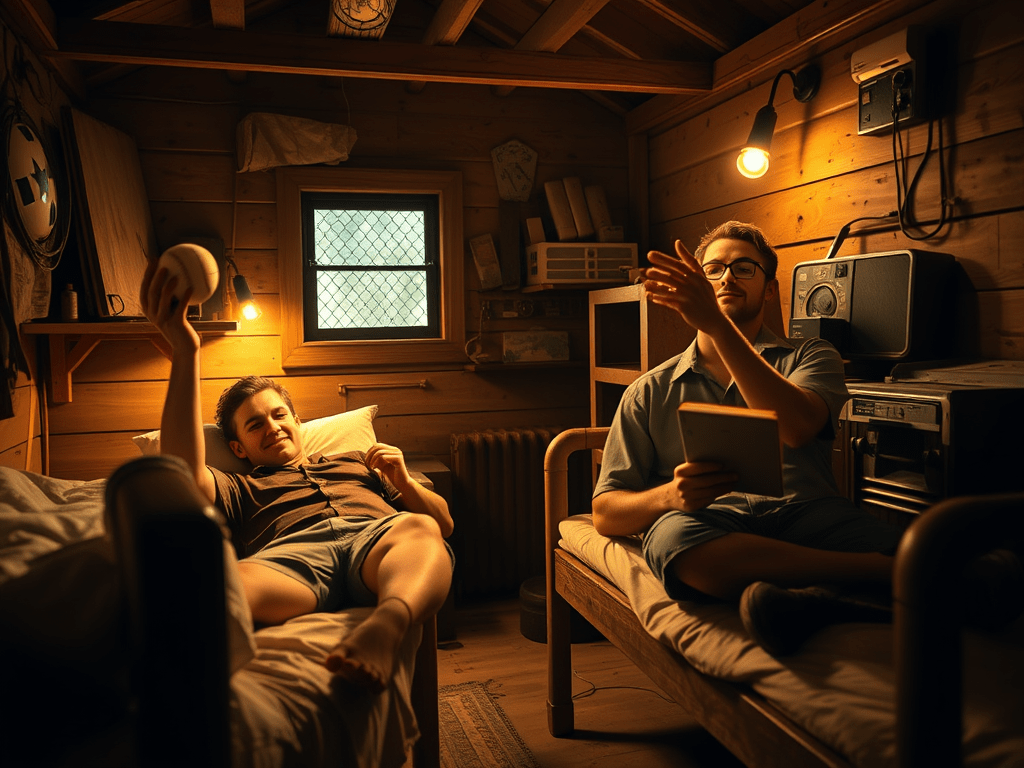
The bunkhouse was a sauna of sweat, pine, and machine oil, its walls groaning under the Tennessee summer of 1944. Cal, 24, a welder with a grin sharp as a switchblade, sprawled on his cot, tossing a baseball against a rafter with a rhythmic thud. Amos, 22, a chemist with glasses that slid down his nose, hunched over a book, muttering about isotopes like they were poetry. The other workers at the secret Oak Ridge plant—Building X, they called it——snored or slapped cards, but Cal and Amos were brewing trouble, a bet taking shape.
“Bet you can’t sneak a radio past the guards,” Cal said, his drawl dripping mischief, baseball frozen mid-air. “Some Glenn Miller’d make this dump feel alive.”
Amos snorted, adjusting his glasses. “And get us fired? Pass, hotshot.” But his eyes flicked to the door, where Guard Jenkins’ flashlight swept the gravel. The thought of swing music cutting the monotony sparked something.
“Double or nothing,” Cal leaned in, cot creaking. “You win, I shine your boots a month. I win, you sneak it in. Deal?”
Amos sighed, but a grin betrayed him. “Deal, lunatic.” The bunkhouse, a low-slung box of cots and secrets, became their stage. Cal, all swagger, schemed: hide a scratched Philco radio in a scrap metal crate, slip it past Jenkins at shift change. Amos, brainy but hooked, timed it—6:17 p.m., Jenkins’ yawn o’clock.
Next day, they lugged the crate to the gate, Cal whistling loud to drown Amos’ fidgeting. Jenkins, burly and scowling, tapped the crate. “What’s this?”
“Scrap for the shop,” Cal lied, smooth as creek water. Amos nodded, sweating buckets. Jenkins’ flashlight lingered, then swung away. Clear—until Amos tripped, the crate crashing, a radio hum buzzing out. Cal’s gut twisted, but he slung an arm around Jenkins, spinning a yarn about loose bolts. “Gotta fix it, boss, or the line’s toast!”
Jenkins grunted, waving them off. Cal shot Amos a glare, then a stifled laugh. Back in the bunkhouse, they unpacked the radio, its dial glowing like a firefly. Workers crowded round, Glenn Miller’s trombone swinging, boots tapping planks. Amos, flushed, punched Cal’s shoulder. “Told you I’d do it.”
“‘Cause I saved your clumsy hide,” Cal grinned. They sprawled, music weaving through Cal’s jalopy-racing tales and Amos’ shy confession of flunking dance class. The bunkhouse felt less like a cell, more like kin.
Two nights later, a new guard, Ramsey, stormed in, catching the radio’s hum. “Whose?” he barked, yanking the cord. Silence fell, workers scattering. Amos froze, glasses glinting, knowing a write-up could end him. Cal sat up, lazy-like.
“Mine,” he said, calm. “Scrap find. My bad.” Ramsey scribbled Cal’s name, not Amos’, and took the radio. The bunkhouse exhaled. Amos stared, mouth agape.
“Could’ve ratted me,” Amos whispered later, snores rising. “Why?”
Cal tossed his baseball, shrugging. “You’re my partner, specs. Ain’t leaving you.” His grin softened. “You’d look awful in shackles.”
Amos chuckled. “Crazier than a June bug.” He slid a hymn sheet from his book—Abide with Me, from chapel. “For you. Figured you’d need it, with your luck.”
Cal took it, fingers brushing the page, no joke for once. “Thanks, Amos.” Next night, by the bunkhouse stove, its warmth cutting the chill, they shared a smoke and sang, Cal’s baritone shaky, Amos’ tenor clear. Others joined, voices weaving a pact—not just for music, but for each other, through shifts and secrets.
Sunday, in the chapel, Cal and Amos shared a hymnal, shoulders brushing, grins a vow. The radio was gone, but they’d won something better—a brother for the next bet, the next night, the next war.
 CovenantRoad
Leave a comment