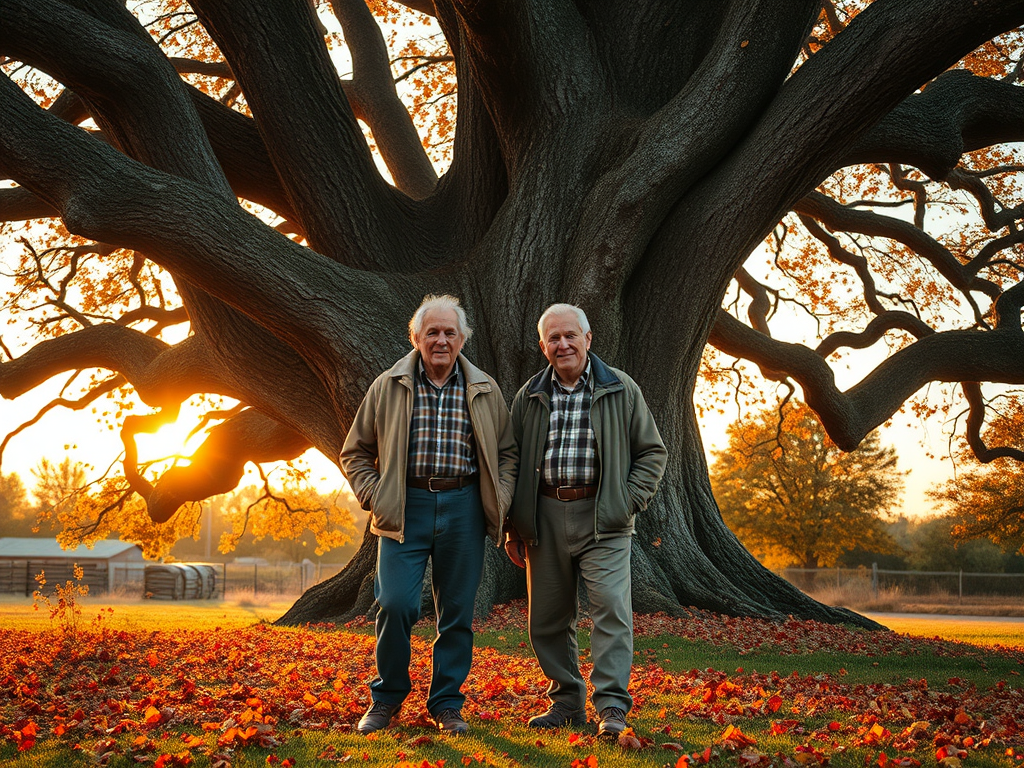
The seasons spun on, each one layering their story deeper into the land. The oak by the porch grew gnarled, its branches heavy with years, much like the men who sat beneath it. They’d carved out a life that defied the whispers of the world—a brotherhood so fierce it stood as a testament, a living sermon etched in calloused hands and shared silences.
The physical pull never left, not entirely. It’d flare in quiet moments—when Jonah’s arm slung around Amos’s shoulders as they watched a storm roll in, or when Amos’s fingers grazed Jonah’s wrist passing him a mug of coffee. But they’d mastered it, turned it into a current that ran beneath their covenant, powering it rather than pulling it apart.
One summer, a traveling preacher came through, a wiry man with a voice like thunder. He stayed a night at the farm, breaking bread with them in the flickering light of the kitchen. He watched them close, his keen eyes catching the way Amos filled Jonah’s plate without asking, the way Jonah’s hand rested easy on Amos’s arm as they laughed over some old story. After supper, the preacher sat back, pipe in hand, and said, “Y’all got somethin’ special here. Like David and Jonathan, souls knit together. Ain’t seen many live it out so true.”
Amos and Jonah exchanged a look, a flicker of pride and something softer passing between them. “Just tryin’ to honor Him,” Amos said, and Jonah nodded.
“Ain’t always easy, but it’s good,” Jonah added.
The preacher left the next day, but his words stuck, a quiet blessing on what they’d built. And build they did—year after year, until the farm wasn’t just a patch of dirt but a legacy of faith and fidelity. The chapel became a gathering place for the scattered folk of the hills, drawn by the warmth of two men who lived what they preached. They’d sit on those oak benches, listening as Jonah read Scripture or Amos prayed in that low, steady voice, and they’d leave feeling the weight of something holy.
Fall came again, decades piling up like the leaves drifting against the barn. Amos was slower now, his back stooped from years of bending to the plow, and Jonah’s hands shook when he whittled, but they still worked the land, still knelt in the chapel, still laughed like the young men they’d once been. One evening, as the sun dipped low and the sky burned crimson, they walked the fence line, checking posts like they’d done a thousand times. Amos stopped, leaning heavy on a post, breath fogging in the chill.
Jonah paused beside him, concern creasing his brow. “You alright?” he asked, stepping close, his hand finding Amos’s shoulder.
Amos nodded, catching his breath. “Just takin’ it in. This place. You. All of it.”
Amos turned, his hazel eyes locking with Jonah’s, weathered and deep with years of shared struggle and triumph. The wind kicked up, rustling the crimson leaves around their boots, and for a moment, they just stood there, the weight of their bond heavier than the post Amos leaned on. Jonah’s hand stayed firm on Amos’s shoulder, a tether as real as the Kentucky clay beneath them.
“Reckon we’ve walked this road right,” Amos said, his voice a low rumble, softened by the years. “Ain’t been easy, fightin’ what we felt, but we made it somethin’ better. Somethin’ He can look down on and call good.”
Jonah nodded, his gray eyes steady, a faint smile tugging at his lips. “Aye. Brothers, true and deep. That’s what He gave us strength for. Ain’t no shame in lovin’ you like this—pure, like David and Jonathan. We kept it holy.”
Amos straightened, clapping Jonah on the back, the gesture rough but warm, a seal on their unspoken vow. “Let’s head in. Coffee’s callin’, and I ain’t freezin’ out here for pride.”
They turned toward the farmhouse, shoulders brushing as they walked, the chapel’s silhouette a quiet sentinel against the fading light. Inside, they shed their coats, the fire already crackling from earlier. Jonah grabbed the pot, pouring two mugs, while Amos sank into his chair, the creak of the wood as familiar as a hymn. They sat across from each other, steam curling up between them, and raised their mugs in a silent toast—not to romance, not to what could’ve been, but to the brotherhood they’d forged, a covenant stronger than steel, rooted in their faith.
Years later, when the townsfolk found them—Amos gone in his sleep, Jonah a day after, unwilling to linger alone—the chapel still stood, their initials carved in the bench. The land bore their mark, a testament to two men who’d wrestled the hum into something glorious, a friendship that glorified God’s design. They buried them side by side under the sycamore, the tree’s roots curling deep, just like the bond they’d lived out to the end.
 CovenantRoad
Leave a comment